Pres polls: (None)
Dem pickups: (None)
GOP pickups: FL IA MI OH PA WI
Previous | Next
Trump Meets Theresa May
Yesterday, British Prime Minister Theresa May became the first foreign leader to visit President Donald Trump in the White House. The meeting got off to a rough start when the day's schedule sent to journalists three times referred to the visit of Teresa May, a British porn star, rather than Theresa May, the Prime Minister of the United Kingdom. As usual, after the meeting, all was said to be fine and dandy between the two leaders, even though they have deep differences on NATO, Vladimir Putin, and the use of torture. In the press conference held afterward, both leaders downplayed NATO and Putin, but May won the battle over torture when Trump said he would abide by the decision of Defense Secretary James Mattis, who joins May in being a strong opponent of torture.
Each of the leaders came to the meeting with an agenda, and on some points they are in agreement. Britain has always been a somewhat ambivalent member of the European Union and soon will be a former member. For May, strengthening ties with the U.S. is absolutely crucial. Trump doesn't like the EU much, since it is an alternative power center in the world, and would be quite happy to see it break up. By offering May a terrific trade deal, Trump is no doubt hoping that other countries leave the EU as well, also hoping for terrific trade deals. (V)
Trump Issues More Executive Orders
President Trump produced two more executive orders on Friday. The first one, which got the lion's share of attention, suspended immigration from Syria, and also bars entry to the United States for people coming from Iran, Iraq, Sudan, Libya, Yemen and Somalia. The ban will last several months until Trump and his Cabinet can decide which individuals will be allowed again, with "extreme vetting." All seven countries are majority-Muslim, of course.
The second order, which was signed at the Pentagon (in other words, major photo-op), calls for a "great rebuilding of the Armed Forces" with new ships, planes, nuclear weapons, and so forth. It orders Secretary of Defense James Mattis to complete a report on military readiness within 60 days, and declares the official policy of the Trump administration to be "Peace Through Strength."
As with Trump's other executive orders, these are largely for show. While he certainly does have the power to shape immigration policy, the obviously discriminatory nature of Friday's order could well lead to lawsuits. Further, the exception for persecuted Christians offers a loophole that you could drive a truck through. Meanwhile, the military order is even more tenuous. If there's going to be an expansion of military spending, Congress will need to give its approval, since they control the purse strings. While GOP leadership may be amenable, the United States already spends roughly $600 billion annually on its armed forces. By comparison, the country that spends the second most is Britain, at roughly $60 billion. So, it's hard to see how much room there is for America's military budget, or its military might, to expand. Particularly if money is also being spent on walls, infrastructure, tax cuts, etc. (Z)
Trump's Approval Rating is 36%...Unless it's 55%
We're a week into Donald Trump's presidency, and we now have two major polls that try to measure his job performance so far. The one from Quinnipiac pegs his approval rating at 36%. Rasmussen, by contrast, has it at 55%.
That's a very large gap; considerably outside the margin of error for the two polls. So, what's going on here? Rasmussen is well known for having a Republican house effect, so that's certainly some of it. Beyond that, however, it's something of a mystery, since the polls used similar methodologies (telephone calls from a live person, and not robocalls). The 55% rating certainly seems a little high, given where Trump started (low 40s), while 36% seems a little low at the end of a week where the President made so many headlines. The correct answer probably lies somewhere in the middle, though pollsters certainly have to be concerned that they still don't seem to have their finger on the Trump pulse. (Z)
How Might Mexico Respond to the Wall?
Donald Trump's insistence that NAFTA is dead and that there is going to be a wall on the Mexican border and Mexico is going to pay for it is going to be a big problem going forward. Thursday, White House Press Secretary Sean Spicer both floated and unfloated the idea of a 20% import tariff on goods coming into the U.S. from Mexico. If that proposal comes back, U.S. companies that manufacture products in Mexico are going to go to the members of Congress to get them to block Trump. If Trump goes for a tax on all imports, not just from Mexico, he can count on massive resistance from Apple, Constellation Brands, Gap, Walmart, Target, and J.C. Penney, among many others, and they will surely put their money where their corporate mouths are.
If he can't have his tariff, Trump may try to block or tax remittances from Mexicans in the U.S. to folks back home. That won't work either, because international banks that operate in the U.S. and Mexico will strongly encourage Mexicans in the U.S. to open accounts with them, let people in the U.S. make deposits to them, and people in Mexico make withdrawals. Canadian and British banks might get into the act, too. It would be impossible to track money flows. It is legal for Americans to have foreign bank accounts as long as they file certain paperwork with the IRS.
And suppose Trump builds the wall somehow, even if Congress has to pay for it. Mexicans would be extremely angry. Long-standing cooperation on drug and human trafficking would be terminated. U.S. exports to Mexico, on which 6 million U.S. jobs depend, would slow to a trickle. But potentially much worse would be the effect on Mexican politics. In 2018, there will be an election and one of the candidates is likely to be the leftist Andres Manuel Lopez Obrador, a Hugo Chávez wannabe. If Lopez Obrador were to win, he would immediately become China's best friend. Mexican oil would go to China instead of the U.S. If China wanted to build a military base in Mexico, Lopez Obrador might be OK with that. Even with a wall separating the two countries, Trump would not be happy with a Mexico run by an anti-American out-and-out socialist friendly with China. (V)
Wall Construction 101
Although Donald Trump has a background in real estate, where characteristics of a property play a large role in its potential use and value, he seems quite unaware of what the U.S. border with Mexico—the location of the Wall— is like. Here is a brief primer on the subject; let's call it "Wall Construction 101." Much of the border that lies in California, Arizona, and New Mexico already has some kind of fencing on it, at least near the cities, so a lot of the new construction would have to be in Texas. The border between Texas and Mexico is about 1,000 miles long, much of it through rough, mountainous terrain. It is also very wiggly, as shown in his small segment of it (which has been rotated 45 degrees counterclockwise):

This section runs through rugged mountains with very few people living there, which would mean hauling construction materials over winding dirt roads, through the mountains. In many places, the nearest road is miles from the actual border, although for some stretches supplies could be hauled in by barge along the Rio Grande. Building a wall along steep cliffs that descend to the river valley is a much tougher project than building one along a flat stretch of Arizona desert.
A second problem is that a goodly chunk of the border is defined by water, particularly the Rio Grande River. Here is a piece near the Amistad Reservoir, 200 miles west of San Antonio. The black line is the border.
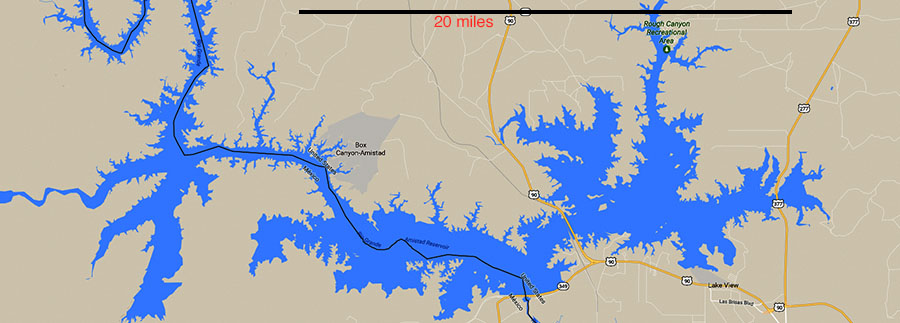
Here we see another problem that will keep the civil engineers awake at night. The edge of the reservoir is not a smooth, straight shoreline at all. There are numerous box canyons all along the edge, so the wall would have to go over water in many places, or go deep inland, far from the actual border, meaning that a substantial amount of U.S. land would be south of the Wall.
But the biggest problem of all is not the very difficult terrain or the water, it is politics. Unlike New Mexico, Arizona, and California—which were once U.S. territories, so the federal government already owns much of the land along the border—Texas was never a U.S. territory. It was part of Mexico until it declared itself a Republic in 1836 and became a state in 1845. As a consequence, virtually all the land along the Texas-Mexico border is privately held by thousands of landowners, so it would have to be taken by the federal government using eminent domain, a power most Republicans hate with a passion. Since the seized land would be used for a public purpose, there is no question about the legality of the seizure, but the government would soon have to deal with thousands of lawsuits from landowners who disputed the "fair market value" of their land, and thus their compensation for the taking.
Rep. Will Hurd (R-TX) represents the congressional district TX-23, which runs 800 miles from San Antonio to El Paso along the border. He is strongly against the Wall, due to the eminent domain issue. He definitely does not want the government seizing his constituents' land and paying them a pittance for it. Arranging for a photo-op with Trump sitting in a bulldozer grinning at the camera during the official groundbreaking ceremony is easy. The next part, not so much.
Finally, the wall wouldn't actually stop the flow of undocumented immigrants much. The majority of them enter the country legally as tourists and just overstay their visas. The wall would have no effect on them. What would have an effect is heavy fines on companies that employ undocumented immigrants, but that in turn would require some form of national ID card so employers could tell who is legally in the country. It's a real rats' nest. (V)
McCain Will Fight Trump on Lifting Russian Sanctions
While many Republicans are scared witless of picking a fight with Donald Trump, even if his position runs completely counter to what they have believed and supported for decades, one Republican who is not (completely) scared of Trump is Sen. John McCain (R-AZ). In particular, McCain is strongly against lifting sanctions on Russia and has said he will work in Congress to make sure they are not undone. Sen. Rob Portman (R-OH) and Sen. Marco Rubio (R-FL) are on the same page as McCain. Together with the 46 Democrats and 2 independents in the Senate, they could block any legislation they don't like relating to sanctions. (V)
McConnell: We Are Not Going to Change the Senate Rules
If Donald Trump picks an ultraconservative for the Supreme Court, Democrats are certain to filibuster him. Many Republicans will urge the Senate to go for the nuclear option and abolish the filibuster for SCOTUS nominations. But first they will have to convince Senate Majority Leader Mitch McConnell, who is having none of it. McConnell said that the Senate already adopted its rules for this session and a change in the rules requires a 2/3 majority. This has been McConnell's position for years and there is no reason to think he will change it any time soon. (V)
What Are Senate Democrats Doing?
Quite a few commentators have observed that, for a party that is supposed to be in opposition to Donald Trump and everything he represents, Senate Democrats have been awfully accommodating of his Cabinet picks so far. Thus far, none of the candidates who has been approved has received less than 15 votes from Democratic senators, and some of them (Elaine Chao, James Mattis) have been nearly unanimous.
So, what is going on here? Why are these senators choosing not to oppose a president who is particularly easy to oppose? Who many of their constituents badly want them to oppose? There are at least five explanations:
- White House "Moles": While nobody would mistake Mattis or Chao for
closet Democrats, they are fairly moderate mainstream Republicans who may rein in some of Trump's
worse impulses. Democrats hope, in particular, that Mattis will be a moderating force on The
Donald.
- 2018: It is clear that quite a few Senate Democrats are looking ahead
to 2018, when they will be facing an unfavorable environment for Democrats. This is certainly true
of red-state Democrats like Sen. Joe Manchin (WV) or Heidi Heitkamp (ND), but apparently there
are even blue-staters like Sen. Elizabeth Warren (MA) who don't want to be tarred by their opponents
as do-nothing rabble-rousers.
- Precedent: Senate Democrats recognize that the day will come when their
party controls the White House again, and they do not want their behavior now to be used as an excuse
for an unending cycle of obstructionism.
- Noise/Signal Ratio: Though they are not broadcasting it, Democratic
leadership has chosen to pick their battles. If they fight back against everyone, then no particular
case of resistance gets much attention. So, they are fighting back against the candidates whose agenda
is most out of step with Donald Trump's base (Steve Mnuchin, Betsy DeVos, and Tom Price, in particular). The blue team
will make the case that these individuals will harm homeowners, the education system, and health care,
respectively.
- Not Machiavellian Enough: Over time, and particularly over the last eight years, the GOP has gotten very comfortable with obstructing anything and everything, believing that the ends justify the means, and recognizing that pushback serves to unify and to fire up their base. The Democrats clearly aren't there yet, and may never be.
So, while there haven't been many fireworks so far, it appears that some are coming in the next week or two, which should reassure Democratic partisans, even if none of Trump's nominees are rejected. (Z)
Back to the main page