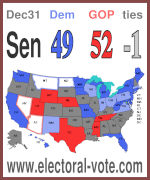
Pres polls: (None)
Dem pickups: (None)
GOP pickups: FL IA MI OH PA WI
Previous | Next
Trump Caves to China
As we noted yesterday, in a Thursday night phone call with Chinese President Xi Jinping, President Donald Trump assured Xi that he will respect the "One China" policy, meaning that on paper, at least, the U.S. will consider Taiwan to be a breakaway province of China, not an independent nation. In December, Trump took a call from Taiwan's President Tsai Ing-wen, breaking a 40-year policy of no official contact with Taiwan and causing an uproar in China.
Now that 24 hours have passed, the implications of this phone call are becoming clearer. A crisis with a powerful adversary has been averted—but at a price. Trump's claimed strength is his ability to negotiate great deals, but to the Chinese, he caved as soon as he was confronted. They are likely to regard him as a paper tiger from now on, which will make it much harder for him to negotiate great trade deals with China down the road. They are likely to drive a very hard bargain and wait for him to cave again. His negotiating position with respect to China would have been vastly stronger had he not taken the call from Taiwan in the first place, so it wouldn't have been necessary to repudiate the implications of it in the second place. One can only hope that he doesn't make too many more rookie mistakes in foreign policy going forward, but with a secretary of state who has no background at all in foreign policy, anything can happen. (V)
Flynn Looks to Be in Hot Water
During the campaign, then National Security Adviser-designate Mike Flynn chatted with officials in the Russian government, most prominently Ambassador Sergey Kislyak. This was a no-no, but Flynn brushed it off, and said that nothing of substance was discussed. He specifically denied that there had been any discussion of the sanctions the Obama Administration imposed on Russia; a denial that was then angrily reiterated by members of the Trump team, most notably Mike Pence. Flynn repeated his denials as recently as Wednesday of this week. Then, the Washington Post published a story in which nine different intelligence officials, speaking off the record, said that Flynn had indeed discussed the sanctions with the Russian government (presumably making a promise that they would be overturned by Trump). Shortly after the publication of the Post story, Flynn changed his story, and said he simply could not recall what he and Kislyak had discussed.
The very best case scenario here is that Flynn broke the rules, had a months-long brain cramp thereafter, and then conveniently got uncramped in short order when it became absolutely necessary. This seems implausible. The more likely explanation is that he lied, multiple times, until he was caught—very possibly ensnaring an unwitting Mike Pence in the process.
The worst case scenario is that Flynn told the ambassador that if elected, Trump would lift the sanctions. Kislyak then told Putin, who ordered his hackers to make sure Trump won, doing whatever was needed. So far there is no evidence of that, but with Flynn changing his story from "We didn't talk about sanctions" to "I don't remember," we probably haven't heard the last of this yet.
Initially, the White House tried to dismiss the story, but on Friday night, President Trump said he would "look into" the reports. So, how much trouble is Flynn in? Hard to say with this administration, where many members have already crossed lines that would have been deal-breakers for past administrations. However, Trump does not like being embarrassed, and Flynn has certainly done that. The general may also have broken the law in a manner that could attach to Trump himself, which would be a major problem. Further, Flynn has many enemies in Washington, does not get along well with Secretary of Defense James Mattis, and has likely alienated the Vice President. Add it up, and the odds are good that his days are numbered. (Z)
Russia May Hand Snowden over to Trump
NBC is reporting that Vladimir Putin is planning to turn Edward Snowden over to Donald Trump as a gift, in order to curry favor with him. Trump has called Snowden a "spy" and a "traitor" who deserves to be executed. For Russia, this would be a win-win situation. Vladimir Putin has no doubt already extracted all the information he possibly can from Snowden, and now he is only a nuisance and a liability. It would also give Trump cover for being nice to Russia: "They helped bring this traitor to justice, so of course we are grateful." It would have the additional value of frightening any potential future whistle blowers.
Of course, there is a downside as well for Trump. Snowden would have to be tried in a U.S. court and would be well defended by the ACLU. It would be an extremely divisive trial and would split the country even more than it is already split. (V)
Some Details of Trump Dossier Confirmed
About a month ago, the public was made aware that highly-regarded former British MI6 intelligence agent Christopher Steele had written a report about a secret dossier the Russians reportedly compiled with an eye toward blackmailing Donald Trump. On Friday, government officials announced that they had confirmed certain details of Steele's report. Not the juicy parts about footage involving adult activities and bodily fluids, but a lot of the underlying details, particularly that conversations Steele said had taken place actually did take place. Put another way, we now know that the people who Steele said had talked actually did talk, we just don't know for certain what they said. At least, the public doesn't know; it's possible the FBI does.
On a day full of Russia-related bad news for the Trump administration (see above), this could prove to be worst of all. And so, it is not surprising that the White House went into bunker mode and chose to attack the messenger, rather than actually respond to the news. White House Press Secretary Sean Spicer said:
This is more fake news. It is about time CNN focused on the success the President has had bringing back jobs, protecting the nation, and strengthening relationships with Japan and other nations. The President won the election because of his vision and message for the nation.
There's an awful lot here: (1) Enough spin for a roomful of LPs, (2) Another salvo in the administration's campaign to delegitimize the media, and (3) A further effort by Spicer and Team Trump to co-opt the "fake news" label. In an op-ed on Spicer's response, the Washington Post's Erik Wemple was extremely critical, characterizing it as "authoritarian," and writing that, "The response from officialdom aligns with an authoritarian's refusal to face facts." As if on cue, shortly thereafter, noted authoritarian Bashar al-Assad issued a statement responding to an Amnesty International report of mass executions in Syria as "fake news."
So, Friday was a bad day for President Trump, between the coverage of his wilting before China, and the several Russia-related stories, and the ongoing travel ban mess. At some point, we have to wonder how many scandals and controversies, back to back to back to back, one administration can weather. The best historical analogue is probably Richard Nixon, who managed to absorb about 18 months of near-daily revelations of dirt about his taxes, and enemies lists, and his secret recordings in the White House before he had to throw in the towel. The bad news for Trump is that Nixon was well-ensconced in the Oval Office by the time Watergate began to unfold, had been elected in a landslide, and was also a shrewd and experienced political operator. And even then, as the scandal began to unfold, the sharks began to smell blood in the water, and started looking under every rock and behind every door. This meant that his fall became all-but-inevitable months before it actually happened. Point is: Trump better find a way to right the ship pretty quickly, or he might not be around long enough to worry about the midterm elections. (Z)
See You in Court
After the Ninth Circuit Court refused to reverse the temporary restraining order on the travel ban, President Donald Trump tweeted: "SEE YOU IN COURT." Which court and how might that work out, exactly? Here are some of the options:
- Ask for an en banc ruling from the entire Ninth Circuit
- Appeal to the Supreme Court
- Re-litigate the case in another circuit
- Withdraw the executive order and issue a new one
Each of these options has its own issues. Asking for an en banc ruling from the Ninth Circuit is problematic because that Circuit has about two dozen judges, so the logistics are difficult, and the Court will be hesitant to grant the request. Besides, most of them (18 of 25) were appointed by Democratic presidents, so the en banc ruling would probably simply support the three-judge panel. In fact, there would be significant risk of a 25-0 ruling, which would leave even more egg on the face of the administration.
Appealing to the Supreme Court could result in a 4-4 tie, thus reaffirming the Ninth Circuit's decision. But probably it wouldn't split 4-4. One of the things the government's case states is that the courts have no authority to review national security issues. If a lawyer really, really wanted to drive Justice Anthony Kennedy into a blue funk, that's the way to do it. In Boumediene v. Bush (2008), Kennedy wrote a decision making it unambiguously clear that the courts have the power to review everything the government does, definitely including national security cases. If Kennedy sided with the Democratic appointees, Chief Justice Roberts would probably join that side so (1) he could determine who wrote the opinion, and (2) to avoid a narrow decision on a case revolving about what powers the president has and what powers the courts have.
The Justice Dept. could re-ligitate the case in a different Circuit, preferably the conservative Fifth Circuit. But if it got the results it wants, then two Circuits would be in conflict, forcing the Supreme Court to take the case, and we are back to the problems described above.
The best option is probably to withdraw the hastily written order and issue a better one after getting input from the State Dept., the CIA, and other agencies. Clearly, banning green-card holders was a huge blunder that can be avoided next time. Still, even if a better written executive order is issued, the Supreme Court might ask the solicitor general (assuming one has been appointed and confirmed in time) why those countries were chosen, given that no one from any of them has every committed a terrorist act in the United States. And while they are at it, one of the justices might ask: "How come none of the countries whose citizens attacked the U.S. on Sept. 11 are included in the list?" Trump has repeatedly said he wants to ban Muslims. The justices are not stupid. All of them have degrees from Ivy League schools. They read newspapers and watch television. Trying to find wording that does not use the word "Muslim" but has the same effect, and very selectively, probably isn't going to fool any of them.
That said, guessing how the Supreme Court will rule on any controversial case that hasn't come before the Court before is always tricky. In general, the Court gives the president wide latitude on national security cases because it assumes the president has access to a vast amount of national security and foreign policy expertise that the Court does not have. However, in this case, apparently Steve Bannon and some congressional aides wrote the executive order without using any of that expertise, which eliminates the argument "the president knows more than you do."
On top of that, even with some deference to the president, there are multiple problems that could bother the Court, to wit:
- The lack of due process for green-card holders and even noncitizens who hold a valid visa
- The Constitution prohibits favoring some religions over overs, no matter no much you try to disguise it
- The anti-Muslim intent could run afoul of the equal protection doctrine
All things considered, it is virtually certain that all four Democratic appointees to the Court are not going to uphold a Muslim ban, no matter how cleverly it is worded. Kennedy doesn't like to be told: "You can't do this." Roberts is worried about the reputation of the Court. Even Gorsuch, if he is confirmed in time to take part and doesn't recuse himself, might be hesitant to vote for Trump because it makes it look like a quid pro quo and that is a terrible way to start ones tenure on the Court. No doubt the Court would prefer to have the case go away, but that may not be in the cards. (V)
Trump Administration Won't Take Ban to SCOTUS Right Now...Or Maybe They Will
As noted above, it's going to be tough for the Trump administration to decide what to do next when it comes to their travel ban, as each of the paths forward carries risks. This being the case, a White House official said on Friday that the administration will not be challenging the Ninth Circuit's ruling right now. Pretty clear, right? Except that an hour later, White House Chief of Staff Reince Priebus changed course and said that, in fact, there might be an appeal to the Supreme Court.
Given that this whole matter made it seem as if the Trump administration is disorganized, impulsive, and more than a bit amateurish, one would think that they would have learned their lesson, and made sure to get on the same page before making any further statements. And, apparently, one would be wrong. (Z)
What Might TrumpCare Look Like?
Republicans are still grappling with what they want to replace the ACA with. Whatever it contains, the Democrats will call it TrumpCare, so they had better be prepared to defend it. Most likely, the main elements of the replacement will be tax credits to buy private insurance, health savings accounts, and high-risk pools. The tax credits get into the thorny issue of who gets credits and how much. Health savings accounts are simpler. People can put pre-tax money into special bank accounts and later withdraw it for medical expenses without incurring any tax. This is simply the government's way of telling people: "Please save money for your own medical expenses." Conveniently, it is also of the greatest value to people in the top tax bracket and of no value to the 47% of people who earn so little that they don't pay any federal income tax.
High-risk pools sound fairly abstract and neutral until you get into the nitty gritty. The idea is to segregate the insurance market into two parts: healthy people and sick people. The first part would be handled by the private insurance sector and since most of the customers would be healthy, premiums would be low and their customers would be happy. Great.
What about the rest? About a quarter of the population has one or more pre-existing conditions that could be expensive to treat. These people would go into a "high-risk pool." The idea is that the insurance companies would be required to divvy them up according to some formula so that everyone was covered, but they could charge these people much higher premiums because they are more expensive to have as customers. Also, there could be much higher deductibles for them than for the regular customers. In addition, there could be annual and lifetime limits on payouts. All these things mean that the sick people would pay far more for their care than the healthy people. If the government were to pick up the tab, that would be fine with the insurance companies. In fact, they would be overjoyed.
The problem is that a study by the Commonwealth Fund concluded that it would take $178 billion in annual government subsides to adequately fund the high-risk pool. The conservative American Enterprise Institute pegged it at only $15 to $20 billion a year. However, Secretary of HHS Tom Price has previously said that the government's contribution to the high-risk pool should be about $1 billion a year. Speaker Paul Ryan's proposal was more generous: $2.5 billion a year. Either way, the bottom line is that if this is the plan, then healthy people get good, cheap insurance and sick people have to pay for poor, expensive insurance themselves. The obvious political problem with this is that many of the sick patients are not too sick to vote. (V)
DeVos off to a Rough Start
Usually, the person leading the Education Department is of interest only to professionals who work with that department—teachers, school administrators, and the like. It's generally something of a second-tier cabinet seat, like Interior or Energy. But Betsy DeVos is not your usual appointee, and so she's attracting rather more attention as she gets to work. Unfortunately for her, she had a pretty bad first day on the job.
Most notably, DeVos tried to visit a school in Washington, D.C., but was blocked at the front door by a large group of protesters. She tried the back door, only to find more protesters. She finally had to sneak in a side door. Afterward, a clearly-rattled DeVos said she respects the right of people to protest. Kellyanne Conway was less neutral, tweeting, "Don't we want the Sec of Education to visit schools?"
DeVos also attempted to diffuse some of the disdain that his been directed at her with a few jokes. The bear joke she made when addressing her staff for the first time drew a mixed response. The tweet where she said, "Day 1 on the job is done, but we're only getting started. Now where do I find the pencils? :)" went much worse, drawing all manner of negative responses on Twitter. Among them:
- If YOU work in education, YOU buy the pencils, the paper, &, sometimes, a kid's shoes.
- You came to and did work with no pencil? That's a materials infraction in many classrooms.
- I hope the one you find has a good eraser. I have a feeling you're gonna be making lots of mistakes.
- I think a grizzly bear came in at ate them all.
- Maybe you could hold a bake sale to buy some pencils.
- Probably should've budgeted for pencils when you were purchasing your position.
- I believe they are made in China by children who will now have a better education than most of America's kids.
Ouch. Perhaps her second day on the job will go better. (Z)
Back to the main page