Pres polls: (None)
Dem pickups: (None)
GOP pickups: FL IA MI OH PA WI
Previous | Next
Trump Wants to Allow Churches to Engage in Politics
President Donald Trump wants to repeal a 1954 law that prohibits churches and other tax-exempt organizations from engaging in partisan politics. This is no doubt a reward for evangelical Christians for turning out for Trump in greater numbers than they did for Mitt Romney in 2012. If the law is stricken, members of the clergy could give sermons telling the faithful how to vote and threatening them with eternal damnation if they vote the wrong way. Christian conservatives have been trying to repeal this law for years and see a realistic opportunity to do so now. (V)
Trump Considering How to Let People Ignore Federal Policies on Religious Grounds
Donald Trump apparently feels a very big debt to the evangelicals, since not only does he want to allow churches to engage in partisan politics (see above), but he also would like to permit individual Americans and organizations to opt out of federal regulations and policies that they object to on the basis of their religion.
For example, the Treasury Department is currently allowed to deny tax benefits for people or organizations that believe that marriage is the union of one man and one woman, with "man" and "woman" defined by their anatomy or genetics at birth. Trump would like to overturn this policy. Among other things, this would allow people and businesses to discriminate against gay, lesbian, and transgender people without fear of federal reprisals. Another example is that a county clerk who refused to issue a marriage license to a same-sex couple would not be punished. In 2015, a Kentucky clerk refused to issue a license to a same-sex couple and went to jail for contempt of court, so this is not just hypothethical.
A problem with this kind of proposal is that it gets the courts into the business of defining exactly what a religion is and exactly what its tenets are. Suppose a Quaker refuses to pay that fraction of his income tax bill that goes to pay for an ongoing war, claiming that his religion opposes wars. Or, with more imagination, someone claims to belong to the Church of the Flying Spaghetti Monster and that one of its beliefs is that people should be allowed to fly planes without a pilot's license. Do the courts really want to get into this kind of stuff?
Trump's proposal also declares that human life begins at conception. This would mean anyone performing an abortion is guilty of first-degree murder and anyone allowing it (such as the pregnant woman) is an accomplice. It would also mean that any pregnant woman traveling internationally without a passport for her fetus would be guilty of human smuggling. There would also be implications for fetuses inheriting property and having tax liabilities for income on that property, among many other thorny issues. (V)
Republicans Taking Their Time with Sessions
GOP senators have been working overtime to get Donald Trump's cabinet approved, doing whatever they can to push through the nominees, even if it means changing Senate rules. The exception to the rule is Attorney General-designate Jeff Sessions (R-AL). Given that one interim AG has already been fired, his confirmation would seem to be especially time-sensitive, and yet no vote on him has been scheduled.
The issue here is not that Sessions is controversial or problematic, or that he needs further vetting and/or questioning. Senate Democrats might agree with all of those sentiments, but they're not the ones calling the shots these days. No, the issue is that until the moment he's confirmed, Sessions is a +1 for the GOP when voting on other candidates. He already cast the decisive vote that allowed Mick Mulvaney, who has been tapped to head the Office of Management and Budget, to make it past the committee stage. And it could well be that Sessions saves Betsy DeVos from being rejected. With the 48 Democratic senators, plus 'no' votes from Lisa Murkowski (R-AK) and Susan Collins (R-ME), it would be 50-49 without Sessions' vote, and thus no tie for Vice President Mike Pence to break. It may be a conflict of interest for the Alabama Senator to help choose his future co-workers, but overlooking conflicts of interest is all the rage in Washington these days, so that's unlikely to be much of a concern. (Z)
GOP Appears to Be Evolving on Obamacare
GOP leadership, particularly in the House, has been quite clear about their desire to repeal and replace Obamacare. But the devil is in the details, as they say, and—as had been the case for six years now—they cannot come up with a plan that everyone agrees upon. In particular, Republicans are struggling to balance their desire to cancel the mandate, to allow the 15 million or so Obamacare insured to keep their insurance, and to keep the insurance market from collapsing. They can have two of the three, perhaps, but not all three.
This state of affairs has the GOP rank and file nervous, as they don't particularly want to face their constituents in two years having created a disaster or having failed to do anything. So, some members are starting to make liberal use of the word "repair." Like Rep. Leonard Lance (R-NJ), who says, "We want to repair the ACA and I have never favored its repeal without a replacement. I think it needs to be repaired and we are trying to focus on repairing it..." Or Sen. Orrin Hatch (R-UT), who is up for reelection in 2018, and who told CNN that the GOP should "try and repair the law." The change in verbiage has not escaped the attention of Democrats on the Hill, with House Minority Leader Nancy Pelosi (D-CA) noting, "I think that some of their vocabulary is changing on the subject. They're using words like 'rebuild' or those kinds of words. You'll hear less and less of 'repeal.'" The upshot is that every day that goes by, it becomes less and less likely that Obamacare goes the way of the dodo. (Z)
Poll: 47% Think Trump Is Moving Too Fast
A Gallup Poll taken Jan. 30-31 shows that 47% of Americans think Donald Trump is moving too fast on his top issues. At the same point in his first term, only 22% though Barack Obama was moving too fast. In terms of overall job approval, Trump stands at 43% approve and 52% disapprove, with only 6% having no opinion, a fairly low number.
Another poll, this one from PPP, shows that 40% of the voters already want to impeach Trump. Only 48% oppose impeachment. For a president who has been in office only 2 weeks, that is not a good omen. The voters' unhappiness cuts across all areas: the Muslim ban, Steve Bannon, repealing the ACA, and more. Historically, presidents are most popular during their honeymoon period, with it dropping off afterward and never returning to the initial level.
Another interesting finding is that Americans find Sen. John McCain, the Washington Post, the New York Times, and CNN all more credible than Trump, despite his attacks on all of them. (V)
The Ten Democratic Senators Least Likely to Support a Filibuster against Gorsuch
If the Democrats decide to filibuster Supreme Court nominee Neil Gorsuch, Republicans will target 8-10 Democratic senators up in 2018 who appear the most vulnerable to try to get them to vote for cloture. Majority Leader Mitch McConnell (R-KY) would greatly prefer a cloture vote to succeed over having to abolish the filibuster forever. The question then arises: "Which senators will be targeted?" Axios has prepared a nice graphic showing the most vulnerable Democrats. Here it is:
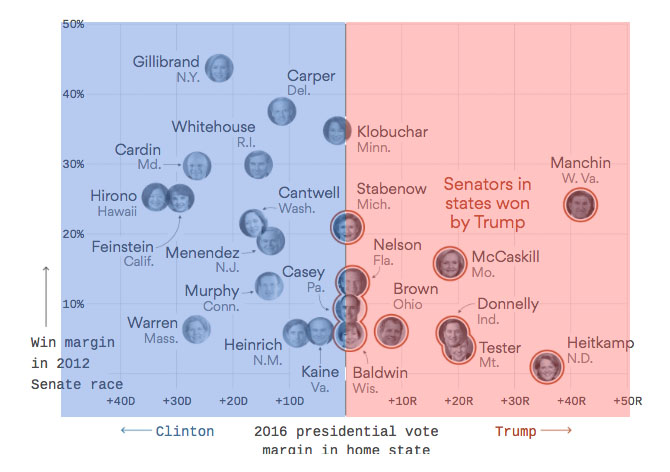
The x-axis gives the 2016 presidential election results. From the graphic you can see that Sen. Joe Manchin (D-WV) is from the state that went most strongly for Trump. The y-axis gives the senator's margin of victory in 2012. So while Manchin is from a deep red state, he is also personally very popular, having demolished his opponent in 2012 by 24 points. Unless the Republicans can find a much stronger candidate than perennial candidate John Raese, who ran against Manchin in 2012, Manchin is probably safe. In contrast, Sen. Heidi Heitkamp (D-ND) is from a state almost as red as West Virginia, and her election was a real squeaker. No doubt Republican strategists are studying this kind of data very carefully. (V)
Protests Are Having an Impact
Since the election of Donald Trump, opponents have taken to streets in a manner we haven't seen since, perhaps, the LBJ years. And it is already clear that the protests are having an impact on politicians on both sides of the aisle.
For example, Senate Minority Leader Chuck Schumer (D-NY) took a rather passive approach in his first couple of weeks in new job (similar to his predecessor as minority leader, Harry Reid). This caused Brooklynites Elizabeth Zeldin and Hae-lin Choi to organize a series of protests held outside the Senator's New York apartment, and entitled "What the f***, Chuck?" Following the first wave of protests, Schumer took to Facebook to announce that he would be voting against the rest of Donald Trump's nominees.
Schumer's colleague, Sen. Sheldon Whitehouse (D-RI), got much the same treatment during an event on Sunday. 1,200 people showed up to protest outside the event, compelling Whitehouse to step outdoors to address the crowd. One of the protesters handed the Senator a list of Trump nominees, and asked him which he would commit to opposing. Put on the spot, Whitehouse promised he would vote against Jeff Sessions, Betsy DeVos, Scott Pruitt, Rex Tillerson, Steve Mnuchin, and Andrew Puzder.
To take another example, there's Rep. Dave Brat (R-VA), best known as the upstart who unseated then-majority leader Eric Cantor. At a meeting last Saturday, which he did not realize was being recorded, Brat acknowledged that he's under enormous pressure from female constituents. "Since Obamacare and these issues have come up, the women are in my grill no matter where I go," Brat explained. "They come up—'When is your next town hall?' And believe me, it's not to give positive input." Brat begged his conservative audience to fight back on his behalf through newspaper editorials and donations.
And then there's The Donald himself. He tends to deny the existence of protesters, and while he may actually believe what he's saying, that doesn't mean that those around him always buy in. This week, he was scheduled to make an appearance at a Harley-Davidson factory in Milwaukee, where he was going to sign executive orders related to American manufacturing. After corporate management got wind of massive protests that were planned, they asked that the visit be called off, and the White House agreed. The aforementioned LBJ got to a point, late in his presidency, that he could appear only at military bases if he did not wish to be shouted down. It's too early to know if the anti-Trump forces can maintain their current level of energy and commitment, but it's not impossible Trump could be headed down the same path. (Z)
Potential Target for the Democrats: Educated Voters
Much has been written about the 2016 election and why Trump won. Most of the attention has gone to Democratic losses in four Midwestern states plus Pennsylvania. But Hillary Clinton also lost North Carolina (which Barack Obama won in 2008) and Florida (which Obama won twice). It would seem, then, that the Democrats have two different paths going forward:
- Appeal to conservative blue-collar workers and win back the Midwest
- Appeal to the Obama coalition of minorities and young people and win back North Carolina and Florida
However, the Los Angeles Times' Matthew Rey proposes quite a different strategy that might work for the blue team: focus on college graduates. In 2016, Clinton won all voters with at least a bachelor's degree by the largest margin since the exit polls began keeping track of educational level. Add to this group millennials and young people, and we get a variation of the second option above, but with the clear intention of picking up educated white-collar workers rather than blue-collar workers.
Consider Michigan, which Clinton lost by 0.2%. Macomb County, a Detroit suburb where only 23% of the population has a college degree, went from D+8 in 2012 to R+12 in 2016, a 20-point shift towards the Republicans. By contrast, Oakland County, another Detroit suburb, went D+8 in 2012 and also D+8 in 2016. But Oakland Country is much more populous than Macomb. If Clinton had picked up 2% more in Oakland County, she would have erased her 10,704-vote deficit statewide and carried Michigan.
Similar situations occurred in Pennsylvania and Wisconsin. Thus, by making a concerted effort in well-educated counties plus trying to convince younger voters that sometimes the lesser of two evils is a lot better than the greater of two evils, the Democrats might have a plan going forward. Additionally, increasing the educated vote is much easier for the Democrats since educated voters already agree with the Democrats on the environment and social issues. Convincing blue-collar workers to come home to the Democrats is harder because the gap on cultural and social issues is very great, and for many people they trump economic issues (no pun intended). (V)
Trump Could Cost the Australian Prime Minister His Job
On Saturday, Donald Trump spoke with Australian Prime Minister Malcolm Turnbull, a conservative, and slammed down the phone 25 minutes into a scheduled 60-minute call. It is possible the call could cost Turnbull his job. Josh Marshall at Talking Points Memo has some interesting background information on Turnbull that puts things in perspective. Marshall's main points are as follows:
- Turnbull is a highly intelligent former lawyer and banker would who probably finds Trump repellent
- Turnbull is relative progressive (for a conservative) and supports action on climate change
- Turnbull has a weak grip on power and has to worry about his right flank
- He can't ignore the right wing of his own party because if he did, he gets dumped (think: John Boehner)
- Refugees are a big deal in Oz and Trump's unwillingness to accept about 1,000 refugees could be fatal
- Steve Bannon undoubtedly knows about Turnbull's position, smells blood in the water, and may have told Trump
- Trump probably sees Turnbull as an intellectual snob of the kind he hates and made that clear
- All of this greatly weakens Turnbull's position in Australia
Since the call is worldwide news, other world leaders are no doubt taking note and thinking about how they can avoid being destroyed by Trump. These calculations can't possibly improve relations between the U.S. and their countries. If Trump behaves so badly with one of America's closest allies, how will he treat other countries? That can't be far from their minds. (V)
Trump and Schwarzenegger in Spat
Donald Trump appeared at the National Prayer Breakfast on Thursday morning, and used the opportunity to (yet again) needle Arnold Schwarzenegger over the ratings for "The Celebrity Apprentice." Calling the new incarnation of the show "a total disaster," Trump said, "I want to just pray for Arnold, if we can, for those ratings."
Apparently, Trump has not seen "Commando," and so does not know that you don't mess with Arnold. Within minutes of the original slight, Schwarzenegger posted a video to Twitter in which he hit The Donald where it hurts. "Hey Donald, I have a great idea—why don't we switch jobs?" said Schwarzenegger. "You take over TV, because you're such an expert in ratings, and I take over your job. And then people can finally sleep comfortably again." In a rare turn of events, Trump, presumably not wanting to be drawn into a discussion of his own ratings (of the approve/disapprove variety), did not take the bait and let the matter drop. At least, for now. (Z)
Back to the main page