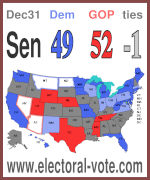
Pres polls: (None)
Dem pickups: (None)
GOP pickups: FL IA MI OH PA WI
Previous | Next
U.S. Drops MOAB on Afghanistan
The MOAB—officially, "Massive Ordnance Air Blast," but colloquially "Mother of All Bombs"—is is a 21,000-pound, GPS-guided device that creates a mushroom cloud visible from 20 miles away. On Thursday, the United States dropped one on Afghanistan in an effort to disable a network of underground tunnels used by ISIS. Thus far, 36 ISIS members are confirmed dead in the attack.
As a strategic matter, analysts say the bombing is justified. The government of Afghanistan has been struggling in its fight against ISIS, not to mention its efforts to remain viable and legitimate. A show of strength from the U.S. helps signal that America will honor its strategic partnership with Afghanistan, negotiated by the Obama administration, and in effect until 2024. The site of the bombing is a hotbed of ISIS activity, and is not too far from where Osama bin Laden was killed.
As a political matter, the bombing continues President Trump's recent pattern of muscle-flexing. It will presumably please the hawks in the GOP, and aggravate the isolationists. This mixed bag may explain why Trump was unwilling to either confirm or deny that he personally approved the attack.
Meanwhile, opponents of Trump, especially the dovish ones, are deeply concerned about this turn of events. We're not yet 100 days into his administration, and Trump has now deployed—for the first time ever—the most powerful non-nuclear bomb the U.S. has, in addition to bombing Syria and waving his sword in the direction of North Korea. Trump's remarks on Friday, such as, "We have given them [the military] total authorization and that's what they're doing," suggest that America's military leaders have carte blanche to do as they see fit. Not a situation that bodes well for world peace, especially since the Doomsday Clock is already at 11:57:30. (Z)
Suburban Voters Have Had It with Trump
One of the "mysteries" of the 2016 election was why so many people who detested Donald Trump voted for him. Actually, it is not really a mystery: They hated Hillary Clinton even more than they hated Trump. The fact that she is not going to be on the ballot in 2018 is beginning to sink in and Republicans are starting to see the consequences. In particular, well-educated white professionals in affluent suburbs in the South and Midwest who are unhappy with Washington are moving away from the Republican Party. Interviews the New York Times conducted with voters in suburban congressional districts in four states give a picture of people recoiling from Trump, which could be bad news in the midterms.
Historically, first-term presidents are whacked hard in the midterms, with the president's party losing seats in the House and Senate nearly all the time. The effect is even larger when the president is unpopular (and no president has ever polled as low as Trump in his first 100 days), and when the opposition is energized while the incumbent's party is not. For example, in 2010, the Democrats lost 63 seats in the House in the aftermath of the Affordable Care Act, which Republicans despised and which Democrats were divided on. Looking at 2018, Republicans are worrying about a similar (but reverse) effect in upscale suburbs that were formerly Republican bastions. There is also a feedback loop at work here. With Democrats fired up, it will be much easier for the party to recruit top candidates since they see a realistic chance of winning in red or reddish districts.
The comments the reporters got from Republican voters in the districts they visited were not encouraging for the GOP, including:
- I'm a Minnesota person so I don't want to be rude, but I'm not a fan [of Trump]
- Congress can't get anything done, and our president is a buffoon
- I love Donald Trump but I just wish he'd keep his mouth shut ...
- You want a five-star rating [of Congress]? How about a thumbs-down
Next Tuesday will be a test of this sentiment. The special election in GA-06 to replace Secretary of HHS Tom Price is in precisely the kind of well-educated high-income district the Republicans have traditionally won and desperately need to hold in 2018. If political newbie Jon Ossoff (D) can get to 50% and win outright without a runoff, it will freak out a lot of Republican strategists. But win or lose in GA-06, the battle for the suburbs will probably determine which party will control the House come January 2019. (V)
Trump's Base Has Had it With Trump
Politico has a story much like the one in the New York Times, except this one focuses on Donald Trump's base. The news here isn't much better for the President: They are fed up, too.
The unhappiness of the base stems from Trump's aggressive pivots away from many of his campaign promises. Among the critical remarks:
- We expect him to keep his word, and right now he's not keeping his word.
- I'm not giving up hope. But it's looking very shaky to me.
- People's belief, their trust in him, it's declining.
- There was always the question of, "Did he really believe this stuff?" Apparently, the answer is, "Not as much as you'd like."
If these individuals' anger had just one source, the problem might be fixable. But the fact is that they are angry about a wide range of things. Some don't like the de-emphasis of Steve Bannon and the rise of moderates like Gary Cohn and Jared Kushner. Others are disappointed in his lack of progress on deporting undocumented immigrants, or on tax reform, or on jobs, or on healthcare. There are some who are upset that he's become more hawkish and interventionist, while others think he's not being hawkish enough, particularly towards China. And if there is one unifying theme, it's that a candidate who ran as anti-establishment seems to be morphing into an establishment Republican. Needless to say, most people who feel this way are not going to be casting their ballots for a Democrat anytime soon, but this is exactly the kind of voter who decides to just stay home on Election Day. (Z)
Virginia Governor's Race Turns Into a Referendum on Trump
As noted above, everyone is watching the GA-06 election to try and discern the future prospects of the Democratic Party. However, as Politico's Kevin Robillard points out, the Virginia governor's race, where "generic Democrat" holds a 10-point lead, may be more instructive.
Representing the establishment wing of the Democratic Party is Virginia's lieutenant governor, Ralph Northam. He is essentially Gov. Terry McAuliffe, the sequel—bland, workmanlike, party insider. He's been steadily working his way up the ranks of the party for more than a decade. He is centrist enough that he admits to having voted for George W. Bush—twice.
The upstart candidate is former representative Tom Perriello, who is running a Bernie Sanders-style campaign. He's been acting like his opponent is Donald Trump rather than Northam, pledging to make Virginia a "firewall" against The Donald. Perriello has the endorsements of Obama staffers Dan Pfeiffer, Neera Tanden, David Plouffe and John Podesta, as well as Sanders himself. Though he only declared in January (whereas Northam has been a candidate for, seemingly, years), Perriello is currently up five points in the polls.
Needless to say, if Perriello has success, it's going to give just about every other Democrat running for office in 2017 and beyond some ideas. And if he wins, which is currently well within the realm of possibility, bedlam is going to break out on the blue side of the aisle, as candidates work to see who can express their loathing for Trump the most loudly and creatively. (Z)
Business Leaders Trying to de-Bannonize Trump
It is widely known that Donald Trump tends to follow the advice of the person he last talked to, so top business leaders are trying to exploit that knowledge to get Trump to ignore the advice of chief strategist Steve Bannon and act like a normal, business-oriented Republican. For example, Blackstone Group CEO Stephen Schwarzman, who has known Trump for years, calls him multiple times a week to give him advice on China, tax policy, immigration, and whatever else is in the news. The fact that Trump has already abandoned nearly all of his campaign promises is no doubt partly due to the influence of leaders like Schwarzman. Many of them are smart enough to skip the ideology and phrase their advice in terms of "this is how you win."
First son-in-law Jaren Kushner, who despises Bannon, also understands the art of Trump management. He tells his father-in-law that he should spend more time talking to people who have been successful in business, since they know how to get stuff done. It seems to be working, as two very wealthy Goldman Sachs alumni in the administration—Secretary of the Treasury Steven Mnuchin and National Economic Council Director Gary Cohn—are gaining influence as Bannon is losing it. Some business leaders think that the White House will be unrecognizable in 6 months. Maybe by December the administration will be a clone of that of not-quite-president Jeb Bush. (V)
Maybe Rumors of Bannon's Death Are Greatly Exaggerated
Trump administration insiders who like Steve Bannon are not comfortable with all the stories about how he is on the way out and the Goldman boys are taking over. Attorney General Jeff Sessions, who likes Bannon, is fighting back, as is Budget Director Mick Mulvaney. Mulvaney went on Laura Ingraham's radio show to announce: "Bannon should stay." Note the use of "should" rather than "will." Typically statements like these in public are meant for Trump himself, rather than for the public at large.
Bannon's supporters both inside and outside the administration realize that Trump's personal psychology works against them. As an ostentatious real estate developer, he was always looked down upon by the real New York elite and never accepted as "one of us." He really craves their respect and wants to be one of them. Trump looks up to Gary Cohn but sees Sessions merely as hired help. There is little Bannon's supporters can do to change this dynamic. (V)
Tax Reform May Not Follow the Ryan Blueprint
Earlier this week, Donald Trump said that he was shelving tax reform to work on healthcare. By next week he will probably (re)discover that healthcare is complicated and go back to tax reform. But it is starting to appear that tax reform will not be based on the vision of Speaker Paul Ryan (R-WI). Instead, other plans are coming from the White House, the Senate, and even the House. The most direct challenge to Ryan came from Mick Mulvaney, who said: "The House can go and do what they want to do. We are going to formulate our own policies." That is exceedingly strong language, just about the strongest it could be without using any unprintable four-letter words. Meanwhile, the Senate is working on a plan based loosely on the one former House Ways and Means Chairman Dave Camp wrote. And the House Freedom Caucus, never a group to be shy about expressing its thoughts, is toying with the idea of cutting tax rates without adding new ones, and just accepting a gigantic hole in the budget.
The reason the tax code hasn't been changed since 1986 is, well, complicated. And it is full of trade-offs:
- Support vs. Goals:
Lots of Republicans have a long wish list for tax reform. The trouble is not all Republicans have the same goals.
To put together a majority, the leadership in Congress may have to sacrifice some popular goals, angering key Republicans.
Furthermore, it is a given that all Democrats will oppose tax reform dreamed up by Republicans, so it will have to pass
using the Senate's budget reconciliation procedure, which may mean sacrificing more goals.
- Taxes vs. Deficits:
Some Republicans want to cut tax rates, come hell or high water, and don't care about any deficits created by their bill.
Other Republicans care a lot about the deficit and will accept much smaller cuts to prevent the budget from blowing up.
These wishes are incompatible.
- Losers vs. Winners:
Any tax bill creates winners and losers, and the losers tend not to like it so much. One plan being floated eliminates certain
deductions to achieve lower tax rates in a revenue-neutral way. For example, it would eliminate the deductibility of
interest payments. Expect the real estate industry to howl to the moon on this one. Another plan is to get rid of state and
local taxes as a deduction. Good luck at getting senators and representatives from high-tax states on board with this. Every
plan has losers and they will fight tooth and nail to save their deductions.
- Growth vs. Benefits:
Not all tax cuts encourage economic growth equally. Cuts to business taxes tend to stimulate growth by giving companies more
money to invest. In contrast, cuts to top tax rates don't have much effect on economic growth. But imagine the poor senator
talking to a Republican megadonor and saying: "We're not cutting your taxes because that won't create many jobs."
- Permanent vs. Temporary:
Republicans would greatly prefer making the tax cuts permanent rather than have them automatically expire after 10 years, but
making cuts that cost the government revenue requires 60 votes in the Senate. Temporary cuts can be done with 50 votes and a friendly
veep. As Republicans discovered in 2013, all Barack Obama had to do to increase taxes on the wealthy was to sit back and watch the 2003
Bush tax cuts spontaneously vanish. They don't want a repeat performance.
- Cleverness vs. Uncertainty: Some of the tax plans, including Ryan's and Trump's, feature a border adjustment tax, which contains a 20% tariff on imported goods. Walmart and other retailers have bitterly complained that this would force them to raise prices by 20% on most of their merchandise. Ryan has countered with the assertion that the tax would cause the U.S. dollar to rise by 20%, thus making the goods 20% cheaper and canceling out the tax. However, to some economists this smells a lot like Arthur Laffer's theory that cutting tax rates results in the government taking in more—not less—revenue. Will the Republicans take the risk?
In short, cutting taxes sounds easy in theory, but as Yogi Berra once observed: "In theory, theory and practice are the same. In practice, they aren't." (V)
Sanders: Trump Will Be a One-term President
In an echo of the statement once made by Senate Majority Leader Mitch McConnell (R-KY) that his biggest goal was to make sure Barack Obama was a one-term president, Sen. Bernie Sanders (I-VT) yesterday said that he believes Donald Trump will be a one-term president. Sanders plans to help out by launching a cross-country tour next week with DNC Chairman Tom Perez. The tour will raise money and awareness for the Democrats. (V)
Prof. Who Called the Last Eight Presidential Elections Says Trump Will Be Impeached
While Bernie Sanders is rooting for Donald Trump to be a one-term president, Prof. Allan Lichtman, who has correctly predicted the winner of the most recent eight presidential elections, notably including 2016's, has predicted that Trump might be lucky to be a 0.75-term president. He sees multiple reasons Trump might be impeached, even by a Republican House. He starts with history. Andrew Johnson and Bill Clinton were actually impeached and Richard Nixon resigned when then-senator Barry Goldwater told him that impeachment and conviction were just days away. Counting Nixon, that's about 1 in 14 presidents, not 1 in a million.
When Attorney General Jeff Sessions was a senator and Barack Obama was president, Sessions clearly stated that a president could be impeached for offenses committed before he was president. If it turns out that Trump was in cahoots with Vladimir Putin before the election, that's pretty close to treason. It's also easy to make a case that Trump has already violated the Constitution's emoluments clause. And if Democrats manage to win 218 or more seats in the House in 2018, then the Ford Rule comes into play. When then-speaker Ford was asked what an impeachable offense was, he replied that it is anything that 218 members of the House think it is. (V)
Back to the main page