Pres polls: (None)
Dem pickups: (None)
GOP pickups: FL IA MI OH PA WI
Previous | Next
Trump and Xi Met, Talked, and Accomplished Nothing
The meeting between U.S. President Donald Trump and Chinese President Xi Jinping is now concluded. The two leaders smiled and agreed that the meeting was a big success. In reality, no progress was made on North Korea, trade, Chinese military bases in the South China Sea, or any of the other thorny issues that the two countries disagree on. Given that Trump wants China to change its policies on these issues and Xi doesn't, lack of actual agreements on them has to be taken as a win for China.
On the plus side for Trump, he didn't insult his guest, violate any diplomatic protocols, or vomit on a key foreign leader, as George H.W. Bush once did.
On the way home, Xi turned a routine refueling stop in Alaska into a business meeting with Gov. Bill Walker (I-AK). Alaska exports a billion dollars' worth of goods (mostly natural resources) to resource-hungry China each year. The governor said his state would be happy to sell China "a generation's worth" of liquified natural gas. Xi didn't give any indication whether or not he was interested, though. (V)
U.S. Carrier Group Headed to North Korea
In a development that is undoubtedly related to Donald Trump's lack of success with Xi Jinping, a fleet of American warships—led by the supercarrier USS Carl Vinson—is now en route to the Korean peninsula.
Thus far, the White House has said little about the move, other than to confirm that it is in response to North Korea's recent missile test, and to say that the plan is to make a "show of force." The problem is that Kim Jong-un is, quite possibly, the world's leading expert in posturing. He leads a backwards country with a tiny economy and a modest scientific establishment, and yet he's got the world's superpowers on their heels. So, a symbolic demonstration—which is what seems to be in the cards—is unlikely to have much impact on him. America's military leaders surely know this, which leads us to the conclusion that this maneuver is primarily for the benefit of voters back in the United States, so that they know "something" is being done.
Indeed, putting on a military show for symbolic purposes seems to be all the rage these days. As details trickle in about the attack in Syria, it is evident that the Tomahawk missile attack on Shayrat Airfield had no appreciable effect on Syria's military capability. The United States did not even attempt to destroy the runway at Shayrat, reasoning—remarkably enough—that it would be easily repaired. Consequently, the airfield is already operational again. Late Saturday, another attack was launched on Ash Sha'irat, the target of the original chemical strike. It is, as yet, unclear if the attackers were Russian or Syrian. What is clear is that the U.S. strike was not a success. Unless, of course, it too was primarily for the benefit of the American public. Certainly, whether by design or by chance, nobody has given much attention to the Trump-Russia connection for the past few days. (Z)
Bannon and Kushner Are Forced to Promise to Be Nice to Each Other
Donald Trump has decided that the infighting between senior advisers Steve Bannon and Jared Kushner has gotten out of hand, so he ordered them to sit down and bury the hatchet. Fat chance. To start with, the anti-Semite Bannon and the orthodox Jew Kushner were never slated to be best of friends. Add to that Bannon's attempt to tear the house down versus Kushner's much more modest approach to things, and battles were inevitable.
Trump's ordering them to sit down and bury the hatchet is completely pointless. They are each trying to pull Trump in different directions, and that's not going to change. Furthermore, Kushner holds all the cards. If Trump fires Kushner, that is going to mean a huge break with his beloved daughter. Ivanka. He'll never do that. Firing Bannon means problems with his biggest financier, Rebekah Mercer, who is close to Bannon, but the lack of campaign financing becomes an issue only in 2020, and a lot can happen between now and then. Bannon surely is aware of this.
A top source told Mike Allen of Axios that unless Bannon becomes more "co-operative" (read: stops challenging Kushner), he's out of there, Mercer or no Mercer. If Bannon had chalked up a few wins instead of losses (Muslim bans, healthcare) he would have a stronger case, but Trump doesn't care much for losers. (V)
Tillerson Is Kushner's Understudy
Secretary of State Rex T. is definitely no T. Rex. In fact, he is hardly ever visible and has almost no power or influence on foreign policy, which theoretically is his job. When Japanese Prime Minister Shinzo Abe met Donald Trump, Tillerson was not even present. He was also absent when Israeli Prime Minister Benjamin Netanyahu was in town. His choice of deputy was vetoed by the president. His department's budget is set to be slashed. People are already speculating that he will be soon gone and U.N. Ambassador Nikki Haley will replace him.
So who is actually in charge of America's foreign policy? It appears that the president's son-in-law, Jared Kushner, is doing most of the work and making most of the decisions that Trump himself is not making and there is nothing Tillerson can do about that. He will just continue to fly around the world—alone—meeting heads of state and accomplishing very little. When he signed up for the job, he probably didn't expect to be playing second fiddle to a 36-year-old with no experience whatsoever in foreign policy, but that's what happened. (V)
Gerrymandering Isn't the Only Problem with the House
Most House districts aren't competitive any more, and gerrymandering gets the blame all the time. But new data from the Cook Political Report show that gerrymandering isn't the only problem. As big a problem is that voters are sorting themselves into red and blue districts, without any help at all from the state legislatures.
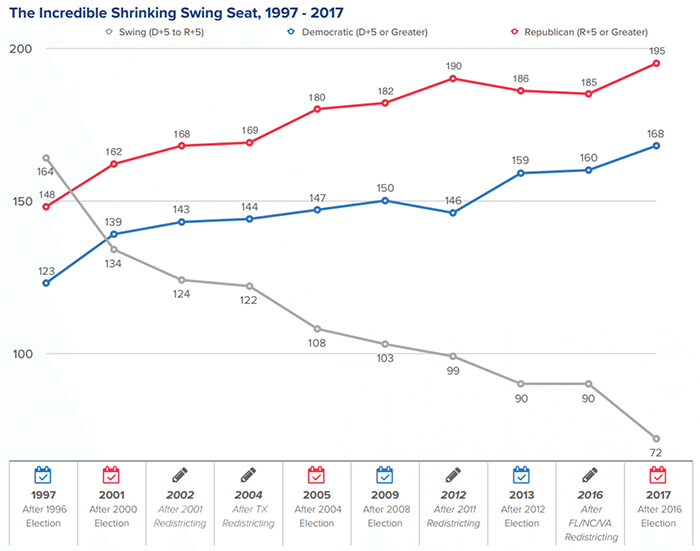
A quick look at this graph shows that the decline in swing districts happens largely between official redistrictings, not as a result of them. In the period between censuses, Democrats move into blue districts and Republicans move into red districts, so the number of swing districts declines. For example, after the 2011 redistricting, there were 99 swing districts (defined as being between D+5 and R+5), but now there are only 72.
Fundamentally, Democrats live tightly-clustered in cities, giving them huge majorities in urban districts, but Republicans dominate outside cities. This effect is not caused by state legislators with sophisticated map-drawing software (although that plays a large role as well), but by where people choose to live. Until Democrats decide to live in rural areas and Republicans choose to live in big cities, the effect is likely to continue. (V)
Burned Out on Coal
Donald Trump has promised to bring jobs back to coal country, and has already signed executive orders that loosen regulatory barriers to coal production. The problem is that coal production in America is not dying because of regulation, it's dying because it's no longer economically sensible. The costs of mining coal and turning it into energy are now higher than the costs associated with alternative energy sources, like solar, wind, and natural gas.
An interesting new article in the Washington Post makes clear that it is not only the United States where energy producers are reaching this conclusion. In Chile, for example, massive solar power farms are in use or are under construction. Chilean Energy Minister Andrés Rebolledo is effusive about the future of the technology. "This is the beginning of a trend that will only accelerate," he declared. "We're talking about an infinite fuel source."
Meanwhile, back in America, even the coal miners have seen what Trump apparently has not. They do want jobs from the administration, but it's not coal mining jobs they have their eyes on, it's "jobs of the future." They recognize that coal harms both the workers and the environment, and that the money isn't there any more. So, they want to see investment in the coal country's burgeoning tourist trade, and also in retraining for high-tech jobs. Even the Kentucky Coal Mining Museum (yes, that's a real thing) has just converted to solar power. Unfortunately for the miners, and for the president, these are the kinds of things that cannot be achieved through executive orders. They will require cooperation with the legislative branch, which thus far has not been Trump's forte. (Z)
Anti-Trump Bar Opens in New York
Much about Donald Trump's presidency is unprecedented, and that includes some of the things that activists are doing to oppose him. In this latter category is a new bar in New York City, called "Coup"—a none-too-subtle comment on how Trump acquired power, in their view. The bar exists solely to fight back against the President and his agenda.
Coup's business model is quite interesting. They will make extensive use of volunteer bartenders. This includes many of the superstars of the New York restaurant scene, though they've also had sign-ups from as far away as Texas and California. All of the profits will go to organizations that are being defunded by Trump (Planned Parenthood, etc.) or are going to fight back against him (the ACLU, etc.) The proprietors expect to keep the doors open as long as Trump is in office. (Z)
Back to the main page