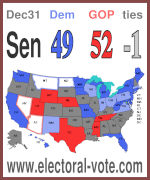
Pres polls: (None)
Dem pickups: (None)
GOP pickups: FL IA MI OH PA WI
Previous | Next
U.S. Attacks Syria
Following a deadly chemical weapons attack by the Bashar Assad regime, the United States has responded with a show of force, firing 59 cruise missiles at the air base from which the chemical strike was reportedly launched. The goal was ostensibly to stop the base from being used for further attacks, though it is unclear whether 59 missiles are enough to achieve that end. Afterward, Donald Trump offered brief remarks in which he made clear how much he was affected by photographs of the devastation. "It was a slow and brutal death for so many," he said. "Even beautiful babies were cruelly murdered in this very barbaric attack. No child of God should ever suffer such horror."
To start, it is worth noting that exactly what so many people feared in a Trump presidency has now come to pass. As recently as a few days ago, the Trump administration's position on Syria was that Assad should remain in power, and that intervention was off the table. But then, something happened that affected Trump on an emotional level, and 36 hours later, missiles were flying. The only real difference between this and the dire predictions that were offered up in November and December was that Thursday's attack used conventional missiles instead of nukes. It's not a huge step from one to the other, however.
In any event, the attack will surely be beneficial to Trump in the short term. Tens of millions of Americans saw the same pictures that the President did, and the notion of retribution will be very satisfying. Trump's actions will be perceived as strong and decisive, and his approval ratings will rise, at least for a while.
Long term, however, things are murkier. Now, Trump owns Syria as a political issue. If the missile attack serves to push Assad toward a peace agreement, then it will be a major feather in the president's cap. But if it serves to further destabilize the region, Trump will have nobody but himself to blame. Not helping matters is that a virtual who's who of America's enemies are involved over there—Russia, Iran, ISIS, Al-Qaeda, Hezbollah. Indeed, there were Russian soldiers present on the base that was struck. Though the administration says that they were warned in advance, Russia has already expressed their irritation, saying the attack is a "significant blow to US-Russia relations." Other affected parties can be expected to weigh in Friday.
If the war rages on—and it's hard to imagine how a single missile attack is going to deter Assad—Trump could also find himself with an acute case of "in for a penny, in for a pound." What if the airfield needs another strike (or several more) to actually be rendered useless? What if there's another chemical weapons attack—why respond to one, and not another? It could get dicey.
The attack has also complicated Trump's already challenging relationship with Congress. The hawks, both Democratic and Republican, offered their support for the decision, while the doves and the isolationists condemned it. Nearly all agreed, however, that any further actions must be undertaken with the advice and consent of the legislature. Whether Trump will be interested in this remains to be seen.
This is, of course, a still-developing story—the missiles were launched just a few hours before midnight eastern time. It is not even clear, as yet, if there are additional strikes already planned. The only thing that's really clear is that Neil Gorsuch has just been knocked off the front page. (Z)
Nuclear Option Is Triggered
The script unfolded exactly as expected on Thursday. The Democrats filibustered Neil Gorsuch, and the Republicans responded by killing the filibuster for Supreme Court nominees. Then, they all spent the rest of the day blaming each other. "This is the latest escalation in the left's never-ending judicial war, the most audacious yet," said Speaker Mitch McConnell (R-KY). "When history weighs what happened, the responsibility for changing the rules will fall on the Republicans' and Leader McConnell's shoulders," responded Minority Leader Chuck Schumer (D-NY). The vote to kill the filibuster was entirely along party lines, 52-48. Today, the 52 Republicans plus half a dozen or so Democrats will vote to confirm Gorsuch, and he will take his seat on the Court.
While 2017 will be remembered as the year that the SCOTUS filibuster was killed, Josh Marshall at Talking Points Memo makes the very good observation that it was de facto abolished in 2005, when John Roberts and Samuel Alito were nominated in quick succession. Republicans made it clear that if the Democrats tried to filibuster either one, they would abolish the filibuster then and there. Rather than let that happen, the two parties made a deal: As long as the Democrats didn't use the filibuster, it wouldn't be abolished, but if they did use it, it would be abolished. In reality, if you have a weapon that will be neutered the first time you try to use it, then you don't really have it any more.
Even with Thursday's developments, the filibuster for legislation remains in place. However, that could very well be just a matter of time. At the moment, McConnell is saying all the right things (or, at least, all the politic things), declaring, "There is not a single senator from the majority who thinks we ought to change the legislative filibuster." But what if a juicy opportunity comes along to pass a key Republican priority—a big tax cut, or a concealed-carry law, or the like? Can McConnell resist the temptation, given that the filibuster has already been so badly degraded? Can Schumer (or his successor) resist once the Democrats are back in power? The smart money says that the answer is "no" to both questions.
Finally, and as a sidebar, Sen. John McCain (R-AZ) has been singularly unimpressive throughout this whole process. He has spoken out against Donald Trump many times. He condemned the talk of abolishing the filibuster, and offered all sorts of verbiage about the importance of the Senate and its traditions. And yet, when push comes to shove, he has consistently backed down and voted the party line. He once had a reputation as a "maverick," but that took a beating when he chose Sarah Palin as his running mate, because she was most politic, rather than Joe Lieberman, who is the person McCain actually wanted. It seems like he never got his maverick mojo back from that point; particularly curious about his unwillingness to vote his (apparent) principles is that he's almost certainly in his final term, and has no need to worry about a re-election bid. By contrast, McCain's fellow Arizonan, Barry Goldwater, spent his last term in the senate firing with all barrels, even if it meant opposing his party. (V & Z)
R.I.P U.S. Senate, 1789-2017
Politico Magazine has an interesting piece on the death of the Senate as the world's greatest deliberative body. The author, Matt Latimer, who was a speechwriter for George W. Bush, gives a number of reasons why going nuclear could turn out to be, well, radioactive, especially if legislative filibusters are next on the chopping block:
- If Republicans lose the Senate and White House in 2020, Democrats will ride roughshod over them
- The Republicans' best 2018 argument ("Give us 60 seats to defeat filibusters") is suddenly weaker
- Senate Republicans can't fight some of Trump's wackier ideas with "We don't have 60 votes"
- The Senate is now just a smaller House with 6-year terms, hardly what the founding fathers envisioned
The Senate used to have traditions and idiosyncrasies that set it apart from other legislative bodies, but they are largely no more. It is now a take-no-prisoners fight to the death on everything, with no end to partisan warfare in sight. (V)
Former Ambassador to China Warns Trump about Negotiating with China
Max Baucus, a six-term former senator from Montana who later served as ambassador to China from 2014 to 2017, has warned Donald Trump that negotiating with China is not like buying commercial real estate. China has its own interests and they may not be aligned with those of the United States.
He also noted that China will probably bring a gift or two. Trump is not much into animals, so it won't be a giant panda. More likely it will be an offer to invest some money in a project in the U.S. and create a few thousand jobs, knowing that Trump will then tweet: "I got the Chinese to create 1,000 jobs in America and I gave them nothing in return. Terrific deal." To the Chinese, even a $1 billion investment in, say, a factory, is peanuts. If they don't have to face down North Korea, revalue their currency, or stop building artificial islands in the South China Sea, it is a huge and cheap win for them. Trump will think he got the better end of the deal, when in fact if the Chinese concede none of the important stuff, they won. (V)
Nunes Temporarily Steps Down from Role in Trump-Russia Probe
Rep. Devin Nunes (R-CA), chairman of the House Intelligence Committee, announced yesterday that he is temporarily stepping aside as the leader of the House probe into the relations between Trump and Russia. He blamed a series of ethics complaints against him for his decision. The complaints were based on a no-longer-secret meeting he had at the White House while he was investigating the White House.
Speaker Paul Ryan (R-WI) expressed his confidence in Nunes but also supported his decision to step down. The next-in-line Republican on the House Intelligence Committee is Rep. Tom Conaway (R-TX), so he will take over the investigation. Ryan also expressed confidence in Conaway's ability to "conduct a professional investigation into Russia's actions and follow the facts wherever they lead."
Whether any political body can investigate the president and follow the facts is doubtful. The Republicans want to make sure Trump is not found guilty of breaking any laws. The Democrats want to make sure Trump is found guilty of breaking some laws. Under these circumstances, it might be best to have an independent counsel look into the matter, but the Republicans don't want that, fearing it might turn into a witch hunt. Or that the counselor may uncover some unpleasant truths. (V)
Trump Is Looking at Combining Infrastructure with Healthcare or Tax Reform
Donald Trump is now considering attaching a $1 trillion infrastructure package to either a healthcare bill or a tax reform bill in order to attract Democratic votes and sideline the House Freedom Caucus. The plan might pick up some Democrats, but it might lose some Republicans in the process. Also, Trump's idea of an infrastructure plan is likely to have $200 to $300 billion in direct federal expenditures, with the rest paid for by tax credits, something the Democrats don't like.
No matter how the infrastructure plan is formulated, it is hard to imagine many Democrats voting for dismantling Barack Obama's signature achievement. In fact, even a stand-alone infrastructure bill would have trouble with Democrats if most of it is achieved by selling off national parks, interstate highways, and other federal assets in return for promises to upgrade them.
Attaching the infrastructure plan to a bill that cuts taxes for the very wealthy is also not likely to attract many Democratic votes. It might also repel Republicans who don't want another expensive federal spending program, even if it is a mere $200 billion. In short, Trump may think this is a winning strategy, but it remains to be seen if Democrats go for it. (V)
Border Wall Is Making America Smaller
The official border between the U.S. and Mexico for a considerable distance is the middle of the Rio Grande. However, building a wall in the middle of the river is a bit tricky, so in many of the areas where there is already a wall, it is on dry land on the American side of the border.
In some cases, the wall or fence is quite far into American territory because the north bank of the river is a flood plain not suitable for wall construction. When a wall is way inland, a sizable piece of land exists between the wall and the river. Technically it is part of the U.S., but it is cordoned off from the rest of the country by the wall. Nevertheless, life goes on there in its own peculiar way. Bloomberg has some interesting photos of life in this unusual location. If Trump gets his wall, there will be much more territory lost south of the wall because in many places, for engineering or legal reasons, it may not be possible to put the wall close to the actual border. (V)
Texas Would Be Negatively Affected by a Border Adjustment Tax
A new study from the Koch brothers organization, Americans for Prosperity, shows that if Donald Trump's proposed border adjustment tax of 20% had been in effect in 2014, importers in California, Texas, and Illinois would have had a tax liability of $170 billion. Even more to the point, Texas' businesses would see a 93% increase in the taxes they pay, even if the dollar strengthens as a result of the tax.
The Koch brothers are against the tax, so publishing a study showing that it is bad for Texas is a not-too-subtle way to convince Texas' 36 representatives and two senators to vote against it if it comes up. The tax affects importers and exporters differently, but an alternative way of looking at it is which states are winners and which are losers. This report examines this aspect, with the goal of influencing Republican legislators from losing states to oppose it. (V)
Back to the main page