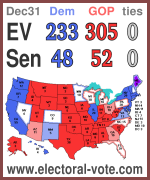
Pres polls: CO FL GA IA IL LA MD NC VA WI
Dem pickups: (None)
GOP pickups: IA NV OH
Previous | Next
Ad Spending Reveals the Campaigns' Priorities
You can tell a lot about a campaign's priorities by where it is spending money. Here is the breakdown for the television spending per electoral vote by state for the week beginning Sept. 13. Total spending for advertising in that week was $11.5 million for Clinton and $2.4 million for Trump.
| State | EVs | Clinton | Trump |
| Nevada | 6 | $106,000 | $0 |
| Florida | 29 | $94,000 | $31,000 |
| North Carolina | 15 | $69,000 | $29,000 |
| Pennsylvania | 20 | $67,000 | $25,000 |
| New Hampshire | 4 | $61,000 | $0 |
| Ohio | 18 | $58,000 | $29,000 |
| Iowa | 6 | $37,000 | $0 |
| Nebraska | 1 | $25,000 | $0 |
| Arizona | 11 | $17,000 | $0 |
As in the Sherlock Holmes story "Silver Blaze," in which the dog that didn't bark gave Holmes the clue to the case, sometimes a lack of spending tells you a lot. Clinton isn't spending in California because she knows she will win there. She also isn't spending in Texas, because she knows she will lose there. But what is missing from the above list? Yes, Virginia and Colorado. Her polling tells her that these states are not in danger, so her money is better spent in places like Nevada, Florida, and North Carolina. Note that Clinton's spending in Nebraska is entirely focused on Omaha, where she has a shot at winning one electoral vote, just as Barack Obama did in 2008.
Clinton has also spent $35 million on national ads; for example, during the Olympics Trump didn't spent anything on national ads. National ads can help drive up her national polling, which doesn't affect the Electoral College, but does affect the media's perception of who is ahead, and that is also important. She would prefer headlines like "Clinton still ahead" to headlines like "Trump passes Clinton nationally." (V)
Why Isn't Clinton 50 Points Ahead of Trump?
A lot of people, especially Democrats but also some Republicans, are wondering why Hillary Clinton isn't 50 points ahead of Donald Trump, given how many people hate him. She even wondered about it herself in public on Wednesday. Aaron Blake at the Washington Post has a few ideas:
- Partisanship:
First comes simple partisanship. Either party could nominate a rabid yellow dog
and 45% of the voters would vote for it. Since Ronald Reagan, both parties have gotten
at least 45% of the vote in two-candidate races. Democrats vote for the Democrat
and Republicans vote for the Republican and that is the way it is. The candidates
don't matter much and neither do the billions of dollars in ads. All of that effort
is aimed at the maybe 10% of the electorate that is truly up for grabs.
- Enthusiasm: If a candidate has more supporters but
they are not enthusiastic enough to actually vote, the candidate could lose. A
recent WaPo/ABC News poll showed that 46% of Donald Trump's supporters were
enthusiastic about him, vs. only 33% of Hillary Clinton's supporters. The poll
also showed that 93% of Trump backers were certain to vote vs. only 80% of
Clinton backers. This disparity shows up in the polls. A lot of Clinton's
trouble is with millennials, who are still angry that their candidate, Sen.
Bernie Sanders (I-VT), who got 12 million votes, didn't win the Democratic
nomination. Many of them believe that he was cheated. Some think a Trump
presidency would cure the Democratic Party of nominating
moderates once and for all. Most of them are too young to realize that the Democrats' reaction to
Ralph Nader in 2000 was to move to the right, to capture more centrist votes in
2004, rather than to the left.
- Hillary Clinton: If Joe Biden were the Democratic nominee, he would certainly have a lead of 10 points or maybe more. But he is not the nominee. Hillary Clinton is the nominee, and she is widely disliked. In the poll mentioned above, her unfavorable score was 59%, almost as bad as Trump's score of 60% unfavorable. The Republicans have been hammering on her for 25 years and that has taken its toll.
A point Blake didn't make is that while political junkies have been following every detail for months, for many Americans, the race starts after Labor Day. Things could change quickly after the debate on Monday, in either direction. (V)
75 Ambassadors Endorse Clinton
Just this week, Donald Trump has been lambasted en masse by scientists and ethics lawyers and by the intelligence community. Now, the diplomats have joined the party. 75 of them, including 57 GOP appointees, signed an open letter endorsing Hillary Clinton. They spend only a few sentences on Clinton, however, focusing most of their verbiage on the reasons they believe Donald Trump is ill-suited to the presidency:
One of the candidates—Donald J. Trump—is entirely unqualified to serve as President and Commander-in-Chief. He is ignorant of the complex nature of the challenges facing our country, from Russia to China to ISIS to nuclear proliferation to refugees to drugs, but he has expressed no interest in being educated. Indeed he has recently demonstrated he entirely misunderstands and disrespects the role of the very officials who could educate him: the senior career officers of our intelligence services and of our military services (whom he has characterized as "rubble").
In his frequent statements about foreign countries and their citizens, from our closest friends to our most problematic competitors, Mr. Trump has expressed the most ignorant stereotypes of those countries; has inflamed their people; and has insulted our allies and comforted our enemies. Shockingly, he has even offered praise and admiration for Vladimir Putin, the leader of Russia whose international activities and reported intrusions into our democratic political process have been among the most damaging actions taken by any foreign leader since the end of World War Two.
If Trump does win, he'll need to appoint about 200 ambassadors. If Thursday's letter is any indication, he's going to have a hard time filling those posts. He's only got five kids, after all. (Z)
Trump's Primary Opponents Give Advice on How to Debate Him
The Hill talked to some of Donald Trump's primary opponents and their top aides to get advice on how to debate him. Here is what they had to say:
- Be authentic, not overly scripted
- Push back, but don't get into the mud
- Lean on your policy strength
- Don't be overly wonky
- Don't prepare for a weak opponent
Trump is a particularly difficult opponent to prepare for because sometimes he is wild and hits hard, but other times he is more reserved. It's hard to tell which Trump will show up. (V)
How Trump Can Win the Debate
Veteran GOP operative Frank Luntz has written an article for Time in which he offers Donald Trump some suggestions for what he should do at the first debate on Monday. He proposes, first of all, a humble and even apologetic tone, wherein Trump communicates what an honor it is to be running for president, and also avers how very sorry he is for his remarks about the Khan family, Sen. John McCain (R-AZ), etc. Luntz also stresses the importance of clear, concise, and thorough explanations of Trump's policy positions, as well as restraint in attacking Hillary Clinton. It's very interesting advice, though one is left to wonder if Luntz has actually been watching the campaign. If Trump actually apologizes for anything, viewers should immediately run to their windows to look for the pigs up in the sky.
The advice of Rich Lowry, writing for Politico, is a bit more grounded in reality. He observes that Trump does not need to win, so much as he needs to not lose. The goal should be to convince Americans that, contrary to what Hillary Clinton and all of her ads say, he is plausible as president. In service of that goal:
Trump doesn't need to be the aggressor. As long as he's firm and calm, he is implicitly rebutting the case against him on temperament. And then he can look for a big moment or two that will be memorable and drive the post-debate conversation in the media that is arguably as important as the debate itself.
This is vastly more plausible than a plan that involves apologies, and humility, and clear and concise policy explanations. (Z)
Trump Warns Lester Holt About Fact-Checking
Donald Trump was on "Fox and Friends" Thursday morning, and was asked how he thinks moderator Lester Holt should manage the first debate. He would prefer, presumably for obvious reasons, that Holt not be in the business of fact-checking. Said Trump:
Well, I think he has to be a moderator. You're debating somebody, and if she makes a mistake, or if I make a mistake, we'll take each other on. But I certainly don't think you want Candy Crowley again.
The Candy Crowley reference is an implied threat. In 2012, Crowley presumed to correct Mitt Romney when he erroneously accused Barack Obama of being unwilling to call Benghazi an act of terror. Crowley was than savaged on social media, in the right-wing blogosphere, on Fox News, and so forth. And in case Holt missed the message, Trump also helpfully reminded him that, "a lot of people are watching." It's hard to imagine that Holt will be cowed by this, though; you don't reach the heights he has without being able to manage a little pressure from a politician. (Z)
Running for President for Fun and Profit
In 2000, Donald Trump bragged that, "I could be the first presidential candidate to run and make money on it." He certainly seems to be making good on that braggadocio. Most obviously, his campaign has already paid his company $8.2 million for food, office space, staffing of events, and the like. Generally, candidates don't do business with their own businesses, for fear of breaking the law or of looking shady to voters. Trump is unaffected by these concerns.
The payments from the campaign to the the business are not the only way he's profiting, either. The Secret Service has paid Trump $1.6 million for transportation on his airplane. They've also paid Hillary Clinton $2.6 million for transportation on her plane, but she does not own hers, while he owns his. Further, Trump has utilized his presidential run to highlight some of his real estate projects, like the new Trump-branded hotel in Washington, netting untold millions in free advertising. And, win or lose, Trump will undoubtedly claim (with some justification) that his presidential run has increased the value of his "brand" by untold billions of dollars. So, even if he loses on November 8, he could be crying all the way to the bank. (Z)
Judge Rejects Attempts to Unseal Trump's Divorce Records
The New York Times and the Gannett Corporation sued to have the records from Donald Trump's first divorce unsealed. They lost. Generally divorce records are sealed, but judges can make exceptions if they see exceptional circumstances. The two parties to the lawsuit said Trump's running for president created an exceptional situation since the public has a right to know what the records might show about his first wife's claim that Trump raped her, and also about his finances. The judge disagreed. The plaintiffs have not yet decided whether to appeal the case. (V)
Heck's Son Embarrasses Campaign
Rep. Joe Heck (R-NV) is in a tooth-and-nail race for Sen. Harry Reid's (D-NV) senate seat. And on Thursday, he got some bad news (on several levels). It would seem that his son Joey is in the habit of lurking in some unpleasant corners of the Internet, where he makes vulgar remarks about Hillary Clinton and registers his support for various racist and anti-Semitic sentiments.
Joey has already released an apology, and says he is getting counseling. On one hand, it's hard to think that the online indiscretions of a 19-year-old should be a consideration in a U.S. Senate race. On the other hand, it's a very close race, and the votes of Latinos and Asians could be decisive. On November 8, Heck senior could be left wishing that Heck junior chose his usernames a bit more carefully. (Z)
Today's Presidential Polls
School is back in session across America, as indicated by all the polls from universities. The pros will get serious again in a week or two; it will be interesting to see if they generate different results. (Z)
| State | Clinton | Trump | Johnson | Start | End | Pollster |
| Colorado | 41% | 34% | 12% | Sep 14 | Sep 18 | CMU-RMPBS |
| Colorado | 44% | 42% | 10% | Sep 13 | Sep 21 | Quinnipiac U. |
| Florida | 44% | 45% | 3% | Sep 19 | Sep 21 | Suffolk U. |
| Georgia | 40% | 47% | 9% | Sep 13 | Sep 21 | Quinnipiac U. |
| Iowa | 37% | 44% | 10% | Sep 13 | Sep 21 | Quinnipiac U. |
| Illinois | 45% | 39% | 6% | Sep 19 | Sep 21 | Emerson Coll. |
| Louisiana | 33% | 49% | 8% | Sep 15 | Sep 17 | SMOR |
| Maryland | 58% | 25% | 6% | Sep 17 | Sep 20 | Goucher College |
| North Carolina | 41% | 41% | 11% | Sep 16 | Sep 19 | Siena Coll. |
| Virginia | 44% | 37% | 8% | Sep 11 | Sep 20 | Roanoke Coll. |
| Virginia | 45% | 39% | 8% | Sep 13 | Sep 21 | Quinnipiac U. |
| Wisconsin | 45% | 38% | 11% | Sep 19 | Sep 20 | Emerson Coll. |
Today's Senate Polls
North Carolina is going to be a real barnburner; it's possible we won't know the winner until after November 8, since the state allows for recounts if the result is within 1%. (Z)
| State | Democrat | D % | Republican | R % | Start | End | Pollster |
| Colorado | Michael Bennet* | 45% | Darryl Glenn | 32% | Sep 14 | Sep 18 | CMU-RMPBS |
| Florida | Patrick Murphy | 34% | Marco Rubio* | 43% | Sep 19 | Sep 21 | Suffolk U. |
| Illinois | Tammy Duckworth | 41% | Mark Kirk* | 39% | Sep 19 | Sep 21 | Emerson Coll. |
| Maryland | Chris Van Hollen | 54% | Kathy Szeliga | 24% | Sep 17 | Sep 20 | Goucher College |
| North Carolina | Deborah Ross | 46% | Richard Burr* | 42% | Sep 16 | Sep 19 | Siena Coll. |
| Wisconsin | Russ Feingold | 52% | Ron Johnson* | 42% | Sep 19 | Sep 20 | Emerson Coll. |
* Denotes incumbent
Back to the main page