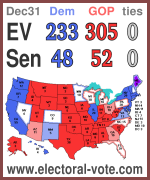
Pres polls: AZ FL IN MA MD MI NH NV OH RI TN
Dem pickups: AZ NC
GOP pickups: IA OH
Previous | Next
Trump Abandons the Rust Belt, Aims at the West
The linchpin of Donald Trump's campaign to win the Rust Belt is Pennsylvania. Poll after poll is showing that he is making no progress at all there. So now, Trump is focusing on three states in the West: Arizona, Colorado, and Nevada. He shouldn't even have to fight for Arizona, since Republicans normally win there easily, but this year it is close. Colorado is most likely a lost cause. Of the three, Nevada is traditionally the swingiest of the states, so Trump held two rallies there this week.
However, his rallies were not flawless. He mocked politicians who mispronounce the name of the state, only to do it himself. On the other hand, he is a major employer in the state. That could help him, but it could also hurt him, depending on how his employees feel about him. If they feel he pays fair wages and treats them well, they are likely to vote for him; otherwise, not so much. Nevada is also a state with very few college graduates, making it Trump-ish territory, in contrast to Colorado, which has a highly educated workforce. (V)
Clinton's Debate Performance Made Supporters More Enthusiastic
There are almost no undecided voters left, so the rest of the campaign is about getting your own party's supporters excited and making sure they vote. Hillary Clinton has had an "enthusiasm problem" for quite a while, including millennials and "Bernie-or-bust" voters (although those two groups overlap a lot). Her performance at the first debate apparently helped a lot, according to a YouGov poll as follows:
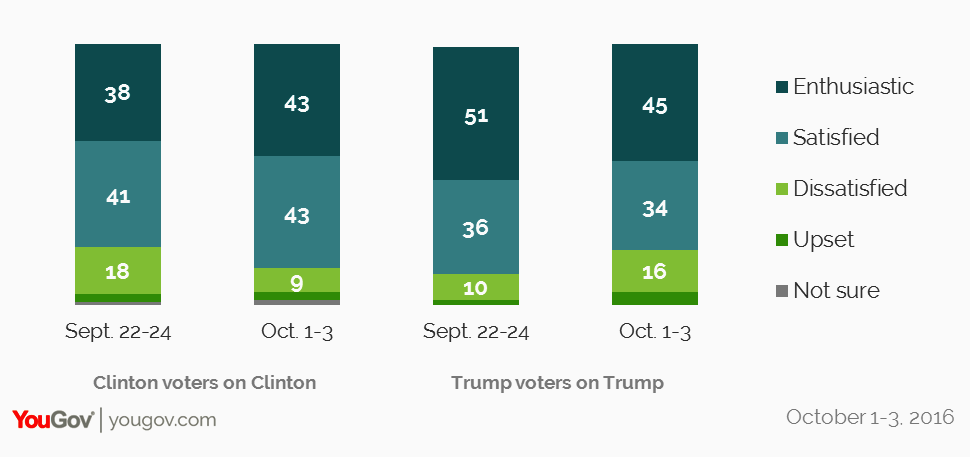
In the Sept. 22-24 poll, 38% of Clinton's supporters were enthusiastic about her. Now that is 43%. Dissatisfied voters have dropped from 18% to 9%. For Trump, the numbers have gone the other way. In Sept. 51% were enthusiastic, now that is 45%. Dissatisfied voters have grown from 10% to 16%. The poll also asked whether the respondent was confident or uneasy about the candidates' ability to handle terrorism, the economy, and immigration. Clinton and Trump scored about the same on all three items. (V)
Trump: I Was Being an Entertainer When I Insulted Women
Apparently Donald Trump's campaign manager, Kellyanne Conway, has convinced him that insulting women is not a good idea, given that they make up a majority of the voters, and that Hillary Clinton is running ads day and night featuring him saying sexist things. So yesterday he said: "A lot of that was done for the purpose of entertainment." He didn't specify who was being entertained. Many women were not amused. This explanation is not going to help a whit with women who feel insulted. (V)
Trump Preps for Debate...Maybe
An observer would be forgiven for thinking that the event Donald Trump held in New Hampshire on Friday was a practice run for Sunday's presidential debate. It was a town hall—something Trump almost never does. There was a moderator, and a two-minute timer, and questions from the audience. Gov. Chris Christie (R-NJ), who is fortunate that New Jersey apparently doesn't need much governing these days, was taking notes in the wings.
Despite appearances, Trump insisted that, "This isn't practice. This has nothing to do with Sunday." And whether or not he actually meant that, there was much truth in what he said, because whatever it is he was doing, it's not going to do much to prepare him for what's coming. To start, the moderator—conservative radio personality Howie Carr—is an unabashed Trump supporter. The same was true of the crowd, whose questions were all softballs. Among them:
- What advice would you give to young Americans looking to achieve the American Dream?
- What is your favorite childhood memory? Go Donald!
- What would you say to convince Hispanics who are deceived by Obama, Clinton and the biased media to vote for you?
Obviously, the crowd, moderator, and questions will not be so Trump-friendly on Sunday. Meanwhile, the candidate also struggled with timing on Friday. He routinely ignored the two-minute clock, and also failed to make it through the 90 minutes that were scheduled, scooting off the stage after 30 minutes. There will be no commercial or bathroom breaks on Sunday.
Trump did work on some aspects of his game, though. Specifically, his attack skills. He managed to slam, at various points, Sen. Mark Kirk (R-IL), journalists John King and and John Harwood, FiveThirtyEight's Nate Silver, the media, Latinos, and the Commission on Presidential Debates. The folks at the CPD may think Trump has forgotten about the microphone problem, but rest assured, he has not.
So, it appears that Trump's plan for debate number two is to wing it, not worrying about annoying things like policy details and world affairs, and instead spending most of his time taking shots at anyone and everyone who displeases him. The careful reader will notice that this is very similar to his plan for debate number one. And we all know how that worked out. (Z)
What Trump Needs To Do in Sunday's Debate
The Hill has drawn up a list of five things Donald Trump needs to do in Sunday's debate:
- Learn from Pence
- Be prepared
- Keep the fight on favorable ground
- Connect personally
- Watch out for interruptions and unforced errors
Making up lists is all well and good, and this one seems fine, but Trump rarely takes advice from anyone. We'll know soon if he is going to act differently in the second debate than he did in the first one. (V)
Clinton Readies a Final Push
In contrast to Donald Trump, who eschews preparation (see above), Hillary Clinton may be the most prepared candidate in history going into the final month. She had $150 million in the bank as of last week, and is now starting to spend it for voter registration, get-out-the-voter operations, and ads. Most of the money will go into Florida, North Carolina, Ohio, and Pennsylvania, with the emphasis on the first three. Final-month campaign blitzes are nothing new, but Trump has far less money on hand ($38 million), so the battle is going to be quite one-sided.
Clinton's ads are mixed: some are positive ads, praising her, and some are ads attacking Trump. Some ads will be in Spanish, in an attempt to get Latinos to actually vote, always a problem for Democrats. While blacks are the Democrats' most loyal constituency, some of them may not be motivated enough to vote, so Clinton is running ads starring Michelle Obama to get them excited. All in all, her operation is the exact opposite of Trump's: data-driven, carefully planned, and very well funded. But in such a strange year with such unpopular candidates, the best laid plans of rodents and humans can go astray. (V)
Six-year-old Wants to Ask a Question at the Town Hall Debate
A six-year-old girl, Sophie Cruz, wants to ask a question at the town hall debate on Sunday. Here is her question, which has been circulating on social media:
If you deport my parents, what happens to me? I am 6 years old and an American citizen. I have a 3 year old sister who is also an American.
For Hillary Clinton, the answer will surely be something to the effect that she is not going to deport the parents of young American citizens. For Donald Trump, there is no easy answer. He could suggest that little Sophie voluntarily go with her parents, but that is not likely to be a popular answer with Latino voters. If he says that her parents should put her up for adoption, much of the country will start attacking him within minutes. His best hope is that the question isn't asked. (V)
Hurricane Matthew Could Help Trump
Hurricane Matthew is bearing down on Florida's east coast. That is where most of the Democrats in the Not-So-Much-Sunshine-Right-Now State live:
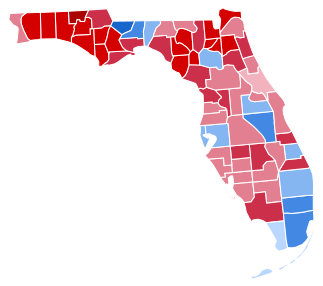
The map above (from Wikipedia), shows which party won each Florida county in 2012. If Miami-Dade, Broward, and Palm Beach Counties in southeast Florida take a direct hit, voting is going to be the last thing on anyone's mind for weeks. This could seriously depress Democratic turnout. Florida's west coast, which is strongly Republican, is likely to escape much devastation. Republicans are sure to say: "This is how God casts His vote." With that said, apparently it's "better safe than sorry." The Clinton campaign asked Gov. Rick Scott (R) to extend Florida's voter registration deadline (October 11) in view of the disaster, and he said no thanks, because "people have had time to register." (V)
How Millennials Describe the Candidates
The Harvard Institute of Politics ran a focus group of Philadelphia millennials while journalists watched. One supported Jill Stein, but the rest were torn. They like the Democratic platform. They just don't like the Democratic candidate. When asked to describe the candidates, some of the most common terms used were:
- Clinton: Career politician, experienced, shady but knowledgeable, untrustworthy but stable, hard working, corrupt
- Trump: All about himself, bully, evil, racist, misogynist, bigot, hot-tempered
- Johnson: Ignorant, uneducated, stoned
The young voters haven't really thought things through well. When someone brought up the question of the Supreme Court, a number of them suddenly realized that was important, and quickly decided Clinton was better than Trump on that score. (V)
Not All Evangelicals are For Trump
In American politics, "evangelical" tends to mean "religious, right-wing white person, probably from the South or the Midwest." Donald Trump has that demographic locked up. But there are other evangelicals in America, and a group of 80 leaders drawn from the latter segment has published an open letter reminding voters of that fact:
We believe that the centrality of Christ, the importance of both conversion and discipleship, the authority of the Scriptures, and the "good news" of the gospel, especially for the poor and vulnerable, should prevail over ideological politics, and that we must respond when evangelicalism becomes dangerously identified with one particular candidate whose statements, practice, personal morality, and ideology risk damaging our witness to the gospel before the watching world.
It's a pretty effective reminder that it really isn't the Christian religion that leads to the choice of Donald Trump. It's pure politics, even when we're led to believe otherwise. (Z)
Obama's Approval Rating Reaches New High
Republicans have been hammering on the idea that a vote for Hillary Clinton is a vote for President Obama's third term. That may not be a good idea. A new CNN/ORC poll puts Obama's approval/disapproval at 55%/44%, the highest point since his second term began. This is also the seventh consecutive month that his approval numbers have been above 50%. Obviously, if all of the people who approve of Obama vote for Clinton, she will win easily. What the Republicans need to do is drive a wedge between Obama and Clinton, but that won't be so easy since Clinton is clinging tightly to him. Furthermore, he is expected to begin serious campaigning for her soon. (V)
We Are in the Age of the Insta-Ad
There was a time when the equipment needed to make a TV commercial was not terribly common, and the lead time needed to get said commercial before an audience was very long. Not any more. With digital video, editing tools like Final Cut Pro and Premiere Pro, and the ubiquity of YouTube, today's screw-up can be tomorrow's attack ad. Sometimes, it doesn't even need to wait that long.
The story of the Alicia Machado ad is now well known. The ad was already in the can (or, more accurately, on the hard drive) when Clinton goaded Donald Trump into an exchange about the former Miss Universe near the end of the first presidential debate. Within 15 minutes of that moment, it was online for all to see; it's now been viewed over 10 million times. And as we pointed out yesterday, the Clinton campaign did something similar again on Monday night. Having sent Tim Kaine into the arena with orders to corner Mike Pence on Trump's most problematic statements, Clinton's ad-makers were ready and raring to go. Within hours of the debate's conclusion, they had posted a video entitled "Indefensible," which juxtaposes clips of Mike Pence saying one thing about Donald Trump, and Trump himself saying the opposite.
It is not just the Democrats' presidential candidate that is producing these insta-ads, either. In the New Hampshire senatorial candidates' debate, Sen. Kelly Ayotte (R-NH) blew it by calling Donald Trump a role model. She knew she blew it, so much so that she released a statement that night disclaiming the remark. Didn't matter; by the next morning her opponent Gov. Maggie Hassan (D-NH) had put up an ad composed of Donald Trump's "greatest hits" (as it were), bookended by the clip of Ayotte calling him a role model. Undoubtedly, Ayotte is rueing the day that Al Gore "invented" the Internet (actually, academic researchers invented it, funded by the DoD's Advanced Research Projects Agency).
With that said, whatever the parties gain in flexibility, they may lose in impact. With television, it was once very easy to deliver messaging to unfriendly or undecided voters. Today, that is considerably less true, thanks to time-shifting and the balkanization of TV viewers wrought by cable. The Internet and social media are even worse, since people tend to situate themselves in like-minded echo chambers. A campaign has to get people talking, and collect some "I'm curious" clicks, as happened with Alicia Machado. Otherwise, the Insta-Ads will just get lost among the sea of cat videos and video-game walkthroughs. (Z)
It's a Civil War at Fox News
At this point, nearly everyone has noticed that Donald Trump—a candidate who was once delighted to sit for an interview with the East Cupcake Elementary School Gazette—has now limited his one-on-one availability to only the friendliest of media outlets. That almost always means Fox News and, more specifically, Sean Hannity (or maybe Bill O'Reilly). Fox employee and Trump nemesis Megyn Kelly has definitely noticed. On her show Wednesday, she declared:
Donald Trump, with all due respect to my friend at 10:00, will go on Hannity, and pretty much only Hannity, and will not venture out to the unsafe spaces these days.
Kelly also made the same basic observation about Hillary Clinton, arguing quite correctly that neither candidate is well-served by avoiding outlets that may be more critical of them.
To nobody's surprise, Hannity was not happy. He defended his approach to Trump, saying that it's ok for him to be in the bag for The Donald, since he (Hannity) is an entertainer and not a journalist. Hannity also inadvertently revealed that he doesn't watch Kelly's program much, since he accused her of being a Hillary Clinton supporter, which she most certainly is not.
At this point, the obviousness of Trump's media strategy, coupled with this public airing of dirty laundry, has created some pretty bad optics for Fox News. The Washington Post's Erik Wemple declares:
The situation cannot last. It's unfair to Kelly that a fellow like Trump can manipulate a news network to avoid her scrutiny. And it's unconscionable that Hannity has so blithely trampled the industry's ethics code in procuring interview after interview with Trump. The I'm-not-a-journalist dodges excuse nothing: Fox News can't require one set of standards for certain programs while exempting "Hannity." ... Soon enough, the company will have to make a choice: Institute standards across its lineup, or say goodbye to a talent like Kelly, whose contract comes up for renewal in 2017. It may be too late to keep her.
The post-Ailes Fox has some very tough decisions to make, very soon. (Z)
Today's Presidential Polls
Lots of new polls today. The most interesting two are in Arizona, which appears to be very close. Clinton might even be a tad ahead. It will be interesting to see if she puts real resources into the state going forward. Florida is close, but the hurricane could affect the actual voting. The deadline for absentee ballot requests is Oct. 11, so alert voters who are thinking ahead can still get one, but it is doubtful that many will. Early voting starts between Oct. 24 and Oct. 29, depending on the county. (V)
| State | Clinton | Trump | Johnson | Start | End | Pollster |
| Arizona | 42% | 42% | 5% | Sep 28 | Sep 30 | OH Predictive Insights |
| Arizona | 44% | 42% | 9% | Oct 02 | Oct 04 | Emerson Coll. |
| Florida | 41% | 38% | 6% | Sep 27 | Oct 04 | U. of North Florida |
| Florida | 44% | 45% | 4% | Oct 02 | Oct 04 | Emerson Coll. |
| Indiana | 38% | 43% | 11% | Oct 03 | Oct 05 | Howey Politics Indiana |
| Massachusetts | 58% | 26% | 7% | Sep 24 | Oct 03 | Western New England U. |
| Maryland | 63% | 27% | 4% | Sep 27 | Sep 30 | U. of Maryland |
| Michigan | 43% | 32% | 10% | Oct 01 | Oct 03 | EPIC MRA |
| New Hampshire | 44% | 42% | 5% | Oct 03 | Oct 05 | Suffolk U. |
| Nevada | 43% | 43% | 9% | Oct 02 | Oct 04 | Emerson Coll. |
| Ohio | 44% | 43% | 5% | Oct 05 | Oct 06 | PPP |
| Rhode Island | 52% | 32% | 5% | Oct 02 | Oct 04 | Emerson Coll. |
| Tennessee | 33% | 44% | 7% | Sep 19 | Oct 02 | Vanderbilt U. |
Today's Senate Polls
Hillary Clinton's strategy of attacking Donald Trump but not the Republican Party seems to be having the effect that many supporters of Sen. Bernie Sanders (I-VT) feared. Voters are avoiding Trump but supporting Republicans downballot. In Arizona, Florida, Ohio, Nevada, and New Hampshire, Republicans are leading in Senate races even though Clinton is leading in the race for the White House. If Clinton wins but Republicans win the Senate, she may come to regret her strategy. And 2018 is certain to be a bad year for Senate Democrats, both due to the map and the expected low turnout. (V)
| State | Democrat | D % | Republican | R % | Start | End | Pollster |
| Arizona | Ann Kirkpatrick | 36% | John McCain* | 52% | Oct 02 | Oct 04 | Emerson Coll. |
| Florida | Patrick Murphy | 39% | Marco Rubio* | 47% | Oct 02 | Oct 04 | Emerson Coll. |
| Indiana | Evan Bayh | 42% | Todd Young | 41% | Oct 03 | Oct 05 | Howey Politics Indiana |
| Maryland | Chris Van Hollen | 58% | Kathy Szeliga | 29% | Sep 27 | Sep 30 | U. of Maryland |
| New Hampshire | Maggie Hassan | 41% | Kelly Ayotte* | 47% | Oct 03 | Oct 05 | Suffolk U. |
| Nevada | Catherine Cortez-Masto | 41% | Joe Heck | 45% | Oct 02 | Oct 04 | Emerson Coll. |
| Ohio | Ted Strickland | 36% | Rob Portman* | 51% | Oct 05 | Oct 06 | PPP |
* Denotes incumbent
Back to the main page