Pres polls: (None)
Dem pickups: (None)
GOP pickups: FL IA MI OH PA WI
Previous | Next
Trump's First Picks Thrill Hard-line Conservatives
When George W. Bush was elected president in 2000 by a margin of 5-4 in the all-important Supreme Court, after losing the popular vote, some observers thought he would have to govern from the center. He didn't. Similarly this time, despite losing the popular vote by over one million votes, Trump's first personnel choices indicate that he is not moving to the center at all, and fully intends to carry out his stated program.
His first cabinet-level picks are:
- Sen. Jefferson Beauregard Sessions III (R-AL) for attorney general
- Rep. Michael Pompeo (R-KS) to run the CIA
- Lt. Gen. Michael Flynn (ret.) for national security adviser
All of these will anger Democrats no end. Ronald Reagan nominated Sessions as a federal judge, and the Republican-dominated Judiciary Committee voted 'no' because the members felt he was too racist. Since he is currently a sitting senator and relatively popular with the other Republican senators, he will be confirmed easily this time. Many minorities fear that there will be little to no enforcement of the country's civil rights laws in the next four years. Flynn is also controversial, having said that Americans should fear all Muslims. No one has charged Pompeo with racism. All he did to get some publicity is co-author the House Benghazi Committee's minority report accusing Hillary Clinton of a cover-up.
Trump's earlier two picks were Steve Bannon as his chief political adviser and Reince Priebus as chief of staff. The only one of the five choices who is not wildly controversial is Priebus. (V)
Report: Mike Huckabee Will Be Ambassador to Israel
According to an unconfirmed report, former Arkansas governor Mike Huckabee, an evangelical Christian, will be the new ambassador to Israel. Like all of Trump's early choices, Huckabee was a strong supporter of Trump (after dropping out of the race himself). His first move is likely going to be moving the U.S. embassy to Jerusalem, which is certain to anger all the Arab countries, including those friendly to the U.S. Conservatives will be ecstatic about Huckabee and the move. (V)
Bannon: We're Really Going to Spend a Trillion Dollars on Infrastructure
Not all the news is so wonderful for conservatives, however. During the campaign, Donald Trump said he would spend a trillion dollars on infrastructure. Many people just thought that was typical Trump excess and it meant nothing. It turns out that Steve Bannon, Trump's chief political adviser, is the guy pushing this and pushing it hard. In an interview yesterday he said:
Like [Andrew] Jackson's populism, we're going to build an entirely new political movement. It's everything related to jobs. The conservatives are going to go crazy. I'm the guy pushing a trillion-dollar infrastructure plan. With negative interest rates throughout the world, it's the greatest opportunity to rebuild everything. Ship yards, iron works, get them all jacked up. We're just going to throw it up against the wall and see if it sticks. It will be as exciting as the 1930s, greater than the Reagan revolution—conservatives, plus populists, in an economic nationalist movement.
If Trump goes along with this and pushes as hard as Bannon, Speaker Paul Ryan (R-WI) is going to have a conniption. Small-government conservatives will go absolutely bonkers. Will they be able to stop Trump? Not so fast. There is a fairly good chance that the Democrats will embrace the plan, which could create millions of jobs. In the Senate, it would take only three Republican defections to get to 51 votes. Sen. Susan Collins (R-ME) and Sen. Lisa Murkowski (R-AK) would probably sign up. Only one more Republican senator would be needed, unless the Republicans decided to filibuster their own president, which would not lead to a happy president.
In the House, the Democrats would need to add 25 Republicans to the 193 Democrats to get to 218. That is probably doable. For example, if the plan includes a 300 MPH state-of-the-art train from Houston to Dallas, it might not be hard to find some Texas representatives from the Houston and Dallas areas that would vote for it. Likewise, representatives from other areas of proposed heavy spending might have a tough time voting against creating tens of thousands of jobs in their districts, in addition to the better infrastructure. If Trump really follows through and pushes hard for this, it is going to make conservatives extremely unhappy, even if they get a Supreme Court justice to their liking.
How might Trump spend a trillion dollars? An article in the New York Times suggests that since Trump always thinks big, rather than filling a pothole here and painting a bridge there, he might opt for massive projects to rival the Golden Gate Bridge and Hoover Dam. Here is the list of possible projects, with their estimated price tags:
- Hudson River rail tunnel ($24 billion)
- San Francisco to Los Angles high-speed train ($65 billion)
- Gordie Howe Bridge from Detroit to Canada ($2 billion)
- Clean up Lake Erie ($3 billion)
- 300-MPH train from New York to D.C. ($100 billion)
- Sea wall to protect Miami from rising seas ($20 billion)
- Putting I-70 underground in Colorado ($1 billion)
- Light rail from the D.C. metro system into Maryland ($6 billion)
- Dams to protect South Carolina from flooding ($1 billion)
- 300-MPH train from Houston to Dallas ($10 billion)
Projects of this scale would rival anything done by Franklin Delano Roosevelt and would shake up D.C. beyond belief, with Trump working with Democrats and being opposed by Republicans.
Or, maybe not. Ronald A. Klain worked for the Obama administration, overseeing the implementation of the President's infrastructure improvements from the 2009 American Recovery and Renewal Act. Klain, in an op-ed for the Washington Post, argues that the whole scheme is essentially a con. He observes that these projects are going to be funded through tax breaks given to developers and investors, as opposed to direct payments from the federal government. At very least, this will cause only the sexiest and most profitable projects to be funded, and not things that are arguably more necessary, like municipal water-system overhauls, repairs of existing roads, and replacement of bridges that do not charge tolls. Beyond that, however, it is probable that most of the money will go to projects that were already going to happen. In that case, the tax breaks would create no extra infrastructure and no new jobs at all, and would simply be a form of corporate welfare. When the plan comes up for a vote, looking at who votes for it should tell the tale. (V)
Trump Agrees to Pay $25 Million to Settle Trump University Lawsuits
One thing hanging over Donald Trump's head, like the sword of Damocles, was the group of lawsuits alleging fraud at Trump University. While Trump hates to settle, if the suits went to trial they would dominate the news for weeks and could be a fatal shot to his presidency. So, quite out of character, he decided to settle them for $25 million. The terms of the settlement give each plaintiff full restitution of the money paid to Trump, and he will pay a fine of $1 million to the State of New York for violating its education laws. If this goes through as announced, it will remove a potentially huge and embarrassing problem for Trump. (V)
WSJ to Trump: Liquidate
The Wall Street Journal, owned by Rupert Murdoch, is not exactly known as a bastion of left-wing thought. Further, they know a little bit about finance, and about politics. On Friday, they offered some unsolicited, but strongly worded, advice to Donald Trump: Liquidate. Now.
The problem, to use the Journal's words, is that, "If Mr. Trump doesn't liquidate, he will be accused of a pecuniary motive any time he takes a policy position." As we have previously noted, they are surely right about this. Indeed, we're less than two weeks into the Trump era, and there have already been issues, like Ivanka Trump wearing a $10,000 bracelet for her "60 Minutes" interview, and then hawking that same bracelet on her website the next day.
Needless to say, The Journal is tilting at windmills. It would not be easy for Trump to liquidate, even if he wanted to do so, which he does not. Meanwhile, he remains a widely-disliked politician who is looked upon with suspicion by the media, so it's going to be an ugly four years full of stories about this issue (among others). Wikipedia's list of Clinton administration controversies has 51 entries, while Obama's has 57, and George W. Bush's has a whopping 176. If Trump plays his cards right, he could leave the trio in the dust before the calendar turns to 2018. (Z)
Muslim Database Coming into Focus
Trump administration insiders insist that the database of Muslims is going to happen. And though The Donald has presented many different versions of what he has in mind, the likeliest scenario is a revival of the Bush-era National Security Entry-Exit Registration System (NSEERS).
So, how would it work? Well, NSEERS targeted males 16 or older from 25 "high-risk" countries. There was no religious specification, but 24 of the 25 countries were majority Muslim (North Korea was the only exception). Individuals coming to the United States from those countries were subject to fingerprinting, photo taking and interrogation. They had to check in regularly with the government, and were subject to fines and deportation for even the smallest of violations. The reason that NSEERS is a particularly appealing option is because the program is actually still in place, and has survived legal challenges from the ACLU and other groups. It was "deactivated" by removing all 25 countries from the watch list, which means that all Trump would have to do would be to put countries back on the list. Presumably, he would put enough majority-Muslim countries on the list to please his supporters, but enough non-Muslim countries on it (Guatemala? Nicaragua? Democratic Republic of the Congo?) to counter charges of Islamophobia.
How successful was NSEERS while it was in effect? Well, the fact that it was effectively deactivated gives some answer to that question. On its first go-round, the program successfully identified zero terrorists. This is hardly a surprise, given that most Muslim perpetrators of domestic terrorism are native-born Americans who became radicalized, as was the case with Florida shooter Omar Mateen and San Bernardino shooter Rizwan Farook. And speaking of becoming radicalized, NSEERS did have one identifiable impact: It damaged the government's relationship with Muslim communities, creating resentment and suspicion. In other words, it sowed the seeds that can easily grow into radicalism. And thus we have the great irony of the Muslim database: It may make some Americans feel safer, but, if anything, it will actually make them less safe. (Z)
Whither Ted Cruz?
There was a time in the distant past (a.k.a. five months ago) that Sen. Ted Cruz (R-TX) was Donald Trump's bitterest critic, up to and including a performance at the Republican National Convention in which the Senator went into the lion's den and ripped The Donald nine ways to Sunday. Now, however, Cruz is singing the President-elect's praises to anyone and everyone who listens, so much so that he's being described by some as Trump's lap dog.
There is no one who has so much as heard the name "Ted Cruz" that does not know what his real game is: He wants to be president, and he will do whatever it takes to achieve that goal. But the question is: What, exactly is his road forward? His rebel/maverick persona is dead, and Donald Trump has stolen his basic shtick and done it better. Consider the possibilities:
- Trump has a successful first term: In this case,
Trump may or may not secure re-election, but he will certainly secure
re-nomination.
- Trump has a disastrous first term: It's hard to
imagine that he could have a bad enough term to lose re-nomination, but if he
does, then certainly a "throw the bums out" mentality will be in full force.
Cruz, given his policy positions and his lapdoggery, would hardly be able to run
as the Republican anti-Trump any more.
- Trump is impeached and convicted, during either term: Mike Pence
would be Cruz's competition for the nomination. Pence has the same exact base
that Cruz does, and would have the advantages of being more telegenic, being
more authentic, and being the sitting president.
- Trump has a disastrous second term: He won't be
able to compete for the nomination in this case, but the "throw the bums out"
instinct should be even stronger. Again, Ted Cruz would be more of the same, not
something different.
- Trump has a successful second term: Again, Pence would be the prime competition for Cruz. And while he would not be the sitting president, he would still have the same base, more authenticity, better media skills, and higher name recognition.
In politics, of course, a week is a long time. And four years is a very long time (particularly the next four years, it would seem). But it's hard to concoct a scenario where Cruz has a realistic shot at the nomination before 2028. And by then, he will have been stepping on toes and ruffling feathers for 20 years, and his brand of evangelical-based populism may have been rendered non-viable by social and demographic changes. Unless the Senator manages to re-invent himself (a la the "New" Nixon), it is probable that Cruz's very best chance was 2016, and Donald Trump stole it right out from under his nose. He's a smart guy, and he presumably knows this, which may explain why he's loudly signaling his interest in being appointed to the Supreme Court. There, he could be the "Old" Cruz for as long as he wants, until he's literally the old Cruz. (Z)
Was Russia to Blame for Fake News?
There has been a lot of talk in the past few days (including on this site) about all the fake news stories that spread across social media during the election. Gedalyah Reback, who has covered international affairs for years, has connected the dots and he suspects that Russia might be behind many of them. Reback's case is circumstantial, but compelling. He observes the following:
- Russia does not like international cooperation or globalization
- To that end, they have planted false news in other countries in support of nationalist movements
- Donald Trump does not like international cooperation or globalization
- Russia certainly aided Trump with their hacking; why not with their propaganda operation?
One imagines that some enterprising reporters will be looking into this further, and that there's a very good chance they will come up with a smoking gun (or six). The real question is: Will Trump's base care? The evidence so far suggests that Russia was anathema to their parents or their grandparents, but not to them. After all, the Cold War has been over for almost 30 years. (Z)
Democrats Hit New Low in State Legislatures
Not only did the Democrats lose the presidential race and fail to capture either the Senate or House (although they picked up two seats in the Senate and six in the House), they were wiped out in the state legislatures as well. In the elections this month, Democrats lost another 46 seats to the Republicans, in addition to all the seats they have lost during the Obama administration. Democrats now occupy 3,129 seats in the state legislatures to the Republicans' 4,170. Here is a chart showing how the two parties have done since 2009 in terms of seats in the state legislatures:
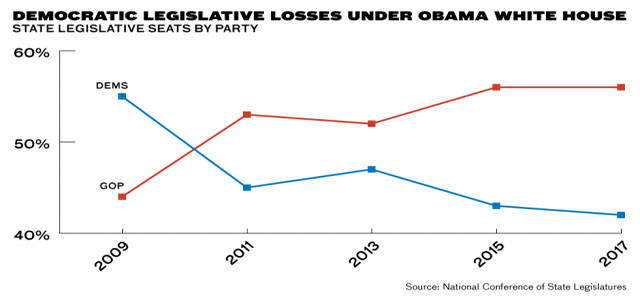
Independents and minor parties have 71 seats, including the entire unicameral nonpartisan Nebraska state legislature. A dozen seats are still too close to call. The huge Republican gains since 2009 occurred in 2010, when they picked up 700 seats, and in 2014, when they picked up another 300 seats. The reason for their gains is simple: Tens of millions of Democrats didn't bother to vote in the mid-term elections.
Starting in January, Republicans will control 67 of the 98 partisan legislative chambers. Since Obama took office, the Democrats have lost control of 27 chambers. The Republicans now control more seats in state legislatures than at any other time since the Republican party was founded in 1856.
And there is more good news for the Republicans. In 2017, at least 33 of the nation's governors will be Republicans. One (Bill Walker of Alaska) is an independent and the North Carolina gubernational race hasn't been decided yet. As a result, the Republicans will have trifectas (control of both houses of the state legislature and the governor's mansion) in at least 25 states (with North Carolina still up in the air). Democrats will control just six states. Eighteen states will have split control. Here is the map showing the trifectas:
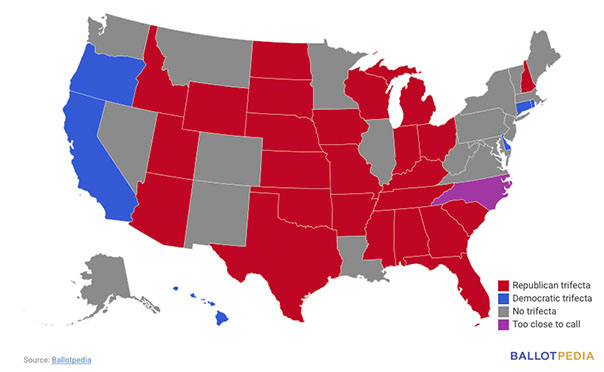
Any way you look at it, this is the golden age for the Republican Party. It controls the White House, both chambers of Congress, a large majority of the state legislatures and a large majority of the governors' mansions. The only downside is that now the party has to deliver. It will be hard to blame the Democrats for failure when the Republicans own nearly the entire show. (V)
Back to the main page