Previous | Next
GOP Candidates Play Nice in Miami
Oh, those Republicans. Just when you think you've got them figured out, they throw a curve ball. The stage was set for carnage at a level that would have put Freddy Krueger to shame. Instead, Donald Trump, Sen. Marco Rubio (R-FL), Sen. Ted Cruz (R-TX), and Gov. John Kasich (R-OH) decided—reportedly, by prearranged agreement—to hold a grown-up debate. So, there was no name calling, no shouting, and limited talking over one another. "I cannot believe how civil it's been up here," noted Trump, early in the debate.
The "no fighting" agreement meant that the debate was rather dry. The four candidates covered the standard issues—the Middle East, Common Core, tax policy, and so forth. Twelve debates in, well, there's nothing here we haven't heard before if Trump, Cruz, and Rubio aren't going to yell at one another or talk lovingly about their anatomy.
Embracing civility also meant that the winners of the evening were decided before the candidates even set foot on stage. Rubio isn't the brawler that Cruz and Trump are. With them neutered, and with the debate taking place in front of Rubio's home crowd, he was pretty much assured of having a good night, and he did. Meanwhile, a low-key debate is all but certain to maintain the status quo. Since the status quo is Donald Trump is the frontrunner, it means that he too was a winner before a single question had been asked. It is instructive that the none of the Republican voters in CNN's focus group said that the debate had changed their vote.
The next GOP debate is 10 days away. By then, another one (or two) of the candidates will presumably have bitten the dust. Meanwhile, who knows what Trump and Co. will cook up to keep viewers on their toes. Maybe they can do debate number 13 entirely in interpretative dance—that would certainly make for must-see TV. (Z)
Democratic Debate Postmortem
There was just enough time to scribble down a few thoughts about the evening that Hillary Clinton and Sen. Bernie Sanders (I-VT) had in Miami before the commentariat had to gear up for the Republican showdown Thursday night. Here are the reviews:
Left-leaning commentatorsMatthew Yglesias, Vox Winners: Sanders, Republicans. Losers: Clinton, Univision, Voters who care about immigration. "This debate was a mess, starting with the fact that Sanders's microphone didn't work at the beginning through to disastrous audio mixing on the simultaneous translation that often left neither the Spanish nor English audible. But the problems went well beyond technical issues. The moderators opened the debate with two process questions in a row, and repeatedly went back to the well of faux hardball questions rather than illuminating ones."Right-leaning commentators
Aaron Blake, WaPo Winner: Clinton, Bernie Sanders' suit, Ted Kennedy, the moderators. Loser: Sanders' chances at the nomination, Clinton's attacks, senators. "This was Sanders's chance, after a big win in Michigan, to change the course of the race. And he was aggressive. He tried. He's getting better. He even handled a very tough question (in South Florida, no less) about his past praise for Fidel Castro. But he didn't do anything to change the fact that Clinton remains the overwhelming favorite to win the Democratic nomination."
Mark Halperin, Bloomberg Winners: Sanders, Clinton. Loser: None. "In the wake of Sanders' Michigan victory and continued fundraising prowess, both candidates (along with the supporters who cheer for them and the reporters who cover them) seemed resigned to prolonged political trench warfare."
Glenn Thrush, Politico Winner: None. Loser: None. "It's time to look past the sartorial sloth to see the political steel in Bernard (no middle name) Sanders. There is no more disciplined candidate in the 2016 field than the 74-year-old Vermont senator—none—and a quick scan of the transcripts of recent debates reveals his metronomic recitation of succinct anti-Clinton attack phrases repeated over and over and over with deadly, aw-shucks efficiency."
Eric Ortiz, TruthDig Winner: Sanders. Loser: Clinton. "Hillary Clinton is the establishment candidate. Bernie Sanders is the anti-establishment candidate. Buckle up: The ride is going to get bumpy if the American people continue to go against the mainstream media, as they did in Michigan."
Ben Geier, Fortune Winner: Clinton. Loser: Sanders. "Clinton held her ground. She still seems presidential, and she did a good job of standing up to Sanders when he directly attacked her record."Foreign commentators
Jazz Shaw, HotAir.com Winners: The Moderators. Losers: Clinton, Sanders. "Outrageous claims of things that never happened were layered in with bold boasts and promises which can never be fulfilled."
Ben Kamisar, The Hill Winner: None. Loser: None. "The Democratic debates may lack the off-color and personal barbs seen on the GOP side of the aisle, but it's becoming clear that the two Democrats are starting to get exasperated with one another."
Caleb Howe, RedState.com Winner: None. Loser: Everybody, Benghazi families. "Hillary ducked, dodged, and generally was belligerent on the [Benghazi] issue, just as she always is. Of course, such things don't matter to the Democrats in the audience."
Peter Weber, The Week Winner: Univision. Loser: None. "Sanders has been in politics for longer than Clinton, and he doesn't come across as much of a natural politician, either. Voters say they want honesty and candor in their candidate, especially this year. Sanders has that in spades—this Castro moment will be one test of whether that authenticity will help him or hurt him at the ballot box."
Scott Bixby, The Guardian (UK) Winner: None. Loser: None. "Bernie Sanders does a decent Donald Trump impression."
Cristina Silva, International Business Times Winner: Clinton. Loser: Sanders. "While Sanders was quick to highlight's Clinton weaknesses such as her relationship to Wall Street and vote to launch the Iraq war, those issues haven't helped him in contests so far, and he seemed to come up short in showing Latino voters he would be the better ally."
Lexington, The Economist Winner: Sanders. Loser: Clinton. "On some big questions, and especially on immigration, [Clinton] gave in to pressure and staked out radical positions which she can expect to see played in Republican attack ads again and again, once the general election is under way.."
Across the thirteen outlets, the tally ends up like this:
Sanders: 4 wins, 3 losses
Clinton: 3 wins, 3 losses
Looks like it was a tie. And speaking of ties, Bernie Sanders' blue or brown suit lingered on into Thursday as one of the big stories of the night. Again, the voters are getting bored. The other big story was that the general testiness of the two candidates is showing, relative to their early encounters (though the Democratic debates remain positively kumbayah compared to the GOP events). Clearly, both are feeling the pressure, albeit for different reasons.
The fact checkers, including CNN, USA Today, Politifact, FactCheck, and WaPo came up with considerably more material than has been customary for the Democratic debates. Hillary Clinton had a particularly "fast and loose" evening, downplaying her missteps (e-mail server) and playing up her better moments (taking on Wall Street) a bit too much, while engaging in the shady tactic of cherry picking a Senator's voting record. Sanders had his missteps, too, including exaggeration about some of the more grim aspects of immigration and poverty. Both candidates also fumbled their history, with Clinton making incorrect statements about the Election of 2000 and Sanders doing the same about the Monroe Doctrine.
For Democratic debate fans, this is going to have to tide you over for a while, since the next candidates' debate is not even scheduled yet—could be in mid-April, could be in four years. Which of these it is going to be will get answered in the next few weeks. (Z)
Two New Polls Show Florida Republican Race Tightening
New polls from Suffolk University and from Wapo/Univision on the Florida Republican race show Donald Trump still in the lead, with Marco Rubio coming in second. The director of the Suffolk University poll, David Paleologos, said that Ted Cruz is killing Rubio in Florida by bleeding away his support. Here are the numbers.
|
|
|||||||||||||||||||||||||||||||||||||
This is a clear example of how Cruz is not a team player and why he is so hated by his colleagues in the Senate. If Cruz had stayed out of the Florida and Ohio races next Tuesday and concentrated entirely on North Carolina, Illinois, and Missouri, he might have let Rubio win Florida and Kasich win Ohio, helping to deny Donald Trump enough delegates to get the nomination on the first ballot. Instead of playing along with the Republican strategy, Cruz is fighting hard in Florida and Ohio, which is likely to hand Trump two key winner-take-all states and probably the nomination. Take one for the team is an unknown concept to Cruz. (V)
Trump Begins His General Election Campaign
With Rubio and Cruz shooting at each other, Trump is moving on and starting to campaign as if he is already the Republican nominee. He is now talking about being flexible in immigration policies (English translation: Wall? What wall? Deport people? Why would I do that?). He says it is important to respect women. He thinks party unity is very important. In other words, "Forget everything I have said so far and meet the new, improved Donald Trump." Kevin Madden, one of Mitt Romney's 2012 advisors, said: "This is beyond Etch-a-Sketch. It is more like Transformers." Trump is betting on the American public having the memory of a flea, allowing him to erase everything he has said for a year and do a complete reboot. The Democrats' oppo research teams might have something to say about that. (V)
Cruz Finally Gets a Senate Endorsement
It can no longer be said that all 99 of the other members of the Senate hate Ted Cruz. One of them endorsed him yesterday. The endorser, Sen. Mike Lee (R-UT), is one of the strongest tea party politicians in Washington. It is unlikely that Lee will be able to help Cruz's campaign much, though, other than Cruz now being able to point out that he is not hated by every politician in Washington. (V)
Most of the Candidates Are Not Very Popular
With the exceptions of John Kasich and Bernie Sanders, none of the candidates have a net positive rating among registered voters. Here is the bad news.
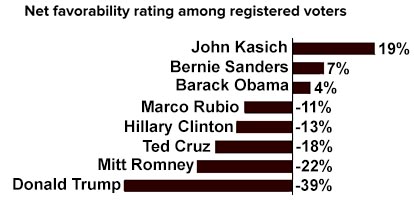
Trump's -39 score is the lowest in history for a major presidential candidate. No doubt the endless attacks for the past year have something to do with this.
Candidates were not always unpopular. In March 2000, for example, George W. Bush was +13% and Al Gore was +12%. In March 2008, John McCain was +20%, Barack Obama was +17%, and Hillary Clinton was +2%. And just wait until the mud flies in the general election campaign. (V)
Obama's Approval Ratings Hit Three-Year High
According to Gallup, exactly half of Americans currently approve of the job that President Obama is doing. That's a three-year high for him, and is also above average for his presidency as a whole.
At first glance, this would seem to be good news for the Democrats, particularly frontrunner Hillary Clinton. The higher the president's job approval, the more likely the voters will want more of the same, as opposed to wanting to toss the bums out. Obama is within shouting distance of 53 percent approval, which many political scientists see as a slam dunk for a party seeking a third term in the White House.
But, not so fast. The Politico article argues that the President's approval is on the rise because he's being compared to those who would replace him—Clinton and Trump, particularly—and in that analysis, he comes off looking not so bad, after all. If that's really what is going on (though it would be hard to prove one way or another), then that would most certainly not be good news for Clinton, since it would imply that she is not, in fact, seen as Obama II. Whatever the case may be, it remains the case that she is well served to keep hitching her wagon to the President. (Z)
Ryan: What Part of "No" Do You Not Understand?
A new super PAC aimed at drafting Speaker Paul Ryan (R-WI) as a presidential nominee (presumably at a brokered convention) is collecting money for him. Ryan was not pleased and had his lawyer send the group a cease-and-desist letter, saying they were violating federal law. Ryan has repeatedly said he has no interest in running for President this year. This poses something of a problem for the Republican leaders, who want to dump Trump at a brokered convention. If they somehow manage to keep Trump from getting 1,237 votes on the first ballot, they will need a strong candidate to coalesce around on the second ballot and it probably won't be Ryan. Maybe the Party has some "Romney for President" signs left over from last time, though. (V)
Carson to Endorse Trump
Though he hasn't been a viable candidate in months, and he hasn't been a candidate of any sort for a week, Ben Carson is doing an excellent job of keeping his name in the headlines. And he made front pages across the country when he issued forth, on Thursday, with the surprise that he plans to endorse Donald Trump today.
Given that Trump laid into Carson a fair bit earlier in the campaign, primarily over falsehoods in the doctor's biography, some observers presumed that Carson's support would go to fellow evangelical Ted Cruz. He's not very likable, however, and he's also a huge underdog. Trump, by contrast, seems to be popular fellow, is the frontrunner, and is—like Carson—an outsider. In any event, the major effect of the news is that one wild card that might have allowed Cruz to catch up to Trump is now gone. (Z)
Politics is Messing Up Trump and Clinton's Friendship
No, not that Trump and no, not that Clinton. Ivanka Trump (34) and Chelsea Clinton (36) are real-life good friends and are often spotted palling around together in Manhattan. They have a number of things in common, including being rich, growing up in the spotlight, having fathers who very publicly cheated on their mothers, being married to Jewish businessmen, and having young children. But the epic battle brewing between their parents, King Kong and Godzilla, makes it hard for them to continue, especially when The Donald keeps bringing up Bill Clinton's affair with Monica Lewinsky. Team Hillary is sure to respond sooner or later with Trump's very public affair with Marla Maples while he was still married to Ivanka's mother. Maybe after it is all over, they can get back together again. (V)
Back to the main page