Previous | Next
New Layout Starting Today
Editorial note: starting today, the top part of the page will be different. In the blue bar, we will report the delegate counts. Right now different media outlets have different counts. It's all still in flux. We have attempted to get the latest count for each state, but that will certainly change later in the day. Going forward we will use the Real Clear Politics count. But note that in the future, media outlets can differ slightly, depending on how caucus results (which only elect delegates to the county caucuses, not the convention) are interpreted. Also tracking the Democratic superdelegates and Republican RNC delegates is not an exact science. The "Needed" columns show how many delegates are needed for the nomination in each party. The Democratic convention has almost twice as many delegates as the Republican one, so almost twice as many delegates are needed.
In addition, on the map, states that have already voted will be shown in gray. In a few cases, the Democratic and Republic nominating contests are on different days. For those states, the coloring corresponds to the Republican one, since that is more in doubt than the Democratic one. (V & Z)
Here Are the Maps of Who Won in Which State
To get an overview of the Super Tuesday results, here is a map of which candidate won in which state.
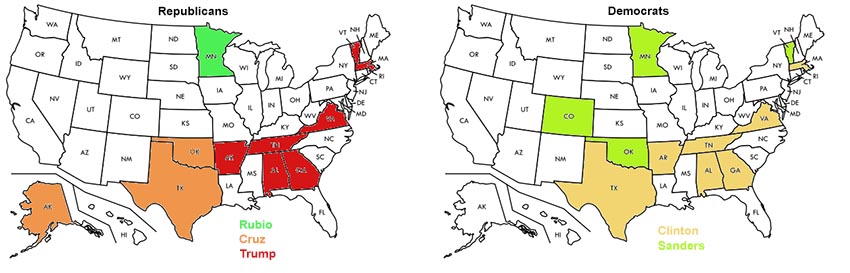
In short, no big surprises this time. The polls were pretty good and for the most part predicted the winners fairly accurately. (V)
Big Night for Trump
Another 11 states' worth of Republicans went to the polls on Tuesday and The Trump Express picked up more steam, taking seven of the 11: Alabama, Arkansas, Georgia, Massachusetts, Tennessee, Vermont, and Virginia. Here are the numbers with 100% of the votes in; TX-20 and TN-9 require recounts, so the three delegates to be awarded for each of those districts are still pending:
| |
||||||||||
| |
|
|
|
|
|
|||||
| State | |
|
|
|
|
|
|
|
|
|
| Texas | 26.9% | 46 | 43.7% | 100 | 17.6% | 6 | 4.2% | 0 | 4.1% | 0 |
| Georgia | 38.8% | 43 | 23.6% | 15 | 24.6% | 18 | 5.6% | 0 | 6.2% | 0 |
| Tennessee | 38.9% | 31 | 24.7% | 10 | 21.2% | 14 | 5.3% | 0 | 7.6% | 0 |
| Alabama | 43.4% | 36 | 21.1% | 13 | 18.7% | 1 | 4.4% | 0 | 10.2% | 0 |
| Virginia | 34.7% | 17 | 16.9% | 8 | 31.9% | 16 | 9.4% | 5 | 5.9% | 3 |
| Oklahoma | 28.3% | 14 | 34.4% | 16 | 26.0% | 13 | 3.6% | 0 | 6.2% | 0 |
| Massachusetts | 49.0% | 21 | 9.6% | 4 | 17.9% | 8 | 18.1% | 8 | 2.6% | 1 |
| Arkansas | 32.7% | 16 | 30.5% | 15 | 25.0% | 9 | 3.7% | 0 | 5.7% | 0 |
| Minnesota | 21.2% | 8 | 28.9% | 13 | 36.8% | 17 | 5.8% | 0 | 7.2% | 0 |
| Alaska | 33.5% | 10 | 36.4% | 10 | 15.1% | 4 | 4.1% | 0 | 11.0% | 0 |
| Vermont | 32.7% | 8 | 9.7% | 0 | 19.3% | 0 | 30.4% | 8 | 4.2% | 0 |
| Total | 250 | 204 | 106 | 21 | 4 | |||||
At first glance, it may seem that Trump had a middling night, since he certainly did not put the race out of reach, and he only outpaced Sen. Ted Cruz (R-TX) by 46 delegates. But first place is still first place and, more importantly, he was competitive everywhere: Big and small states, conservative and liberal, Southern and Northern. His worst result, and his only third-place finish, was in Minnesota and he still did well enough even there to take some delegates.
Cruz, meanwhile, avoided the embarrassment of losing his home state, and in fact won there quite convincingly, while also taking Oklahoma and Alaska. Once the Texas result was in, he delivered a speech in which he crowed about his win and called on any Republican that had not won a state to drop out. At the time he made that declaration, that would have left it a two-man race between Cruz and Trump. And undoubtedly, Cruz will spin Tuesday's result as vindication of his oft-repeated assertion that he is the only person who can dethrone Trump. Don't believe it; it's an illusion created, quite obviously, by the fact that he played the biggest, juiciest ace in the hole that any candidate has this cycle: A huge home state with lots of delegates. If Florida, or California, or New York was the "big prize" on Tuesday rather than Texas, Cruz would have finished a distant third. And since Canada doesn't get to pick the U.S. president, Cruz won't be getting any further hometown bonuses. Meanwhile, consider the four states he has actually won:
- Iowa. Small, idiosyncratic caucus state.
- Texas. Home state.
- Oklahoma. Ultraconservative, only state never to give a county to Barack Obama.
- Alaska. Small, ultraconservative. Gave us Sarah Palin.
So, in states that are ideally suited to his philosophy and his skills as a political strategist, Cruz can eke out a victory. States that are even a little bit removed from the far right end of the spectrum (Georgia, Alabama), he loses. States that are centrist or left-leaning (Virginia, Massachusetts, Vermont), he loses big time. There are 35 states left to go; how many of them can Cruz conceivably win? In how many of them can he even put up a good fight? A few of the mountain west states (Idaho, Wyoming, Utah) and perhaps Kansas and Mississippi, and that's about it.
Late in the evening, Marco Rubio finally got into the win column, taking Minnesota to the bank. Ted Cruz was presumably as surprised as anyone, given the speech he'd delivered just an hour earlier. He probably shouldn't have been; this is a state that once elected a professional wrestler governor, after all. This means that Rubio technically no longer deserves the "can't win a state" label. However, his finish in the delegate count was a pretty dismal third, and he was roundly trounced by Trump or Cruz (or both) in most states. He desperately needs to win Florida, and if the polls are right, he's not going to do so.
Gov. John Kasich (R-OH) proved that he can do well in New England, adding second-place finishes in Massachusetts and Vermont to his second-place finish in New Hampshire. If this were the election of 1796, when New England made up half the country, that might get the job done. But we're no longer in the eighteenth century, no matter what Ted Cruz's dad might say. Sorry, John.
The good news for Ben Carson is that he doubled his delegate total on Tuesday. The bad news is that means he's now up to eight. His own campaign staff says he has no path to the nomination, but Carson says prayer will take care of everything. Maybe God will deliver what GOP strategist Rick Wilson says will be needed: "A meteor has to kill Trump, Cruz and Rubio, and John Kasich has to get mauled by a wolverine." While we wait for that to happen, GOP leadership plans to pressure Carson to drop out and run for Florida's senate seat instead.
The GOP candidates are going to have just 24 hours to digest and spin the results, and then it will be time for another debate and another five states (Wyoming, Kansas, Kentucky, Louisiana, Maine) to cast their Republican votes on Saturday. (Z)
Big Night for Clinton, Too
It was a frontrunners' kind of night, as Hillary Clinton did as much to maintain her momentum as did Donald Trump. She too won seven states (along with one territory): Texas, Georgia, Massachusetts, Virginia, Tennessee, Alabama, Arkansas, and American Samoa. Here are the numbers; the last column shows delegates whose disposition is unclear due to breakdowns that are still pending (TX-16, TX-23, and TX-26, for example) or because of superdelegates that have not yet committed to a candidate:
| |
|||||
| |
|
|
|
||
| State | |
|
|
|
|
| Texas | 65.2% | 139 | 33.1% | 64 | 49 |
| Georgia | 71.2% | 84 | 28.3% | 28 | 5 |
| Massachusetts | 50.3% | 62 | 48.5% | 46 | 8 |
| Virginia | 65.3% | 75 | 34.8% | 33 | 1 |
| Minnesota | 38.3% | 44 | 61.7% | 47 | 2 |
| Colorado | 40.1% | 37 | 57.6% | 38 | 4 |
| Tennessee | 66.1% | 44 | 32.4% | 22 | 10 |
| Alabama | 77.8% | 48 | 19.2% | 9 | 3 |
| Oklahoma | 41.5% | 18 | 51.9% | 22 | 2 |
| Arkansas | 66.4% | 27 | 29.7% | 10 | 0 |
| Vermont | 13.5% | 4 | 86.1% | 19 | 3 |
| Democrats Abroad | N/A | 2 | N/A | 0 | 15 |
| American Samoa | 68.3% | 7 | 25.7% | 3 | 0 |
| Total | 588 | 341 | 101 | ||
Clinton's biggest surprise of the evening, and arguably her most important win, was in Massachusetts. It wasn't by a huge margin, but it represents another big hole in Sen. Bernie Sanders' (I-VT) "she's only a regional candidate" argument.
Sanders had a nice night, meanwhile, taking his home state in a massive landslide, while also grabbing Minnesota, Colorado, and Oklahoma. That said, a careful look at the numbers also reveals some pretty bad news. He continues to get absolutely crushed in states with large numbers of black voters. Just as important, when he does win a state, he wins by a huge margin. His four victories Tuesday were by 10, 17, 24, and 73 points. But he is running out of liberal states. The rest are pretty mainstream. And remember, Clinton beat Obama in nearly all the big blue states in 2008 and Sanders is probably not as strong a candidate as Obama was. In any event, turnout for him has not rivaled Obama's pace in 2008. The math is already looking dreary enough that the headline on Politico is: "Clinton's new problem: How to let Bernie down easy."
Like the GOP candidates, Clinton and Sanders will only have a short time to catch their breath. Kansas, Louisiana, Maine, and Nebraska Democrats will be voting later this week, and the Flint, MI debate is on Sunday. (Z)
Winners and Losers
Lots of news sites have lists of winner and losers. Here are a few, briefly summarized. First, Niall Stanage writing in The Hill.
Winners- Donald Trump. He won nationally and Rubio flubbed. Trump will be hard to stop now
- Hillary Clinton. It's all over but the shoutin'. She will now focus on Trump, not Sanders
- Ted Cruz. He's back from the dead and probably the Party's only hope to stop Trump
- Chris Christie. By being the first major figure to back Trump, he could get a nice job if Trump wins
- Marco Rubio. By winning only one state out of 15 so far he is now facing gale-force winds
- Bernie Sanders. Winning four states was nice but he lost Massachusetts. He won't give up but he won't win
- John Kasich. He will face even more pressure to drop out now, but he won't until Ohio votes
- The Republican establishment. This is the worst of all possible worlds, with Trump and Cruz #1 and #2
- Mitt Romney. He said that Trump's tax returns could contain a bombshell. Nobody cares what he says
- Ben Carson. There is simply no rationale for him to remain in the race
Now the Washington Post's Chris Cillizza.
Winners- Hillary Clinton. It's (close to) all over. Now it is all about how she negotiates the peace treaty with Sanders
- Donald Trump. He will certainly have the most delegates in the end but will he have more than half?
- Ted Cruz. All of a sudden, he could become the Great White Hope, even though his party hates his guts
- Liberals. A majority of Democrats in all states that voted yesterday call themselves "liberals"
- Political junkies. The great white whale—a brokered convention—might have been dimly seen on the horizon
- Marco Rubio. If you want to be the nominee, you need to do better than 1 in 15
- Bernie Sanders. The narrative hasn't changed. Clinton is still marching to the nomination
- The Republican establishment. They fear Trump and loathe Cruz. They're between a rock and a hard place
- Chris Christie. He looked awkward behind Trump. He's not used to playing second fiddle
- Fairfax County. For a rich and educated county, it took forever to count the votes. Shame
Tom Bevan of Real Clear Politics, a right-wing news site, also chimed in. Here is his take.
Winners- Donald Trump. It was expected but still impressive. He is the odds-on favorite now and has all the momentum
- Hillary Clinton. She is a shoo-in now, barring some catastrophic event
- Ted Cruz. He is in second place now in wins and delegates and could be Trump's only competiton
- African-Americans. Their collective muscle drove Hillary Clinton to huge wins in the South. She won't forget them.
- Marco Rubio. The win in Minnesota salvaged an otherwise terrible night. He better win Florida or it's all over
- The GOP establishment. They are now past denial and into full-blown panic. That gaping sound is the big schism
- Ben Carson. To be a loser, you have to actually play. Ben? Ben? Are you there? Ben?
In short, Hillary and Donald came out on top and the Republicans now have an elephant-sized problem. The two frontrunners are both totally unacceptable to the party leadership. They pray for a brokered convention. There is no Plan B. We might add that the pollsters were also winners. There were no surprises. The polls were largely on target. (V)
Paul Ryan Issues Pro Forma Denunciation of Trump
House Speaker Paul Ryan denounced Donald Trump yesterday for not being sure if he wanted KKK Grand Wizard David Duke's support. He said:
If a person wants to be the nominee of the Republican Party, there can be no evasion and no games. They must reject any group or cause that is built on bigotry. This party does not prey on people's prejudices. We appeal to their highest ideals. This is the party of Lincoln.
Noble words, but Ryan knows it will have no effect at all. He had to go through the motions because if he didn't, the Democrats would attack him for not doing so. Ryan's predicament is that neither he nor any other Republican leader has any idea what to do about Trump. Nor can they predict what he might say next so they can't even make plans.
In fact, the leadership can't even unite on a single opponent to take Trump down. Many Republicans are gingerly gravitating towards Rubio, but they all know that if he loses the Florida primary to Trump, he will be toast. If Kasich wins Ohio, maybe they can switch horses and back him, but he is currently polling around 5-6% nationally, so that is also a risky bet. Ryan basically doesn't know what to do other than be against bigotry. It's not much, but it is all he's got right now. (V)
New York Court Declines to Throw Out Trump University Fraud Case
New York Attorney General Eric Schneiderman has alleged that Trump University defrauded students using a bait and switch scam. Trump lawyers argued that the case had expired under the statute of limitations. Yesterday a state judge ruled that the case could go forward. A similar case is underway in California and is expected to go to trial in August. No date has been set for the trial in the New York case. Being on trial for fraud in two states is not something Trump wants in the middle of a presidential campaign, but like Hillary Clinton's email server, this issue could linger for a very long time. (V)
Kasich Rules Out Running for Vice President
Once again, John Kasich ruled out running for Vice President. As he put it: "Zero chance, just stop there. Zero chance." Many observers have speculated about a Trump/Kasich ticket or a Rubio/Kasich ticket. Such a Shermanesque statement seems to rule that out, however. The attraction of a Rubio/Kasich ticket is that Rubio is from Florida and Kasich is from Ohio, the two biggest swing states. But it sounds like Kasich really means it. A Trump/Christie ticket covers New York and New Jersey, two states the Democrats will win by huge margins. (V)
New Hampshire Union Leader Apologizes for Endorsing Christie
When New Hampshire's biggest newspaper, the Union Leader, endorsed Gov. Chris Christie (R-NJ), a lot of people saw that as an omen that Christie could win New Hampshire. He didn't. He came in sixth and got no delegates. Yesterday the paper published an editorial apologizing for the endorsement. The publisher, Joseph W. McQuaid, was incensed that Christie endorsed Donald Trump, the man McQuaid wanted Christie to beat. McQuaid said that by making the endorsement Christie had betrayed the very principles of his campaign that had attracted the paper's support. (V)
Could Trump Run as an Independent?
The Republican leadership is not happy with yesterday's results and desperately wants to stop Donald Trump in his tracks. Their next opportunity will be March 15, Mini-Tuesday, when Florida, Ohio, Illinois, North Carolina, and Missouri vote. If the Trump bandwagon continues to roll, the only way to stop him may be to aim for a brokered convention. One small weapon the party has are the 168 members of the Republican National Committee, all of whom are voting delegates at the convention (analogous to the Democrats' superdelegates, but less numerous). They could all be instructed to vote for a non-Trump candidate of their choosing to help force a second ballot. If Trump were to lose on the second or subsequent ballot, he might be furious at being denied the nomination by parliamentary trickery, especially if he has a large plurality of the delegates. He might decide to tear up his promise to the Republican Party not to do so and run as an independent anyway. The promise has no legal force. It is merely a contract between private parties. In principle, the RNC could sue Trump for breach of contract but that case could drag on for 3 or 4 years.
Suppose Trump decided to run as an independent. Could he do it? You might be thinking: "Sure, he has enough money." That's true, but a bigger issue is each state's filing deadline. If you don't file on time, you can't run. Here are the deadlines according to Ballotpedia.
| State | Deadline | Signatures | EVs | Possible EVs |
| Texas | May 9 | 79,939 | 38 | 538 |
| North Carolina | June 9 | 89,366 | 15 | 500 |
| Illinois | June 27 | 25,000 | 20 | 485 |
| Indiana | June 30 | 26,700 | 11 | 465 |
| New Mexico | June 30 | 15,388 | 5 | 454 |
| Nevada | July 8 | 5,431 | 6 | 449 |
| Georgia | July 12 | 49,336 | 16 | 443 |
| Delaware | July 15 | 6,500 | 3 | 427 |
| Florida | July 15 | 119,316 | 29 | 424 |
| Oklahoma | July 15 | 40,047 | 7 | 395 |
| South Carolina | July 15 | 10,000 | 9 | 388 |
| Michigan | July 21 | 30,000 | 16 | 379 |
| Washington | July 23 | 1,000 | 12 | 363 |
| Missouri | July 25 | 10,000 | 10 | 351 |
| Arkansas | Aug. 1 | 1,000 | 6 | 341 |
| Kansas | Aug. 1 | 5,000 | 6 | 335 |
| Maine | Aug. 1 | 4,000 | 4 | 329 |
| Maryland | Aug. 1 | 38,000 | 10 | 325 |
| Nebraska | Aug. 1 | 2,500 | 5 | 315 |
| New Jersey | Aug. 1 | 800 | 14 | 310 |
| Pennsylvania | Aug. 1 | 25,000 | 20 | 296 |
| Vermont | Aug. 1 | 1,000 | 3 | 276 |
| West Virginia | Aug. 1 | 6,705 | 5 | 273 |
| Massachusetts | Aug. 2 | 10,000 | 11 | 268 |
| South Dakota | Aug. 2 | 2,775 | 3 | 257 |
| Wisconsin | Aug. 2 | 2,000 | 10 | 254 |
| Alaska | Aug. 10 | 3,005 | 3 | 244 |
| Colorado | Aug. 10 | 5,000 | 9 | 241 |
| Connecticut | Aug. 10 | 7,500 | 7 | 232 |
| Hawaii | Aug. 10 | 4,347 | 4 | 225 |
| New Hampshire | Aug. 10 | 3,000 | 4 | 221 |
| Ohio | Aug. 10 | 5,000 | 18 | 217 |
| Washington D.C. | Aug. 10 | 4,600 | 3 | 199 |
| California | Aug. 12 | 178,039 | 55 | 196 |
| Utah | Aug. 15 | 1,000 | 6 | 141 |
| Montana | Aug. 17 | 5,000 | 3 | 135 |
| Alabama | Aug. 18 | 5,000 | 9 | 132 |
| Tennessee | Aug. 18 | 275 | 11 | 123 |
| Iowa | Aug. 19 | 1,500 | 6 | 112 |
| Louisiana | Aug. 19 | 5,000 | 8 | 106 |
| Minnesota | Aug. 23 | 2,000 | 10 | 98 |
| New York | Aug. 23 | 15,000 | 29 | 88 |
| Idaho | Aug. 24 | 1,000 | 4 | 59 |
| Virginia | Aug. 26 | 5,000 | 13 | 55 |
| Oregon | Aug. 30 | 17,893 | 7 | 42 |
| Wyoming | Aug. 30 | 3,302 | 3 | 35 |
| North Dakota | Sept. 5 | 4,000 | 3 | 32 |
| Arizona | Sept. 9 | 36,000 | 11 | 29 |
| Kentucky | Sept. 9 | 5,000 | 8 | 18 |
| Mississippi | Sept. 9 | 1,000 | 6 | 10 |
| Rhode Island | Sept. 9 | 1,000 | 4 | 4 |
[Note: On dates with multiple states having deadlines, the last column shows what is possible if Trump goes after the states in alphabetical order and makes some and misses the others, but this is a minor point.]
Suppose by mid-April it is already clear to Trump that he won't win on the first ballot and the party pooh-bahs are implacably opposed to his winning on any ballot. At that point he could hire people to collect the 79,939 signatures necessary to get on the Texas ballot. If that succeeded and also in every other state, he could get all 538 electoral votes, in principle.
However, if he didn't decide to run as an independent until mid-May, he would miss the Texas deadline. If he made all the others, he could still be on the ballot for states worth 500 electoral votes (last column in the North Carolina line above). If he missed the May and June deadlines, but made the Nevada deadline on July 8, he could still rack up 449 electoral votes, far more than the 270 needed to win.
Most likely, he won't make a decision to run until the Republican National Convention, July 18-21. If he didn't get the Republican nod and quick like a bunny managed to collect 30,000 valid signatures in Michigan and get them filed by July 21 (plus the following states) he could still get 379 electoral votes. The longer the process is delayed, the more deadlines he misses. If he misses the Aug. 1 deadline in eight states, best case is 268 electoral votes, two shy of the 270 needed to win.
Of course, he could play it differently. If his goal was simply to punish the Republicans rather than win, he might focus only on the swing states. Getting on the ballot in Texas hardly matters. He could never win it anyway. But North Carolina matters a lot. If he pulled 15% of the vote from the Republican candidate, the Democrat would certainly win the state's 14 electoral votes. This might be called the "revenge strategy."
Alternatively, he could play dirty pool and start collecting the signatures in April and not tell anyone. It might leak out, but he could say the signature collectors were not authorized by him. Or he could say they were, as an implied threat to the Republican leadership should they try to deny him the nomination. (V)
Back to the main page