Previous | Next
Can Disaffected Democrats and Republicans Write in a Candidate?
Some Bernie-or-bust Democrats can't stomach the idea of voting for Hillary Clinton and really prefer Sen. Bernie Sanders (I-VT) to the Green Party's Jill Stein. A lot of Republicans can't bear the thought of voting for either Donald Trump or Hillary Clinton and the Libertarian Party's Gary Johnson may be a bridge too far. So are we going to see a big spike in write-in votes this year? Possibly, but probably not. Are write-in votes even counted? How does that work? For anyone interested in how write-in votes work, one of us (Z) has written a feature story on the subject. Previous feature stories (basically, longer pieces about one topic) can be found using the menu to the left of the map.
Incidentally, if you would like to help the site, we are open to readers with expertise in some area relevant to the elections contributing signed feature stories. To submit a proposal, write an abstract and send it to Zenger, who will act as editor. Also, please briefly describe your expertise in the area (or include a CV).
Trump Isn't Really Running a Campaign
The Washington Post has a piece on the general election numbers so far. While national polling this far out is not worth a lot, it is clear that Donald Trump is way behind Bush 2004, McCain 2008, and Romney 2012 at this point in those years. Of course, the campaigns have barely started, but being way under where McCain and Romney were 142 days before the election is not a great starting place.
Another thing the author, Philip Bump, points out is that Trump is not running a national campaign in the sense of having field workers and running ads. For example, consider the number of paid field staff Clinton, Sanders, and Trump have had on the payroll this far:
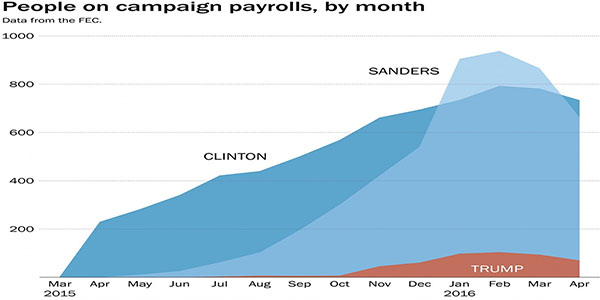
Trump simply isn't running a normal campaign, and unless he manages to raise a lot of money or opens his own checkbook, he won't even come close to competing with Clinton. In addition to staff, Clinton is about to start a full-bore ad campaign in eight swing states. Trump has no plans for doing anything like that. If Trump wins simply by tweeting and dominating coverage with various controversies and outlandish statements, it is going to change politics forever. (V)
Covering Donald Trump
Harvard's Shorenstein Center on Media, Politics, and Public Policy released a new report this week on media coverage of the 2016 campaign, specifically reviewing the pre-primary season (aka the "invisible primary"). Their main findings have already been noted many times, on this site and others: Donald Trump got far more coverage than any other candidate ($55 million in free advertising according to the Shorenstein report), and his coverage was overall quite positive, particularly compared to that of Hillary Clinton (Trump stories were 43% negative, Clinton's were 84%).
Since these conclusions are not new, of much greater interest is the reasoning the report offers for the two trends. As to the amount of Trump coverage, they write:
So what explains the news media's early fascination with Trump? The answer is that journalists were behaving in their normal way. Although journalists play a political brokering role in presidential primaries, their decisions are driven by news values rather than political values. Journalists are attracted to the new, the unusual, the sensational—the type of story material that will catch and hold an audience's attention. Trump fit that need as no other candidate in recent memory. Trump is arguably the first bona fide media-created presidential nominee. Although he subsequently tapped a political nerve, journalists fueled his launch.
As to the positive tone of Trump coverage, they say:
Why was Trump's coverage so favorable? Why did the watchdog press say so many positive things about Trump's candidacy? The reason inheres in journalists' tendency to build their narratives around the candidates' positions in the race. This horse race focus leads them into four storylines: a candidate is "leading," "trailing," "gaining ground," or "losing ground." Of the four storylines, the most predictably positive one is that of the "gaining ground" candidate, particularly when that candidate is emerging from the back of the pack. It's a story of growing momentum, rising poll numbers, and ever larger crowds. The storyline invariably includes negative elements, typically around the tactics that the candidate is employing in the surge to the top. But the overall media portrayal of a "gaining ground" candidate is a positive one.
Keep in mind that the report only covers the months prior to the Iowa caucuses. Their next report will cover primary season, and the last will cover the general election. Still, their analysis does much to highlight a dilemma that the commentariat finds itself in right now. The first phenomenon they note—Trump makes good copy—remains 100% true; with an entire career built on self-promotion, he's a master at commanding headlines and attention. The second, however, no longer holds. He's not at the back of the pack, now he is the pack. Therefore, we're at a point in the process when he's going to get negative coverage about the outrageous/offensive things he says and negative coverage in the "losing ground" category. When the next Shorenstein report comes out, that "43% negative" number for Trump will probably double (or more), simply because his status has changed.
The appearance this will create, for many readers, is that the media are obsessed with Trump and that they are trying to tear him down. The New York Times has already gotten criticism along this line, so too have the Washington Post, CNN, Fox News, and even this site. It certainly fits The Donald's narrative well, but it's also largely not true. Assuming the Shorenstein report is correct—and their analysis is strong, and well supported with evidence—then it's really just a byproduct of the manner in which the political system and the journalistic establishment interact with each other, particularly the "horse race" approach to political coverage. (Z)
Trump at Odds with NRA
Following last week's Orlando shootings, Donald Trump took a very...loose stance on the Second Amendment. He declared that if only the club-goers had been carrying guns, they could have significantly reduced the death toll. Apparently, he was unconcerned about the potential for collateral damage that might be done by frightened people unleashing a hail of badly-aimed bullets in a poorly-lit environment trying to hit a hard-to-spot target. It was the kind of pro-gun statement that we've come to expect from the NRA more than from nominees for president.
Or maybe not. On Sunday, NRA CEO Wayne LaPierre was on CBS' "Face the Nation." While LaPierre believes everyone should be armed "because they're coming" (whoever "they" might be), he also said "I don't think you should have firearms where people are drinking." At almost the same time, NRA lobbyist Chris Cox was on ABC's "This Week," and he said almost exactly the same thing, "No one thinks that people should go into a nightclub drinking and carrying firearms." It's almost as if their responses were coordinated.
Trump would like a meeting with the NRA to discuss their views on certain gun-control measures, like barring sales to people on the government's terrorist watch list. Judging by the responses on Sunday, though, this could be another GOP power center that prefers to hold The Donald at arm's length. (Z)
Trump at Odds with Bush (Again)
Donald Trump is not fond of his former opponent, Jeb Bush. He is also prone to conspiracy thinking. It probably should not surprise us, then, that these two tendencies have now merged, as Trump has begun openly suggesting that Bush is conspiring behind the scenes to deny him the GOP nomination.
As far as Trump's conspiracy theories go, this one is a bit more on the credible side. Only a bit more, though. There is no doubt that GOP insiders are organizing to block Trump's nomination, but Jeb is likely not at the center of that movement. If he were, there would be no particular reason for it to remain a secret. Further, Jeb was never the string-puller in the Bush clan, Poppy Bush (aka G. H. W.) was, and he tended to exercise his influence through trusted lieutenants like, say, Dick Cheney, and not through his sons. A spokesperson for Bush denied he has any role in the efforts to dump Trump, and called Trump's "obsession" with Bush "unhealthy." (Z)
It's All about the Electoral College
Politico has a long piece today reminding everyone that it is the Electoral College that matters. Any Democratic nominee starts the general election with a huge lead there these days. In the past six elections, 18 states plus D.C. have voted for the Democrat every time, giving them 242 electoral votes. New Mexico is five for six and with 48% of the state being Latino, no one seriously expects Trump to have a chance there, bringing Hillary Clinton to 247 electoral votes as a base. That means she needs 23 more electoral votes and there are numerous ways to get it. Florida has 29 electoral votes all by itself, so there will be a furious battle there. Virginia and North Carolina have 28 together. Colorado plus Ohio have 27 together.
Basically, what Trump needs to do is win almost all the swing states as well as peeling off a few states from the so-called "blue wall" (which isn't related to Trump's wall). To do that, Trump is going to need to get millions of blue-collar workers who didn't vote in 2008 or 2012 to come out to vote for the first time. While there were many more Republican primary voters than in previous years, studies show that most of them voted in the general election before, so that won't do the job. Trump needs to energize people who have not voted in years and so far there is little evidence that he is going to be able to do it. (V)
Senate Could Go Either Way
At Larry Sabato's Crystal Ball, the prognosticators are looking closely at the Senate races—in particular,
the implications of Sen. Marco Rubio (R-FL) running for reelection to a job he really dislikes. Their conclusion
is that he is the strongest Republican candidate, but against Rep. Patrick Murphy, the race is at best a toss-up.
Here is the
Crystal Ball's Senate map.
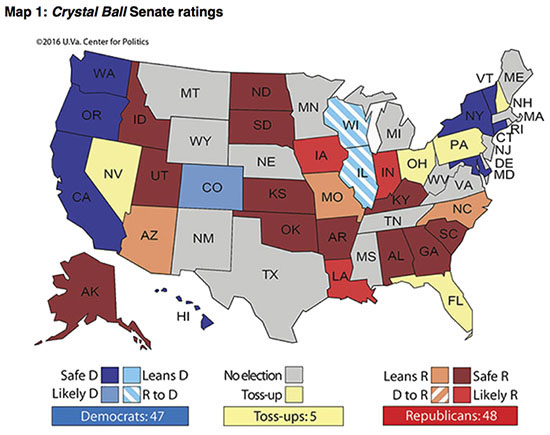
Currently Democrats (and independents who caucus with them) have 46 seats; Republicans have 54 seats. If Democrats pick up Illinois and Wisconsin, as the Crystal Ball predicts, they would have 48 seats, except Nevada is a toss-up, bringing them to 47. However, six Republican seats are marked as flipped or toss-ups, so they have a base of 48. The bottom line is that the Senate could go either way.
Ticket splitting is increasingly rare, so if the Democrats win the White House, they will probably also win the Senate. If the Republicans win the White House, they will almost certainly hold the Senate. (V)
Is the House in Play?
Conservative pundit Ramesh Ponnuru is worried that not only is the Senate in danger for the Republicans, but also the House, despite the mighty gerrymander that has kept it Republican since 2010. He points out that polling of individual races is sparse, but a generic poll of the House showed Democrats with an 11% lead. If the Democrats manage an 8% lead nationally, the House could be in play, despite the gerrymandering. (V)
Pressure Growing for Changes to Democrats' Nomination Process
The superdelegates favored Hillary Clinton. The caucuses favored Bernie Sanders. Both tend to give undue influence to a small number of loyalists/insiders at the expense of a much larger number of rank-and-file voters. And now, both may be going the way of the dodo. The California Democratic Party is the latest to call for both to be curtailed, replacing all caucuses with primaries, and also reducing the number of superdelegates while binding the remainder to vote the way their state voted.
Given the bad publicity that has accrued to both aspects of the process, not to mention the desire to reach out to young voters/Sanders supporters, it would be surprising if the DNC did not take some sort of move in this direction during their convention. A change in the superdelegate system seems likely. Ending the caucuses is the longer shot, as that would represent an override of local preference, would go against a lot of tradition, and would fundamentally alter the dynamics of the ultra-critical Iowa contest. (Z)
Profanity Reigns
This year, campaigning has been extremely coarse compared to previous years. In the past, candidates and their supporters yelled at each other, but rarely did they use profanity. And printed material was never profane. This year is different. Trump paraphernalia this year includes slogans such as:
- Hillary s**** but not like Monica
- We're going to knock the s*** out of ISIS
- Trump that b****
Hillary stuff isn't like that (yet). (V)
Back to the main page