Previous | Next
Even If Sanders Gets What He Wants, He Still Loses
Despite being beaten badly in New Jersey and California Tuesday, Sen. Bernie Sanders (I-VT) is soldiering on and refusing to admit defeat. He thinks that the superdelegates can yet hand him the nomination. In particular, he thinks that superdelegates in states that he won should vote for him at the convention. Let's see how that would work out. The second and third columns below give the number of pledged and superdelegates each state (and territory) has, total. The next two columns give the number of pledged delegates Clinton and Sanders have won, respectively.
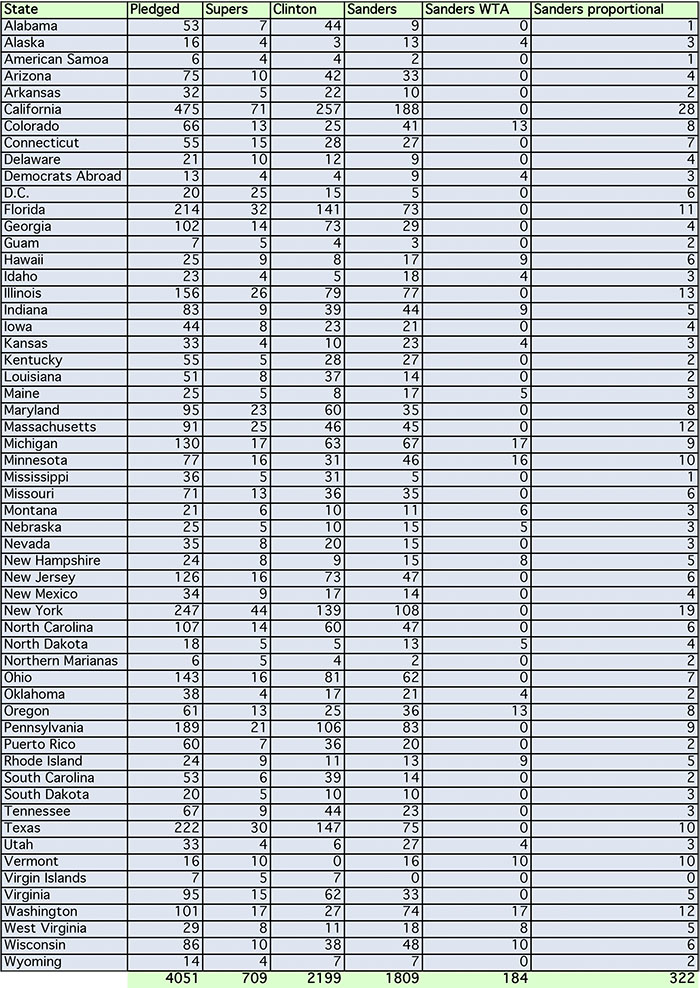
To start with, there is one more primary to go, in D.C. next Tuesday. Nearly all Democrats in D.C. are either black or Democratic Party insiders, so Clinton is going to sweep that contest. Let's assume Sanders does unexpectedly well there and gets 5 of the 20 delegates, which is probably overly optimistic for him. Then he would have 1,809 pledged delegates.
What Sanders has asked for is for the superdelegates to vote the way their states voted. If they all do that, winner take all, he picks up the super delegates in the "Sanders WTA" column, giving him 184 super delegates and a total of 1,993 delegates, still 390 delegates short of a majority, so Hillary Clinton still wins by a very large margin.
Now suppose Sanders, who says he is good at arithmetic, is also good at Excel. He could easily deduce the fact that he is better off asking the superdelegates in all states to be allocated in proportion to the pledged delegates so he can get some delegates in the big states he lost, even if that means losing a handful of delegates in the small states he won. With this allocation, he gets 322 superdelegates, for a total of 2131. Now he is only 252 delegates shy of a majority, so Clinton's lead is reduced to just over 500 delegates. That doesn't do the trick, either. What he needs is for the superdelegates in the states he won to all vote for him and for a very large number of delegates in states he lost to override the will of the voters and vote for him anyway, because he really wants to be the nominee very much. That's going to be a tough sell. (V)
Sanders Losing Key Supporters
It is unclear exactly how long it will take Bernie Sanders to wave the white flag. But while la revolución might viva a little longer in Vermont, it's coming to an end in other quarters. To start, Sanders' only Senate endorser, Jeff Merkley (D-OR), said on Wednesday that the race is over, and that the time has come for Democrats to unite behind Hillary Clinton. And an even bigger blow looks to be headed down the pike in the next few days. Sen. Elizabeth Warren (D-MA) has made a point ot remaining neutral throughout primary season out of respect to her Senate colleague and fellow progressive. But now she reportedly plans to throw her support behind Clinton within the week.
With the two most important Senatorial holdouts on board the Clinton bandwagon, not to mention the President (who appears likely to formally endorse Clinton after meeting with Sanders next week), ongoing denial of reality will become harder and harder for the Vermont Senator. The odds are fairly good (though hardly ironclad) that he will take this week to either negotiate the concessions he wants, or to come to grips with defeat, and that his withdrawal from the race will come not long after D.C. votes. (Z)
Takeaways from the Primaries
The New York Times has a number of takeaways from the primaries this year:
Hillary Clinton's coalition held. The final round of voting, on Tuesday, was much like the earlier ones. Clinton's base of women, older voters, and nonwhites held together and allowed her to win in New Jersey and California, just as she had won most of the other diverse states. She will have to build on this for the general election, in particular getting younger voters to accept her.Bernie Sanders is in no mood to give up. Despite Hillary Clinton's having clearly demonstrated that she is the choice of Democrats nationwide, by winning 4 million more votes than Sanders, more pledged delegates, and more states, Sanders doesn't seem to be in the mood to acknowledge the simple reality: He did well, but she did better.
Donald Trump finally gave the speech the party wanted. On Tuesday, in his "victory" speech, Donald Trump made an attempt to act presidential. How long this lasts is anyone's guess, but he was praised by Republican leaders merely for not going rogue. Usually it is taken for granted that nominees make some attempt to act presidential, but with Trump, you can never be sure.
This is a national identity election. It is already clear this year's election is not going to be a battle of the platforms, with the Democrats promising to raise taxes on the rich and Republicans promising to lower them, although that may also be the case. Clinton will stand for a big-hearted, fair-minded country open to immigration and diversity. Trump will be an "America first" candidate, guardian of traditional values and demographics and enemy of a corrupt system of government.
Clinton wants Republican votes. While Clinton definitely hopes that Sanders' supporters will eventually come around in order to prevent a Trump presidency, it is also clear she is going to attempt to win over Republicans who can't stand Trump. She will attack him as being totally unfit for the job and an abuser of so many people. Moving left to get the Sanders voters and right to get the moderate Republicans will not be easy, but she is going to try.
Very little of this could be foreseen a year ago, and after the general election there are likely to be takeaways no one can see now. (V)
Five Burning Questions
The above news item was about the primaries. The Hill takes a look at where we are going and asks five burning questions:
- Can Donald Trump adapt to a general election campaign and appear presidential?
- Can President Obama unite the Democratic Party?
- How tightly will Hillary Clinton embrace gender?
- Where do Bernie Sanders' supporters go?
- What does the next wave of polls say?
The last question will be answered in 2 or 3 weeks. After Donald Trump became the presumptive Republican nominee, Hillary Clinton's rather substantial lead in the national polls vanished. Now that Clinton is the presumptive Democratic nominee, the big question is will the polls revert back to the way they were before Trump unified the Republican party? (V)
Sanders Supporters Can Help Elect Trump
While general election polls this early usually don't mean much, a new PPP poll released yesterday is noteworthy. The blue state most likely to flip to the Republicans is Pennsylvania, and the poll shows Clinton ahead of Trump by a microscopic 41% to 40%, with Gary Johnson at 6% and Jill Stein at 3%. Without Johnson and Stein, it is 44% to 44%. Among people who support Sanders, only 72% support Clinton. If Clinton could win half of the skeptical Sanders' voters, her lead would jump to a comfortable 47% to 40%. So if Sanders' supporters decide to sulk and not vote or vote for Trump or Jill Stein to "punish" the Democrats for not nominating Sanders, Trump could win key states like Pennsylvania. Clinton is going to have her work cut out for her trying to convince these people that she is better than Trump. (V)
Trump's Fundraisers See No Chance to Raise $1 Billion
Hillary Clinton is widely expected to raise a billion dollars for her general election campaign. Donald Trump's fundraisers have essentially admitted that they have no chance to get anywhere near this and expect to be massively outgunned in the fall. Trump himself is already starting to say he doesn't need that kind of money. Republicans are now talking about raising $300 million as a possible goal, meaning Clinton may be able to outspend them 3 to 1.
Making the problem even harder is Trump's unwillingness to kowtow to the donors. He doesn't work the phones for hours a day and certainly doesn't tell them things they want to hear. And even if he did, many big Republican donors want to have nothing to do with him. One possible way out is for fundraisers to ask donors to give to the RNC instead of to Trump. That would help donors who are dyed-in-the-wool Republicans but who can't stand The Donald. (V)
What Did We Learn from the Judge Curiel Episode?
Paul Waldman has a piece in the Washington Post pointing out some of the things we learned from Donald Trump's criticisms of Judge Gonzalo Curiel and its aftermath, as follows:
Trump uses his campaign to fight personal battles. Trump's attacks on Curiel seem more heartfelt than any of his snide remarks about "Lyin' Ted" or "Little Marco." His lawyers are probably pulling out their hair by now. They know, of course, that you don't win a court case by attacking the judge's ethnicity. Surely they have told their client this. But he can't resist, despite the fact that it brought down most of the Republican Party on him. It's going to happen again. And again.Trump can't resist making bigoted attacks. Despite the fact that Judge Curiel has made a number of rulings in Trump's favor, Trump can't stand the idea that someone with Mexican heritage has real power over him. He assumes the judge must hate Anglos, just as he hates Latinos, and that brings his bigotry to the surface.
Trump's thin skin is his Achilles heel. Trump can't tolerate even the mildest criticism. If anyone says anything even slightly critical of him, Trump lets the accuser have it with both barrels. Hillary Clinton [and even more so, Sen. Elizabeth Warren (D-MA)] are going to exploit this to the hilt. They are going to say things that make him angry in the expectation that he will explode and say something that is toxic.
His greatest fear is being exposed as a penny-ante grifter. Why did Trump start Trump University, whose apparent goal was getting vulnerable people to max out their credit cards? He ultimately made $5 million on it, petty cash for someone who claims to be worth $10 billion. Why didn't he spend his time making billion-dollar deals with Hilton and Marriott instead? If it turns out he is just a small-time con man, it destroys his brand.
Trump has a tin ear. He has no sense of what harms him politically. He thinks mocking a disabled reporter is going to get him votes. Surely none of his advisers told him that. He simply shoots off his mouth and has no idea of what the impact is of some of the things he is saying. One of his fans ought to give him a gold-plated copy of that famous (apocryphal) sign supposedly displayed at the Air Force Academy in Colorado: "Be sure brain is in gear before engaging mouth."
Trump can be tamed, but it is hard. Finally, the Republican leadership convinced him to read a calm speech from a teleprompter. Once. But will he do it a second time? Maybe at the convention. Most likely he is going to go rogue many more times during the campaign and calm speeches will be reserved for formal occasions.
In so many ways, Trump and Clinton are polar opposites, especially in personality and style. She is overly scripted; he is insufficiently scripted. (V)
Guess Who's Not On the GOP Website?
At the moment, there are four politicians featured on the GOP's website: Abraham Lincoln, Hillary Clinton (twice), Bernie Sanders, and George H.W. Bush (or, his socks, at least). Conspicuously missing from the list, as TPM observes, is Donald Trump. Not only is he not featured on the main page, he's barely present on the site at all. Even a search for him nets only 86 results (by contrast, a search for "Clinton" returns 2,020 hits, "Romney" returns 711, and "ISIS" returns 551).
Perhaps this is a deliberate tactical choice by Reince Priebus, et. al., to keep the GOP brand separate from its candidate. Or, maybe it is more of an inadvertent/subconscious snub that simply reflects the Party's lack of enthusiasm for The Donald. Perhaps it will make him feel better to learn that the Democrats' site has a whole Trump section, even including an interactive Trump conspiracies quiz. It's going to be quite an election. (Z)
Trump Hires Eric Cantor's Pollster
Despite repeated warnings from the GOP leadership to avoid hiring pollster John McLaughlin, who famously predicted that former House Majority Leader Eric Cantor would handily defeat some unknown college professor in his primary, Donald Trump has hired McLaughlin anyway. His main job will be polling New York state, which Trump said he will win. Every pollster other than McLaughlin thinks Trump will be crushed in the Empire State, just like every other Republican since Ronald Reagan. But Trump doesn't listen to anyone. Trump's main pollster is Tony Fabrizio, who has worked for other businessmen turned politician, including Gov. Rick Scott (R-FL) and Gov. Matt Bevin (R-KY). (V)
Back to the main page