Previous | Next
Computer Model Predicts Near-Certain Clinton Win
A new computer simulation of the general election by Prof. Sam Wang of the Princeton Election Consortium predicts a near certain win for Hillary Clinton in November based on the state polls. Very briefly, if a state poll says that Clinton is at 48% with a margin of error of 3%, then there is a 95% chance that her actual score is in the range 45% to 51%. The computer can pick a number in that range on a given run. Similarly, for every other state it picks a number based on the state polls. It does the same thing for Trump. This process is then repeated many times to give a histogram of the results, as shown below.
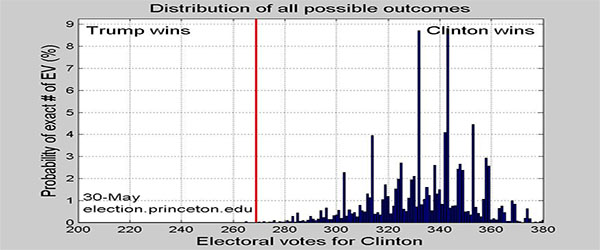
One note here is that general election polls of Clinton vs. Trump have been published in only 21 states so far, and some of those are quite old. In the states where there has been no polling, Wang used the 2012 election results. This sparsity of polling is the reason we haven't switched to general-election mode yet, which we will certainly do some time after the conventions, when polling will begin in force. Nevertheless, the results are striking, even if a bit premature. (V)
Charlie Cook: General Election Is Not as Close as It Looks
Veteran political guru Charlie Cook has weighed in on the general election and explained that the Republicans are like Dorothy (Judy Garland) in the 1939 "Wizard of Oz" movie when she says to her dog Toto: "I don't think we're in Kansas any more." The Republicans have come to realize that like it or not, Donald Trump is their nominee. The Democrats haven't reached that point yet, but may in the next two or three weeks, when all the primaries have been finished. Cook's basic point is that in modern elections, partisanship dominates over all other factors. In the end, Democrats vote for Democrats and Republicans vote for Republicans. The campaign, the issues, the billion dollars worth of ads, none of it matters all that much.
He also noted that NBC's Chuck Todd calculated that if 70% of the Sanders supporters come to realize that they are not in Kansas any more and Clinton is their nominee, for better or worse, she will have an 8-point lead over Trump. We should know if Cook and Todd are right within a month. (V)
California Poll: Clinton 13 Points Ahead of Sanders
As next Tuesday's California primary nears, polling in the Golden State is increasing. California is a big place and unfortunately the polling is all over its large map. A new poll by the Hoover Institution puts Hillary Clinton at 51% and Sen. Bernie Sanders (I-VT) at 38%. But before Clinton fans begin cheering and Sanders fans begin crying, it is worth noting that recent polling of the primary race in California has been wildly inconsistent. Here are the five most recent polls of the California Democratic primary:
| | ||
| Pollster | Clinton | Sanders |
| Hoover Institution | 51% | 38% |
| Public Policy Institute of California | 46% | 44% |
| SurveyUSA | 57% | 39% |
| Fox News | 48% | 46% |
| Gravis | 47% | 41% |
In short, Clinton is probably ahead, but how much she is ahead is anyone's guess. (V)
Jerry Brown Endorses Clinton
Just a week ahead of the California primary, Gov. Jerry Brown (D-CA) has endorsed Hillary Clinton. So has virtually every other California Democrat. In his endorsement, Brown said: "This is no time for Democrats to keep fighting each other. The general election has already begun."
Endorsements usually don't mean much, but Brown is special because he is a liberal who has run for President himself and who is respected by many supporters of Bernie Sanders. Brown also has a lot of bad blood with the Clintons, so the fact that he has buried the hatchet and now supports Clinton means a lot more than the endorsement of say, Sen. Barbara Boxer (D-CA), who has always supported Clinton. (V)
Libertarians Off To a Good Start
Yesterday, we noted that newly-minted Libertarian Party vice-presidential candidate Bill Weld is a skilled fundraiser who might very well help bring in the big bucks, particularly by the fairly modest standards of the LP. Well, the prediction is already coming true. Tuesday afternoon, California agribusinessman Chris Rufer declared that he will be donating at least $1 million to a Libertarian Party-affiliated super PAC. It's the largest single donation to a Libertarian-aligned group since 2010's Citizens United decision. By way of contrast, Libertarian super PACs took in a grand total of $670,000 during the entire 2012 campaign.
Certainly, the high-profile Johnson-Weld ticket and the immediate financial success have to have the pro-Trump forces nervous. Every dollar the LP takes in represents money and votes being siphoned off from Trump. Further, money equals advertising which equals legitimacy, which means a seat at the debates. Rufer has been a generous donor to the LP before, so this could merely be an aberration. But if the Kochtopus, or some of the other Libertarian-leaning big dogs, get out their checkbooks, the floodgates could open very quickly. (Z)
Sessions to GOP: Adapt To Trump or Die
In an interview with Politico, Sen. Jefferson Beauregard Sessions III (R-AL) said that the Republican voters have spoken, their message is clear, and Republican politicians need to get with the program, and fast (English translation: I would love to be the Republican vice presidential nominee). Sessions is an unreconstructed Southerner named after not one but two prominent Confederates (Jefferson Davis and P.G.T. Beauregard), and he brings little to the ticket. Blue-collar workers aren't going to identify with someone from a state that has been pretty good at getting factories to relocate there due to low wages and lack of unionization. On the other hand, he has been known to make off-color racial jokes and being from the deep South may appeal to voters for whom Trump's racial views are a plus rather than a minus. (V)
Trump's Donation to Veterans: $5.6 Million
Donald Trump has revealed the final numbers for his debate-avoiding fundraiser for veterans. Though the total donation was not the $6 million that was promised, the vets did get $5.6 million. So, close enough, right? Well, maybe not. Though the total money donated was ok, the timing proved to be a little fishy. As in, most of the $5.6 million was only coughed up in the last week, which is after the Washington Post did an exposé on the matter.
Trump, of course, is claiming the timing was coincidental. Nearly everyone else, including Hillary Clinton, believes that the money would never have materialized if not for the Washington Post's reporting. Needless to say, it is unlikely we will ever know for certain (unless Corey Lewandowski turns state's evidence). In any case, Trump is once again showing a black belt-level ability to dodge scandals, worthy of Ronald Reagan or Bill Clinton. We may soon have to decide that Trump, and not mafioso John Gotti, is the one who is truly entitled to the nickname "Teflon Don." (Z)
Things Still Quite Ugly on the GOP Side of the Contest
Because the Republican nomination is settled and the Democratic one is not, the media's focus in the last couple of weeks has been on bickering and infighting among Democrats (particularly those in Nevada). Let us not forget, however, that there's still plenty of nastiness going on among members of the red team.
Case in point: Glenn Beck. The conservative pundit hates Donald Trump and was one of the instigators of the National Review's anti-Trump issue. Last week, Beck was hosting conservative author Brian Thor on his SiriusXM talk show, and the discussion turned to stopping Trump, with both Beck and Thor agreeing that it had to be done, but there were "no legal means available." The implication, of course, was that Trump might have to be assassinated. The conversation caused SiriusXM to suspend Beck's show for at least a week, with the suggestion that he might never be back on their airwaves.
Anyhow, the next time you see a "Democrats are divided" story, just remember that, at very least, nobody on the blue team is threatening to kill Bernie Sanders or Hillary Clinton. (Z)
Kristol May Have His Horse
Speaking of the National Review, editor Bill Kristol seems to be stuck on Stage 3 of the grief cycle (bargaining), having forgotten to move on to depression and then acceptance. He has tried desperately to recruit an independent candidate to challenge Trump, first focusing on candidates with national stature like Mitt Romney and Sen. Ben Sasse (R-NE), then moving on to candidates who at least have political experience, like Rep. Adam Kinzinger (R-IL).
Having been rejected by so many suitors, Kristol has decided to change his approach, and is now focusing on a candidate who has neither national stature nor political experience: David French. French is a conservative writer, a lawyer, a Trump hater, an Iraq war veteran, and a Bronze Star recipient. It's a nice resumé, but nothing that will bring throngs of disaffected GOP voters to the polls. Kristol is presumably counting on the might of the National Review to buoy French's chances; if so, he might want to think back to that anti-Trump issue as an object lesson in how many voters are actually listening to what the magazine has to say. (Z)
Back to the main page