Previous | Next
Democratic Convention, Day 4: Clinton Gets the Job Done
The final day of the Democratic convention was not quite as strong as the third day. However, the drop off was not substantial, and certainly not enough to feed into any sort of "ends with a whimper" narrative. Here are the key moments:
- The theme Thursday was, "Stronger Together," and the plan was to
highlight the diversity and inclusiveness of the Democratic Party. On the last
day of their convention, the Republicans featured Peter Thiel, the first openly
gay man to address the RNC. The Democrats did the Republicans one better, with
Sarah McBride
becoming
the first transgender person to speak at a convention for either major party. "Will we be a
nation where there is only one way to love, only one way to look, and only one
way to live?" she asked.
- In addition to presenting themselves as more forward-looking on LGBTQ
issues, the Democrats also spent much time drawing a contrast between their
views on Muslims and those of Donald Trump. Rev. William Barber II got a
thunderous
response
when he urged the crowd to love Israelis and Palestinians equally. Basketball
superstar and author Kareem Abdul-Jabbar, who is Muslim, had one of the lines of
the night when he walked out on stage and said, "Hello everyone. I'm Michael
Jordan and I'm here with Hillary. I said that because I know that Donald Trump
couldn't tell the difference." (Abdul-Jabbar is six inches taller and 20 years
older than Jordan, though both are black and bald.) He
lambasted
Trump's discriminatory proposals. Also speaking on this theme was Khizr Khan,
the father of a Muslim-American soldier killed in Iraq. Outside of the headliner,
Khan's
address
got more attention than any other. Asserting that Trump has "sacrificed
nothing," he said: "Let me ask you, have you even read the United States
Constitution? I will gladly lend you my copy," as he pulled a pocket copy of the
document out of his jacket.
- It fell to Chelsea Clinton to perform the same task that Ivanka Trump
handled so ably last week:
introduce
the presidential nominee, who also happens to be her parent. Chelsea inherited a fair
bit of her father's charisma and is a battle-tested political speaker, so
she did a fine job, giving a touching address that was the equal of Ivanka's.
- Then it was time for the big show. In case there is any doubt that a female candidate is judged by different
criteria than a male candidate, Google revealed that the single most common
convention-related question searched for on Thursday
was,
"What will Hillary wear tonight?" The answer, for inquiring minds, was an all-white pantsuit, an
obvious nod to the preferred shade of the women's suffrage movement.
- Clinton is simply not a great public speaker, particularly when compared to the
superstars who preceded her over the last three days. In part, at least, it's
her general wonkiness. In part, it's her voice, which is not nearly as
mellifluous as Barack Obama's or her husband's. Point is, she's not going to
walk out there and give the Gettysburg Address or the "I Have a Dream" speech.
Still, within those limits, the address
she gave
was quite successful. Divided into four fairly distinct sections, it got the
crowd involved, incorporated several very good moments (read: sound bites), and
clearly communicated her case for the presidency.
- First was the "getting to know you" material, as Clinton talked about her
background and her path to the nomination. This was, not surprisingly, the least
effective part of the speech, since she is not particularly comfortable talking
about herself. Fortunately for Hillary, some of the slack on this front was
picked up by Chelsea, and by the Morgan Freeman-narrated biographical
video
shown right before she took the stage (which
lit Twitter up).
- The second portion of the speech was the policy proposals, something that
was not to be found in Trump's acceptance speech. Here, Clinton was in her
element, and started to hit her groove. Declaring that, "I believe that Wall
Street can never be allowed to wreck Main Street again," she veered in a
decidedly leftward direction, ticking off a series of policy proposals that came
straight from Sen. Bernie Sanders' (I-VT) platform: combating climate change,
fixing economic inequality, fighting against trade agreements, etc. She also
addressed herself directly to Sanders & Co.: "To all of your supporters here
and around the country: I want you to know, I've heard you. Your cause is our
cause. Our country needs your ideas, energy and passion." Clinton also responded to
some of the charges that have been leveled against her by the GOP, most notably
insisting that she has no intention of repealing the Second Amendment (not that
presidents can do that anyhow).
- Part three was the
case against Donald Trump,
and it was pretty devastating. Lamenting the divisiveness of The Donald's
campaign, she promised, "I will be a president for Democrats, Republicans and
independents. For the struggling, the striving and the successful. For those who
vote for me and those who don't—for all Americans." She also made an
argument that we will be hearing a lot in the next few months, namely that Trump
is temperamentally unfit to be president. "A man you can bait with a tweet is
not a man we can trust with nuclear weapons," she announced, in what was
unquestionably the sound bite of the night. Trump promptly took to Twitter to
assure Americans that they need not be concerned, and that he would always be
calm and level-headed in a crisis. Oh, wait, no he didn't. Instead, he
said
at a rally in Iowa that he would like to "hit" many of the DNC speakers "so hard their heads would
spin." That will certainly show Hillary how wrong she was to say that he is
easily provoked.
- The final segment of the speech was the upbeat "America is headed in the right direction" part. The blue team has already been criticized for looking at the world too much through rose-colored glasses (see below), and Clinton doesn't do hope as well as her husband or President Obama do, so she kept this part short and sweet. She did end well, though: "And so my friends, it is with humility, determination and boundless confidence in America's promise that I accept your nomination for president of the United States."
Taken as a whole, Clinton absolutely did what she needed to do. The conventioneers were thrilled by her speech, and the occasional attempts at a "Bernie!" chant were quickly drowned out with "Hillary!" or "USA!" 72% of respondents in CNN's insta-poll of viewers said they viewed the speech very favorably, and 60% said it made them more likely to vote for her. Keeping in mind that attracting the Obama coalition is all she really needs to do (getting independents and crossover Republicans would be a bonus), these are very good numbers.
What about the post-convention bounce? Undoubtedly, it's coming. First, because the bounce almost always happens—5% on average, for Democrats. Second, because it was a very successful convention, watched by more people than the RNC. And third, because Trump got his, and his speech was viewed somewhat less positively than Clinton's (57% of CNN's insta-poll respondents viewed it very favorably). In fact, if one was investing in polling futures, one would probably be wise to bet that Hillary will do a little better than 5%, maybe 6% or 7%. We shall learn next week. (Z)
Has Trump Violated the Logan Act?
A federal law known as the Logan Act prohibits private citizens from trying to influence the conduct of foreign governments. The law dates from 1799 and was inspired by George Logan's unauthorized negotiations with France in 1798, but the law is still in force and violation of it is a felony. A case can probably be made that Donald Trump has urged Russia to intervene in a U.S. presidential election, which would seem to be an attempt at influencing the conduct of a foreign government. It is doubtful, however, that the U.S. Dept. of Justice will indict Trump for his crude request for Russia to hack Hillary Clinton's email server and then release whatever it finds. Any such prosecution would seem too partisan during an election season. (V)
Trump to Dems: Your Worldview is a Fantasy
In response to the Democrats' very upbeat convention, Donald Trump yesterday accused them of living in a world that doesn't exist. He pooh-poohed their vision, mocking it as:
A world where America has full employment, where there's no such thing as radical Islamic terrorism, where the border is totally secured, and where thousands of innocent Americans have not suffered from rising crime in cities like Baltimore and Chicago.
Then he went on to castigate them for not talking about Hillary Clinton's email server, Islamic terrorism, and the agreement with Iran. He concluded his remarks by saying he will make America great again, as he has said countless times before. (V)
Billionaires Urge Koch Brothers to Back Trump
Up until now, the billionaire Koch brothers have not given any money to the 2016 Republican presidential candidates. Now a group of billionaire Republicans is urging the Koch brothers to open their checkbooks and write Donald Trump some really big checks. The argument is simple: If they want influence in a Trump White House, they had better get on board the bandwagon right now. The main problem, however, is that the brothers can't stand Trump, and hate his policies on trade and immigration. They do like his running mate, but ultimately it is the #1, not the #2, that matters.
On Saturday, the Koch network will have its semi-annual meeting in Colorado, where some of the members, all of whom must pony up at least $100,000 a year to belong, will make this pitch to the brothers. However, other big donors also despise Trump, so it could be a heated meeting. At the January meeting in California, nearly all the donors opposed Trump, but now that he is the Republican nominee, some of them may have changed their tune. (V)
Rubio Thinks Trump Will Learn on the Job
Rather than having to defend the idea that Donald Trump knows how to be president, Sen. Marco Rubio (R-FL) is now saying that Trump's positions will evolve as he gets more experience on the job. However, he added that it is an open question whether Trump will ultimately get more informed on the issues, even as president. Furthermore, Rubio believes that the Senate will act as a check on him should he do something inappropriate. To some extent that is true, of course. For example, if he decides to really build a wall along the Mexican border, that is estimated to cost something in the $10 to $40 billion range, so Congress would have to appropriate the money. If the Senate refuses to approve the appropriations bill, there will be no wall.
On the other hand, if Trump orders troops to invade some country (or not take any action in the event of a Russian invasion of, say, the Baltic Republics), as commander-in-chief it's his call, and the Senate has little or nothing to say about it. (V)
How Asian-Americans Became Democrats
Asian Americans strongly supported Barack Obama in 2012, giving him 73% of their votes, but they weren't always Democrats. In fact, a mere 25 years ago, most of them were solidly Republican. While a lot of attention has been given to the voting habits of Latinos, blacks, and other groups, little has been written about this rapidly growing demographic group. A long piece in American Prospect by Karthick Ramakrishnan explains in detail how this political migration happened. Ramakrishnan's story is summarized below, but the magnitude of the change can be seen in this graph.
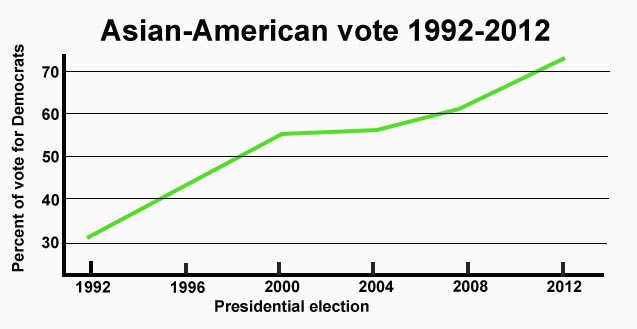
For over a century, Asian Americans faced legal and de facto discrimination, including the Chinese Exclusion Act of 1882 and more. During World War II, American citizens of Japanese descent who lived west of the Mississippi River were rounded up and herded into internment camps as possible enemy collaborators. Given this history, Asian Americans tended to avoid politics. The first time the exit polls in a national election asked if people were Asian Americans was in 1992, when they supported George H.W. Bush over Bill Clinton by a margin of 55% to 31%.
Since then they have moved steadily leftward, as shown in the graph above. There are several causes for this movement. President Bill Clinton projected a pro-business image, which was attractive to the many Asian-American small business owners. He also appointed the first Asian American ever to be a cabinet officer, Secretary of Transportation Norman Mineta, the child of two Japanese immigrants.
Since 2000, the Republicans have contributed to the further loss of Asian-American Republicans by demonizing immigrants. The rise of the Christian Right as a key part of the Republican Party further alienated Asian Americans, relatively few of whom are Christians. Furthermore, education is an extremely important issue to this group and the Democrats have long promoted better public schools, whereas Republicans have often focused on charter schools (many of which are religious or anti-science). These schools are of little interest to Asian Americans. Finally, laissez faire and the free market are not concepts widely supported in Asia, so Asian Americans are much more in line with the Democrats' views that the government should play a big role in the economy. There is every reason to expect that the leftward march of the past 25 years is likely to continue at least until November, given Donald Trump's many negative remarks about immigrants and people who are different from him. (V)
New Stars Shine at the Democratic Convention
In addition to nominating a candidate for president, national conventions are also a place where rising stars in a party can break through. McClatchy reporter Lesley Clark interviewed a number of convention delegates and came up with a list of Democrats to watch in the future:
- Sen. Cory Booker (D-NJ) reminded many people of Obama's 2004 speech
- Sen Chris Murphy (D-CT) spoke passionately about gun control
- Alison Lundergan Grimes is part of a new generation of Southern Democrats
- Steve Benjamin, mayor of Columbia, SC, delivered a heartfelt tribute to Clinton
- Rep. Tulsi Gabbard, an early Sanders supporter, is the youngest Democratic woman in Congress at 35
- Kamala Harris, likely the next senator from California, didn't speak but got plenty of attention
- Joe Kennedy III is Bobby Kennedy's grandson and a could be a force in national politics
Whether any of these become breakout stars in the future remains to be seen, of course, but Obama's performance at the 2004 convention is surely an inspiration to all of them. (V)
Joe Biden Loves the Word 'Malarkey' but Americans Don't Know What It Means
Joe Biden called out Donald Trump on Wednesday, saying: "He is trying to tell us he cares about the middle class. Give me a break. That is a bunch of malarkey." Americans grabbed their smartphones and keyboards—to look up what "malarkey" means. The Merriam-Webster dictionary website said it zoomed to the top of the list for words looked up on Wednesday. Apparently Americans don't know the word very well, even though Biden has repeatedly used it during his career, most famously during the 2012 vice presidential debate when Paul Ryan began cataloging all the things wrong with U.S. foreign policy, and Biden interrupted him with "With all due respect, that's a bunch of malarkey." Here's the video clip. Incidentally, it means "nonsense" or "foolishness." (V)
Tim Kaine Plays the Harmonica
It is often said that people vote for the person who they would prefer to have a beer with. Given this year's candidates, many voters will become teetotalers. However, at least one of the running mates is going to give being likable a shot: Tim Kaine is going to push his folksy ways for all they are worth. In particular, he is a musician and plays the harmonica, an instrument that is small enough to bring to rallies and turn them into mini-concerts. Here is a video of him playing an old Christian hymm "Will the Circle Be Unbroken" in a band while he was governor of Virginia. Suppose he learns a couple of patriotic/religious songs like Irving Berlin's "God Bless America" or even Samuel Francis Smith's "My Country, 'Tis of Thee" and plays them at the start of every rally. For younger audiences he could do Woody Guthrie's "This Land Is Your Land." It would be tough for Gov. Mike Pence (R-IN) to top this for likability, especially if he gives negative speeches attacking gay people. (V)
Today's Presidential Polls
The biggest news here is the Pennsylvania result; if the Keystone State becomes out of reach for the GOP, it would be hard to construct a plausible victory scenario for Donald Trump. The New Hampshire number is a surprise; the purplish state has gone Democratic in five of the last six elections. (Z)
| State | Clinton | Trump | Johnson | Start | End | Pollster |
| California | 46% | 30% | 7% | Jul 10 | Jul 19 | Public Policy Inst. of California |
| New Hampshire | 39% | 48% | Jul 19 | Jul 21 | Inside Sources | |
| Pennsylvania | 46% | 37% | 5% | Jul 25 | Jul 27 | Suffolk U. |
Today's Senate Polls
One would not expect McGinty or Ayotte to have such big leads in their respective, highly-competitive races. This certainly makes it less likely that the Pennsylvania and New Hampshire numbers above are on target. (Z)
| State | Democrat | D % | Republican | R % | Start | End | Pollster |
| New Hampshire | Maggie Hassan | 41% | Kelly Ayotte* | 49% | Jul 19 | Jul 21 | Inside Sources |
| Pennsylvania | Katie McGinty | 43% | Pat Toomey* | 36% | Jul 25 | Jul 27 | Suffolk U. |
| Vermont | Patrick Leahy* | 66% | Scott Milne | 24% | Jul 11 | Jul 23 | Castleton State Coll. |
* Denotes incumbent
Back to the main page