Economy Adds Another 292,000 Jobs in December
While foreign crises come and go, one constant in all elections is the economy. If unemployment and inflation are low, that tends to help the party occupying the White House. If either or both are high, the other party yells: "Throw the bums out." The Labor Department announced a better-than-expected addition of 292,000 new jobs in December, bringing the total new jobs in 2015 to 2.65 million, making it the second best year (after 2014) in this millennium. The unemployment rate held steady at 5%, half of what it was at the peak of the crisis. While neither Hillary Clinton nor Sen. Bernie Sanders (I-VT) can take credit for the economy, this continual improvement makes it very difficult for the Republicans to claim they would handle the economy better. If things continue on their current trajectory and another 2 million jobs are added by November, the economy will certainly help the Democrats in the general election. Here is a chart of job growth since 2009 from the BLS
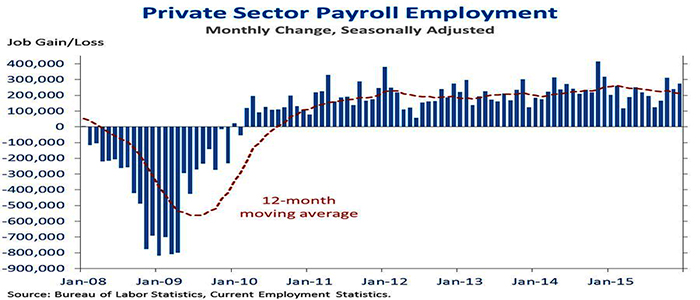
President Obama signed the stimulus bill into law in February 2009, and it took about a year to kick in since the money had to be distributed, states had to open competitive bidding for construction projects, winning companies had to hire workers, and so on, but within a year the country began adding jobs and that has continued until today. Expect this chart to play a big role in the election. (V)
Is Donald Trump the New George Wallace?
Many people have written that Donald Trump is the illegitimate spawn of Richard Nixon's "Southern Strategy" but there are also other roots to the Trump phenomenon. One clear predecessor to Trump was actually a Democrat most of his life, Alabama governor George Wallace, whose inauguration address in 1963 included the famous line: "Segregation now, segregation tomorrow, segregation forever." In 1968, Wallace ran for President as an independent on a racially divisive, populist platform. He pioneered the use of dog whistles, like the "bloc vote" and "thugs from America's inner cities," which his supporters understood to mean blacks, but most Americans didn't understand.
Wallace and Trump appeal to the same frustrated blue-collar audience and more or less for the same reason. Wallace supporters were afraid that the newly emancipated blacks (in much of the South, the Civil War was still in progress in 1968) would take their jobs or their tax money to go on welfare. Trump's supporters see Mexican immigrants as the bad guys, but the story is basically the same. Both candidates effectively said that the proper model for America was 19th century small-town rural America, run by upstanding white Christian men. In both cases, the mainstream media didn't take the candidate seriously at all for quite a while, but as he began building momentum and refused to go away, they had to finally start dealing with him.
We don't know Trump's fate yet, but we do know Wallace's. He won five states in the Deep South and got 46 electoral votes. Richard Nixon won 301 electoral votes but if Hubert Humphrey had gotten 3% more votes in California, he would have won the state and neither major party would have made it to 270 so the election would have been decided in the House, with each state getting one vote. Trump's support is fairly diffuse though, so even if he runs as a third party candidate, he is unlikely to win any states. (V)
Poll: 20% of Democrats Would Vote for Trump
Mercury Analytics, a research firm that has been in the political polling business since...well, last week, has released the results of a new survey revealing that one in five Democrats plan to cross the aisle to vote for Donald Trump in the general election. This puts a big dent in the "Trump can't actually win" narrative, so the poll is getting a fair bit of attention, including being posted on The Donald's own website.
It's an interesting and somewhat unexpected result, but—at the moment—it doesn't mean a great deal. The poll also determined that 14% of Republicans would vote for Hillary, so the net swing here is not enormous. Further, voter preferences remain extremely fungible right now, particularly given that The Donald has been handled with kid gloves by his Republican counterparts, but would not receive such treatment from Clinton. Most importantly, even if Mercury's numbers are correct, it matters a great deal exactly where those party-switching Democrats live. In the absence of evidence to the contrary, the guess would be that socially conservative members of the party would be the most likely to "defect" to Trump. And the majority of socially conservative Democrats are found in Southern and Midwestern states which, outside of Ohio and a small handful of others, are going to be in the Republican column anyhow. Every single Democrat in Texas or South Carolina or Oklahoma could vote for Trump and it would not change anything. Once it becomes clear that Florida or Colorado Democrats are going to cross the aisle in large numbers, then we can talk. (Z)
Trump Is Not Living in Iowa or New Hampshire
Nearly all the other presidential candidates have essentially moved to either Iowa or New Hampshire, except for the occasional one who commutes between the two. If you have multiple rallies and many diner stops in either state for days on end, it makes sense to stay at local hotels every night. Not so with Donald Trump. Almost every night he flies home to sleep in his own bed in his luxury Manhattan apartment. For example, Monday he campaigned in Lowell, MA, just across the state line from Nashua, NH. Tuesday he had an event in Claremont, NH, only 100 miles north of Lowell. But instead of staying in a hotel in Claremont, where he could have met the staff and perhaps won a few votes, he flew back to New York. When he is using his Cessna Citation X jet, he lands at the Teterboro, NJ airport, but for long trips, his personal Boeing 757 is much more comfy and he can land at LaGuardia. Often he arrives past midnight and the drive to his Fifth Avenue apartment from either airport takes another half an hour.
Other candidates would consider this very inefficient, even if they could afford it. They want to spend every possible minute talking to voters, and if staying in local motels is the price they have to pay for this, so be it. But Trump's campaign is not like the others. He does not want to personally meet as many voters as possible. Trump manages to get in the news every day for free and holds big rallies rather than meeting people in small groups. On Feb. 10 we will know how well this strategy worked. (V)
The Conventional Wisdom Is Often Wrong
Prof. Larry Sabato of the University of Virginia has collected a number of prominent statements made in January of previous election years. Here is an abridged version of his collection.
1960: If Democrats nominate the very young, Catholic John F. Kennedy, they will throw the election away1964: President Lyndon B. Johnson, a "Southern conservative," could be opposed by a Northern liberal in the
primaries
1968: LBJ's got a tough fight, but he's the favorite for reelection
1972: President Richard Nixon is losing to several top Democrats in the polls
1976: Jimmy Who?
1980: If President Jimmy Carter can whip Ted Kennedy's ass in the primaries, he'll surely defeat Ronald Reagan
1984: Reagan, called a "failed president" after a deep recession ... looks to be the 6th consecutive president to leave
office early
1988: Vice President George H.W. Bush is a wimp. He's drawn major GOP opponents, and the electorate seems ready
to switch back to the Democrats
1992: No way can President Bush, the liberator of Kuwait, lose to some scandal-drenched hick from Arkansas
1996: Ever since the 1994 GOP landslide, it's preordained that President Bill Clinton will be a one-termer
2000: Clinton escaped ouster over the Lewinsky scandal, but it'll ensure no third term for the Democrats
2004: With solid leads in the polls and Gore's endorsement, how is anyone going to stop Howard Dean?
2008: It's Hillary Clinton for the Democrats, of course. John McCain's got no shot at the Republican nomination
2012: The economy is weak and President Barack Obama is very vulnerable. Republicans take to saying: "Even my
dog could beat him
Things didn't always turn out as predicted. One year needs a footnote. While Al Gore didn't win the electoral vote in 2000, he did win the popular vote and would almost certainly have won the Florida and the electoral vote had it not been for (1) the 92,000 Floridians who voted for Ralph Nader and (2) the crazy butterfly ballot which caused thousands of lifelong Democrats in Palm Beach County to accidentally vote for Pat Buchanan. The message here is remember Harold Wilson's observation: A week is a long time in politics. (V)
Democratic Candidates Get Testy
Each of the three leading Democratic presidential candidates had some pointed remarks on Friday, albeit for different reasons. Hillary Clinton, for her part, hit Bernie Sanders on gun control, offering some of her harshest criticisms of the Vermont Senator thus far. She asserted that he had helped protect gun makers and lobbyists, and called on him to issue an apology for his past actions.
Sanders responded angrily to Clinton's remarks, calling her a flip-flopper who was anti-gun as a Senate candidate in 2000, pro-gun as a presidential candidate in 2008, and is now back to anti-gun as a presidential candidate in 2016. In addition, in a deft bit of passive-aggressive campaigning, Sanders described Bill Clinton's sexual scandals as "totally disgraceful" but said he would not be using them for political gain.
Meanwhile, Martin O'Malley had more immediate issues to be cranky about, as NBC News released its criteria for the January 17 Democratic presidential debate, and he's at risk of not making the cut. The former Maryland governor blasted NBC, accusing them of turning the presidential campaign into The Apprentice. Clinton and Sanders also issued statements that NBC should not be culling candidates without cause, so it seems likely that the network will find a way to make certain O'Malley qualifies. (Z)
Rubio, Abbott Call for Constitutional Convention
Sen. Marco Rubio (R-FL) published an editorial in USA Today on Wednesday in which he called for a new Constitutional Convention "to amend the Constitution and restore limited government." On Friday, Texas governor Greg Abbott (R) put into words what Rubio and other GOP politicians are thinking, with a list of nine proposed amendments:
- Prohibit Congress from regulating activity that occurs wholly within one state
- Require Congress to balance its budget
- Prohibit administrative agencies—and the unelected bureaucrats that staff them—from creating federal law
- Prohibit administrative agencies—and the unelected bureaucrats that staff them—from preempting state law
- Allow a two-thirds majority of the States to override a U.S. Supreme Court decision
- Require a seven-justice super-majority vote for U.S. Supreme Court to invalidate a democratically enacted law
- Limit the powers of the federal government to the powers expressly delegated to it in the Constitution
- Give state officials the power to sue in federal court when federal officials overstep their bounds
- Allow a two-thirds majority of the States to override a federal law or regulation
The proposal is nonsensical on many levels, not the least of which is that nobody knows exactly what it takes to "call" a constitutional convention. Further, these "amendments" are vague and full of holes, and would effectively rewrite the Constitution and re-invent the federal government, while at the same time rendering moot a huge percentage of the last two centuries' worth of jurisprudence. As a practical matter, there is the fact that Americans are very loath to change the Constitution; nine amendments would be as many as have been adopted in the last century combined. Trying to gain broad support for so many radical changes, all at the same time—well, it's an impossibility.
Of course, Rubio knows this, and his editorial is just posturing—a free advertisement, essentially, reminding voters that he is a "small government" politician (or, at least, that he claims to be—very few politicians in either party actually are, unless their last name is "Paul"). Associating oneself with a proposal that many voters will find off-putting or even kooky would seem to be politically unwise, but Rubio probably understands that very few voters will understand a word of this but will come away with the feeling that he is for "small government." (Z)
Democrats Press Obama on Deportations
During Christmas week, news broke of a plan being put together by the Department of Homeland Security to arrest and deport undocumented families that have fled violence in Central America and crossed America's southern border. The arrests (121 of them so far) have begun taking place, and—predictably—the blowback from Democrats has been fierce. A dozen members of the Congressional Hispanic Caucus met with DHS Deputy Secretary Alejandro Mayorkas to demand that the process be halted. Many of the most prominent Democrats in Congress, including House Minority Leader Nancy Pelosi (D-CA), Senate Minority Leader Harry Reid (D-NV) and Bernie Sanders have echoed those demands.
One can scarcely believe that President Obama has allowed this to progress as far as it has. Beyond the very legitimate humanitarian questions involved, it's very bad politics. The Democrats are relying on Latino votes in 2016, and this is not going to help on that front, particularly given that the President plans to welcome 10,000 Syrian refugees into the country. Latino voters and their leaders will ask, "Why them and not us? Is violence and persecution in Syria somehow more dangerous than violence and persecution in El Salvador, Honduras and Guatemala?" Under the circumstances, it will be a great surprise if DHS actually moves forward with the deportations. (Z)
Back to the main page