Antonin Scalia Is Dead
As if this presidential race weren't complicated enough, Supreme Court Justice Antonin Scalia died yesterday in Texas at 79. Scalia was nominated by Ronald Reagan in 1986, and was the intellectual and spiritual leader of the Court's conservatives.
His death is going to complicate the race in unforeseen ways. To start with, President Obama has to decide what kind of replacement he wants to choose. If he picks a moderate conservative, he might get it through the Senate but at the cost of alienating much of the Democratic Party. If he picks a liberal, it will be bottled up in the Senate Judiciary Committee and never even come to a vote. However, if Obama does nominate a clean-as-a-whistle legal giant and Majority Leader Mitch McConnell won't even allow a vote, the Democrats will quite correctly say the Republicans are playing politics with justice.
It didn't take more than a couple of hours for McConnell to say that he thinks the new President should make the appointment to replace Scalia. This means Obama could name McConnell himself to the Court and McConnell wouldn't let it come to a vote. As a consequence, Obama doesn't really have to compromise and name a moderate since McConnell is going to take his chances on getting a Republican President. Also, from his point of view, a Clinton or Sanders appointment wouldn't be much different from an Obama appointment. This means Obama is free to play the whole thing for the politics knowing it doesn't actually matter who he nominates.
Reporters and debate moderators are surely going to ask candidates for the type of nominee they prefer. Most likely, Republican candidates will say something like: "I would like a Scalia clone who is about 30." Democrats are more likely to name one of the four justices appointed by Democrats or perhaps justices who previously served. The questioning already started at last night's debate, but will go on for a long time.
If a Democrat wins the White House and the Democrats take back the Senate by a small majority, under current rules, the Republicans could filibuster the nominee. It is doubtful that Sen. Chuck Schumer (D-NY), the expected Democratic leader in the Senate, would allow the seat to remain vacant for 4 years. Schumer could either abolish the filibuster altogether, or at the very least, change the rules and require a Mister-Smith-Goes-to-Washington type filibuster, keeping the Senate in session continuously until every Republican senator has dropped on the floor of the Senate and has been carted back to his or her seat.
The stakes couldn't be higher here and everyone knows it. If a Democratic President can replace Scalia with a young Ruth Ginsburg, the Democratic appointees would have a clear majority on all cases, with or without Anthony Kennedy. The Democrats would love for such a Court to revisit Citizens United, the Voting Rights Act, and quite a few other cases. In addition to all the complications for the candidates, the Court itself has a problem. A number of controversial cases are before the Court right now. They could easily end up 4-4, in which case the lower court ruling holds and no national precedent is made.
The election of a Democratic President and confirmation of Scalia's successor could have a domino effect. Ruth Ginsburg has had cancer twice. She may or may not survive for 4 years, but would probably step down as soon as it was clear the President could get his or her nominees through. Stephen Breyer has long wanted to retire. Thus a Democratic President might get to make three choices early on. No doubt Sen. Bernie Sanders (I-VT) and Hillary Clinton are already scrounging around for names to throw out when asked—probably today.
Rick Hasen, one of the foremost authorities on election law in the country, has written an excellent piece on the implications of Scalia's death. He says that the choice of who replaces Scalia is the most important civil rights issue of our time, more important than racial justice, marriage equality, voting rights, money in politics, abortion rights, gun rights, or climate change. Most political observers will probably agree. So all of a sudden all these issues and many more may take a back seat to the question: "Who will you nominate to replace Scalia?" (V)
Could Scalia's Replacement Really Be Held Up until 2017?
Antonin Scalia hasn't even been buried and already the factions are strategizing for the battle that lays ahead. President Obama said that he will fulfill his "constitutional obligation to appoint a successor—in due time." Republican leaders declared that it would be inappropriate for Obama, in his last year in office, to presume to do so. "The American people should have a voice in the selection of their next Supreme Court Justice," said Senate Majority Leader Mitch McConnell (R-KY), while Senate Judiciary Committee Chair Chuck Grassley (R-IA) insisted that, "The fact of the matter is that it's been standard practice over the last nearly 80 years that Supreme Court nominees are not nominated and confirmed during a presidential election year." Ted Cruz and Marco Rubio repeated these sentiments during the Republican debate on Saturday.
So, who is correct here? The chart below shows every name that was put into nomination for a seat on the Supreme Court in the last eighteen months of a president's term, and the outcome of those nominations. It also shows whether that president's lame duck status was official (due to term limits, having already declined renomination, or having already been defeated) or just possible (he was nearing the end of his term, but had the potential to run again):
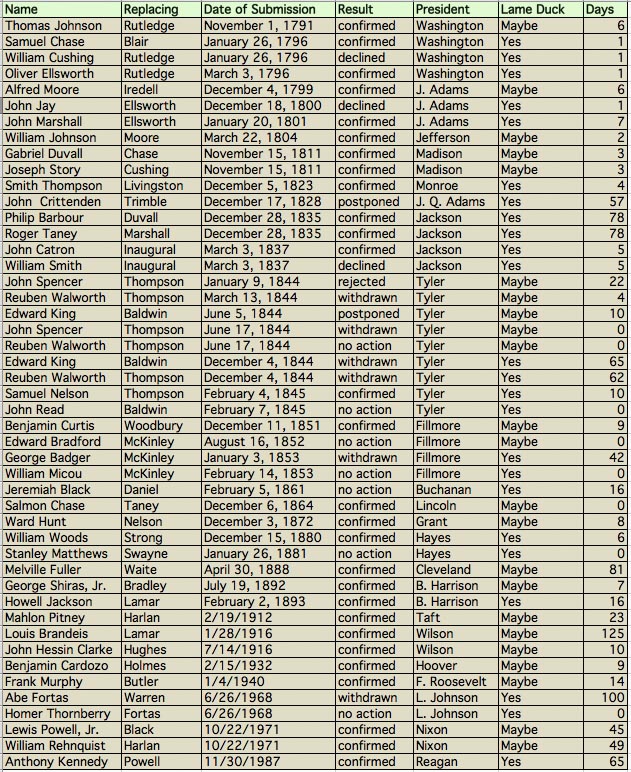
The data can be parsed in many different ways, but here are a few salient observations:
- 47 of the 112 justices in Supreme Court history were submitted in the
last 18 months of a presidential term.
- Of those 47, 28 were confirmed, six were withdrawn, three declined the
offer, two were rejected, and for eight no decision was made.
- Just over half of those 47 were placed into nomination by a president
whose lame duck status was official.
- For official lame ducks, it is 11 confirmations, four withdrawals, three
declines, one rejection, and five where no decision was made.
- The average length of time for a decision to be made is 37 days; the longest
a nominee has languished is 261 days. There are 342 days left in Barack Obama's
term.
- Late-term appointments were vastly more common in the 19th century than they are today. In part, this is because justices live and serve longer now, so there is less turnover. And in part it is because the Court's increased importance over time has caused more justices to strategically "time" their resignations and retirements; rarely does a seat come open in the third/fourth year of a president's term unless a justice dies unexpectedly.
The upshot is that there is no "tradition" of lame duck presidents withholding their Supreme Court nominations in order to "give the voters a chance to weigh in." The Court has business to do, the President has a role in making sure that business gets conducted, and no chief executive—including Ronald Reagan—has declined to fulfill their responsibilities because their time in office was short. Grassley, Rubio, and Cruz zoomed in on "80 years," because only two vacancies have occurred in the last 18 months of a president's term during that time (one each for LBJ and Reagan). Two instances does not a "tradition" make, however, and in any event, both of those presidents made a nomination.
There is some precedent for filibustering a nominee (or failing to take action, which was the 19th century equivalent). However, in each case where a nominee lingered for 100 days or more, the issue was not constitutional or legal but instead 100% political. Namely:
Both John Tyler and Millard Fillmore were Democrats-turned-Whigs who assumed the presidency on the death of the incumbent (William Henry Harrison and Zachary Taylor, respectively). They weren't Whiggish enough for the Whigs and were considered apostates by the Democrats in Congress, so their nominees were punished. In fact, Tyler's failures (he only got one of six nominees approved) gave us the longest vacancy in Supreme Court history, at 27 months.
Woodrow Wilson's nomination of Louis Brandeis outraged conservatives in Congress, who deemed the justice-to-be "too radical." There was also some amount of anti-Semitism driving opposition to the appointment, though it was eventually approved.
LBJ's nomination of Abe Fortas to the chief justiceship (and Homer Thornberry to fill the associate seat that would have been vacated by Fortas) is the case that the GOP is currently hitching its wagon to; Cruz specifically mentioned it during the debate. In Fortas' case, Congressional Republicans were angry about the Great Society, Democrats about the Vietnam War, and both sides felt the nominee was too closely connected to the President, so they refused confirmation.
Certainly, it is entirely possible for Obama's nominee to be held up for the rest of his term. More than a dozen of his appointments to lower courts have already waited for a year or more. But the President's opponents cannot rest on "custom" or "tradition" or "precedent" as their reason. Sooner or later, as the president's choice waits longer than any appointee ever has, it will be obvious that the delay is pure politics. And at that point, the question will be whether the calculus adds up for the GOP.
So, then, what is the calculus? Obviously, losing control of the Court for a generation or more is a big problem, but it may become clear by May or June that the presidential contest is hopeless for the Republicans (e.g., Trump vs. Clinton) and that that ship has sailed. Both sides will use "the future of the Court is on the line" as a get-out-the-vote tool; this seems likely to benefit Democrats more than Republicans, both because there are more of them, and also because many of the Democrats (a.k.a. the Sanders supporters) are specifically angry about Citizens United and want to make sure it gets overturned. If Democratic turnout is up relative to Republican turnout, it could flip control of the Senate, and even the House. So, there may be something to be said for making the best of a bad situation and working with Obama to find a centrist nominee that is tolerable to both sides. Otherwise, the GOP could get punished in the election, lose one or both houses of Congress, and end up with a real fire-breathing leftist on the Court in 2017. If Hillary Clinton wins the Democratic nomination she may have to placate Sanders to get his endorsement and one way to do so is to give him a veto on Supreme Court nominees, all done quietly, of course. Overall, between this situation, Donald Trump, the tea party, and half a dozen other headaches, it's not a fun time to be a leader of the Republican Party. (Z)
Could Obama Make a Recess Appointment to Replace Scalia?
If Obama really wants to stir the pot, he could make a recess appointment to temporarily replace Scalia until the next Senate is chosen. The Constitution gives the President the power to temporarily fill vacancies without Senate approval when the Senate is not in session. But remember, in the 18th Century, the Senate often wasn't in session and it took weeks for all the senators to reassemble in Washington, especially in the winter when their horse-drawn carriages could get stuck in the mud. In fact, even notifying the senators to reassemble was a real problem since the Morse telegraph wasn't even tested until 1837.
The Senate is likely to recess later this year so members can hit the campaign trail. Suppose Obama seized the opportunity and made a recess appointment. What would happen next? Short answer: all hell would break loose. The Supreme Court recently decided a case involving the power of the President to make recess appointments: National Labor Relations Board v. Noel Canning. It was a mixed decision, with some things for the President and some for the Senate (which opposed the appointment). The Court ruled the recess power applies even for a break in the middle of a session but it also ruled that the break has to last more than 3 days.
Of course, wily old fox McConnell could keep the Senate formally in session until the new Senate is installed next January. To do that, he would ask Republican senators who live closest to D.C. to show up once or twice a week to hold a session. The closest states with Republican senators are Pennyslvania, West Virginia, and North Carolina. Sen. Pat Toomey (R-PA) and Sen. Richard Burr (R-NC) are up for reelection, so they are excused. So Sen. Shelley Moore Capito (R-WV) and Sen. Thom Tillis (R-NC) would take turns showing up and gaveling the Senate into session. Then they would ask the empty room: "Do I hear a motion?" Failing to hear one, they would announce a lunch break lasting until the next morning. If Obama claimed the Senate wasn't really in session and made a recess appointment, the case would end up in the Supreme Court and it wouldn't be clear if the newly nominated justice could vote to break the 4-4 tie. Just imagine a justice having to make the decision on his or her appointment to the Court? It wouldn't be pretty. There is much more on recess appointments at SCOTUSbog. (V)
Lawsuit Filed in Voter ID Case
The executive director of the U.S. Elections Assistance Commission has unilaterally changed the federal voting registration form to require proof of citizenship. He was immediately challenged by the League of Women Voters and other groups. The director, Brian Newby, is no newbie to elections. He previously worked under Kris Kobach, Kansas' Secretary of State, a champion of requiring photo ID to vote and other restrictions. Civil rights activists say that many poor people do not have state-issued photo ID cards and can't afford documents (such as birth certificates) to get one, even if the voter-ID cards themselves are free. In the past, states wanting to require voters to show photo ID have lost. This case is certain to end up in the U.S. Supreme Court, which could easily deadlock 4-4 if it gets the case before Scalia is replaced. (V)
Trump Way Ahead in South Carolina
A new poll conducted for Fox 5 Atlanta, the Augusta Chronicle, and the Morris News Service by Opinion Savvy, an organization we have never heard of before, has Donald Trump with a huge lead in South Carolina. For what it is worth, here are the numbers.
| | ||
| Rank | Candidate | Pct |
| 1 | Donald Trump | 36% |
| 2 | Ted Cruz | 19% |
| 3 | Marco Rubio | 15% |
| 4 | Jeb Bush | 11% |
| 5 | John Kasich | 9% |
| 6 | Ben Carson | 5% |
Trump leads every age group except the millennials. He also leads in every other demographic group. Of note here is the comeback of Marco Rubio to third place, if one considers getting 15% as a victory of sorts. The poll was taken after the New Hampshire primary but before the Republican debate. (V)
Republicans Get Nasty in South Carolina
With the passing of Antonin Scalia, the ninth GOP candidates' debate ceased to be the lead story of the day. Still, the six men on stage did their best to make some headlines, nonetheless. Here are the main story lines:
The Scalia Question:The debate began with a moment of silence for the deceased justice, followed by a round of questions about replacing him. The responses were predictable—he was a conservative giant who needs to be replaced by an originalist, which Barack Obama just doesn't understand. The most interesting responses came from Donald Trump, who admitted that if he was in Obama's shoes, he would certainly try to make an appointment, and Jeb Bush, who said he would not require a specific litmus test (for example, on abortion) for prospective nominees.
The Ugliest Debate So Far, By Far: One might have thought that the death of one of the nation's leading conservatives would impose a certain restraint on the evening. And one would have been wrong. Whether it is because actual votes are now being cast, or desperation, or weariness with the campaign, or the South Carolina weather, nearly all of the candidates came out ready to rumble. Donald Trump was the most aggressive, attacking Ted Cruz and Jeb Bush head on, describing the former as a "nasty guy," blaming the latter's brother for the 9/11 attacks, and calling both men liars. Cruz and Bush both gave as good as they got, and Cruz had some success at causing The Donald to lose his cool. Cruz also locked horns with Rubio on several occasions, far more aggressively and nastily than in the past. Kasich waded in on occasion, also targeting Trump, though the Kasich-Trump duel was mere fireworks as compared to the dynamite being hurled in the Trump-Cruz and Trump-Bush showdowns. Only Carson stayed above the fray though, in fairness, he may have been asleep. Meanwhile, the crowd was...rowdy—not only cheering and booing loudly, but also shouting, and whistling, and catcalling. If one listened to just the audience, one might be left with the impression that they were watching a rodeo or a wrestling match, not a presidential debate. Such Jerry Springer-style theatrics (and that was indeed the program that the evening brought to mind) might be entertaining, but surely they are beneath the dignity of the presidency.
Whither MarcoBot? There are two pieces of good news for Marco Rubio. The first is that he didn't perform nearly as badly as in the last debate. The second is that other stories were significant enough to push his performance down to third place on the list. However, he was still quite obviously relying on canned talking points for much of the evening. For example, "Our culture's in trouble. Wrong is considered right and right is considered wrong." Whatever that means. And when he went off script, he didn't fumble, but he did turn nasty. For example, when addressing a comment from Ted Cruz about an interview that Rubio conducted on Univision, the Florida Senator responded, "I don't know how he knows what I said on Univision because he doesn't speak Spanish." Then he called Ted Cruz a liar, which launched a 90-second shouting match between them. Rubio probably feels quite good about his performance, but he shouldn't. He looked like a small man tonight.
The Real Donald Trump, Jeb Bush, and John Kasich: At least three of the six men on stage are not conservative Republicans, and on Saturday night the trio owned that fact more clearly than at any point so far. Trump, as noted, went against right-wing orthodoxy by acknowledging that he would do what Obama is doing in appointing a Scalia replacement, and in blaming George W. Bush for the 9/11 attacks (Rubio cleaned that one up later by making clear that it's Bill Clinton who is to blame). Trump also had positive things to say about Planned Parenthood. Kasich and Bush, for their parts, both embraced their inner moderates. They each lamented the anti-immigrant rhetoric of their opponents, acknowledged a willingness to work with the other side to get things done, and made a variant of the "I'm a conservative who can actually win the election" argument. Between this and the fire he showed in dueling with Trump, Bush gave the performance of the night, which makes three debates in a row where he's been at or near the top of the class. If he had discovered this version of himself six months ago, we might have a different race. Now, we will see if his rebirth came in time.
It's two weeks and another 80 delegates until the candidates meet again, presumably sans Carson. There are no more "bromances" and the slings and arrows hurled on Saturday night will not be forgotten. So expect a nasty two weeks on the campaign trail and another bloodbath in Houston on Feb. 25. (Z)
Back to the main page