Previous | Next
Trump Is Very Close To a Majority
If we update our Republican delegates spreadsheet, taking into account Tuesday's results and using Larry Sabato's Crystal Ball for the states that haven't voted yet (marked in yellow), we get this picture:
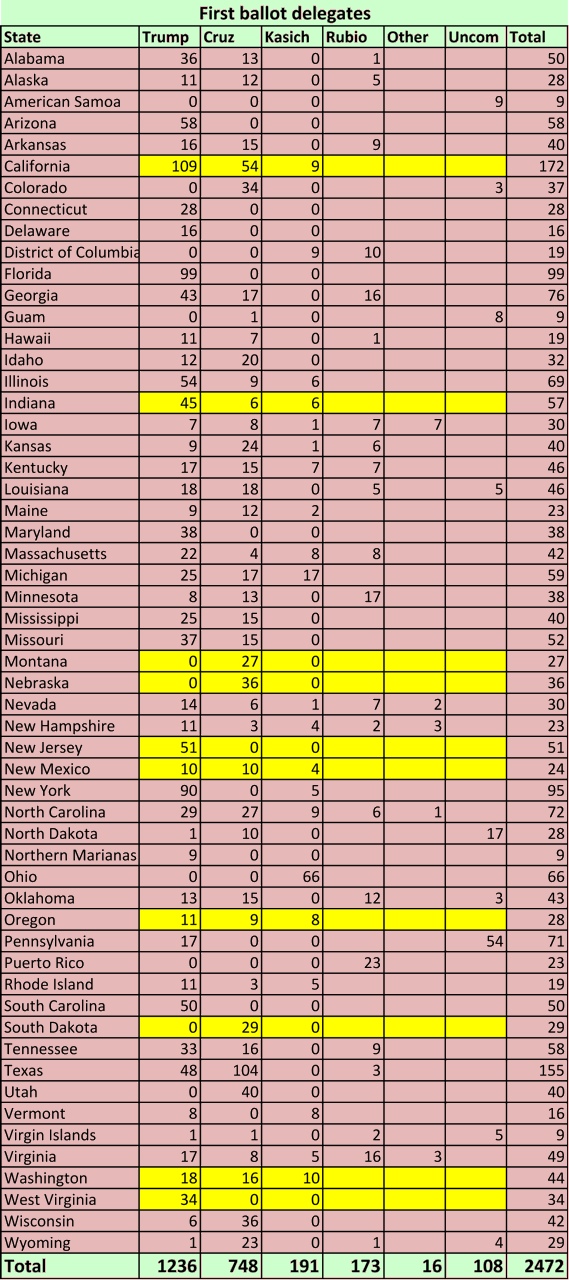
The prediction here is that Donald Trump will finish with 1,236 delegates, one delegate shy of a majority. If he gets that far, he will certainly be the nominee because at least 39 of Pennsylvania's unbound delegates have said they will vote for Trump on the first ballot. This means that Trump really needs only 1198 pledged delegates to get a majority on the first ballot. That is looking more likely every day. (V)
In Hail Mary Play, Cruz Picks Fiorina for Veep Slot
Yesterday afternoon, Sen. Ted Cruz (R-TX) announced that if he is the Republican nominee for President, he will choose Carly Fiorina as his running mate. He based his decision on thought and prayer. This is not the first time a candidate has announced his Veep choice before getting the nomination. In 1976, Ronald Reagan said that if he were to be the nominee, he would choose Pennsylvania senator Richard Schweiker as his running mate. Reagan made this decision to win the hearts and minds of the Pennsylvania delegation at the convention but the ploy failed. The convention chose President Gerald Ford as the nominee. Despite this one precedent, it is a very unusual thing to do and indicates that Cruz is desperate and needs to shake things up and fast, in particular before next Tuesday's primary in Indiana. If Trump wins that, it will be nearly impossible to stop him. Fiorina has a mix of characteristics that may or may not help Cruz much. Here are some of her pros and cons.
* PRO FIORINAShe's a woman. This is probably her biggest asset. Many women, including Republican women, hate Donald Trump and picking Fiorina is a fairly transparent ploy for their votes in the remaining primaries. Also, in the general election, she could attack Hillary Clinton 24/7 and probably not be called sexist.
She is like a tethered goat. When going after dangerous animals, hunters will sometimes tether a goat near their blind and wait for their target to show up. We already know that Donald Trump doesn't think Fiorina is likely to do well in one of his beauty pageants and Cruz is hoping that he will repeat some of the things he has said about her before. The temptation may prove overwhelming and Trump may end up saying something that proves fatal in the upcoming primaries. No other choice has so much potential for causing Trump to say something that hurts him with so many voters.
She knows the issues. Republican candidates who understand the issues and can speak intelligently about policy questions are few and far between this year. She is one of the best. If a reporter asks her what newspapers she reads, she isn't going to say "What's a newspaper?" Sarah Palin style. She knows her stuff and is not gaffe prone.
She is a good debater. If she makes it to the vice presidential debate, she will be able to hold her own against whomever Clinton picks. She can both attack and defend well.
She is an outsider with business experience. In a year when the voters seem to be trying to send the politicians a message, having a person who has never held political office (through no fault of her own) but has business experience, may be a plus.
* CON FIORINA
She's a patrician. Sarah Palin could boast that she was the daughter of a secretary and teacher and thus understood middle-class problems. That won't work for Fiorina. Cara Sneed, as she was formerly known, is the daughter of Joseph Tyree Sneed III, a lawyer who later was a full professor at the Stanford Law School and then Dean of the Duke Law School until Richard Nixon tapped him as deputy attorney general, the number two position in the Justice Department. When a vacancy opened up in the U.S. Court of Appeals for the Ninth Circuit, Nixon appointed him, where he served for 35 years. So Fiorina was born to power and wealth. As the Washinton Post's Richard Cohen succinctly put it: "She always knew the fork goes on the left."
She fired 30,000 people at Hewlett-Packard. When she was CEO of Hewlett-Packard, she fired 30,000 people. At a time when blue-collar workers are worried about their jobs, this is not exactly the business experience that they want—another job destroyer, like Mitt Romney. How long will it take Donald Trump to say: "I like business leaders who create jobs, not leaders who destroy them"?
She herself was fired. It is extremely rare for a Fortune 100 company to fire its CEO. You have to be really incompetent to pull that off, but Fiorina was fired by her board of directors in a very public way. But at least they gave her $21 million as a going-away present so she wouldn't feel bad about it. The day she was fired, the company stock went up by $3 billion, indicating that investors thought HP was worth a lot more without her than with her. That's not much of a testimonial.
She was crushed in her Senate race. One of the things Cruz desperately needs is to win the California primary. Picking someone that Californians know very well from her failed 2010 Senate race against Sen. Barbara Boxer (D-CA) and who they overwhelmingly rejected seems like an odd move, but maybe Cruz knows something no one else knows.
All in all, such a target-rich Veep seems more like a lead chain around Cruz's neck than a life jacket. (V)
Trump Likely To Get More Primary Votes Than Any Republican in History
With his blow-out wins Tuesday, Donald Trump has already gotten more Republican primary votes (10.1 million) than Mitt Romney did in 2012 and is almost certain to end up with more primary votes than any Republican in history. If Trump falls just short of 1,237 votes at the convention, he is surely going to point out that he got more votes than any Republican ever did and denying him the nomination would set off a firestorm. (V)
Trump's Speech Does Not Impress Experts
Donald Trump's new adviser, Paul Manafort, is trying to make him look more presidential, so he instructed Trump to give a speech on foreign policy to an invitation-only group of elites and journalists. The speech was very different from previous ones. For one thing, although he has constantly mocked President Obama for reading his speeches from a TelePrompTer, Trump read his speech from a TelePrompTer. In addition, he clearly didn't write the speech since it was written at an eighth-grade level, rather than a third-grade level, as his previous speeches have been. He even mispronounced some of the words.
It didn't impress the experts. Bud McFarlane, Ronald Reagan's National Security Advisor, said it was lacking in policy prescriptions and "its strident rhetoric masked a lack of depth." Sen. Lindsay Graham (R-SC) said the speech was "full of disconnected thought" and demonstrated a "lack of understanding of the threats we face." Then Graham tweeted: "Ronald Reagan must be rolling over in his grave."
The strange part of this is that given that Trump outsourced the speechwriting, why didn't he hire someone who knows a lot about foreign policy to write a good speech? Maybe he doesn't know anyone who understands foreign policy. It would be perfectly acceptable for Trump to admit that he is no foreign policy expert, but plans to have experienced professionals as Secretary of State and National Security Advisor. No one would even think that to be unusual. (V)
Latinos Registering in Record Numbers
About 9.7 million Latinos voted in 2008 and 11.2 million voted in 2012. And now, based on the current rate of new registrations, it is projected that 13.1 million will vote in 2016. That, of course, would be a record. To nobody's surprise, the spike in registration appears—by all evidences—to be due to Donald Trump. In some states, as many as 80% of Latino voters say that Trump makes them more likely to vote against the Republican candidate, whoever he may be. So, the billionaire looks like he is going to hurt the Party in 2016 (and probably beyond) whether or not he gets the nomination.
The largest number of new registrants are in Texas and California, two states that are a done deal, regardless of how many Latinos sign up to vote. However, next on the list are Florida, Colorado, and Nevada—all of them swing states that could very well be swung by Latinos. After them is Arizona, which is looking more and more like it could be in play, too. The only way for the GOP to offset the Democrats' hypothetical gains among Latinos would be to get a massive—and unprecedented—increase in the white vote. Not going to happen. And so, once 2016 is in the books, it could well be remembered as the year when Latinos truly arrived as a key voting bloc for the Democratic Party, on par with black voters or Jewish voters or labor. (Z)
It's California or Bust for Sanders
After losing the four biggest states that voted on Tuesday, Sen. Bernie Sanders (I-VT) has reassessed his campaign and decided to fire hundreds of paid campaign workers and focus on the remaining states, mostly California, which has 475 delegates. What is significant is that he is letting them go, rather than simply redeploying them to California. Sanders' fundraising has been prodigious, but his burn rate is also prodigious. It may well be that he simply can't afford to move all the campaign workers to California, a state he can't afford to lose. (V)
Democrats Want to Win While Republicans Want to "Send 'em A Message"
Tuesday the insiders did very well in the Democratic primaries. Hillary Clinton won four of the five states that voted. The establishment candidates for the Senate in Pennsylvania (Katie McGinty) and in Maryland (Chris Van Hollen) won their primaries easily. It was a clear victory for the establishment.
In contrast, on the Republican side, the establishment is having a fit. The only chance of stopping the extremely antiestablishment front runner, Donald Trump, is to prop up another antiestablishment candidate, Ted Cruz. Either way, the institutional party loses. The difference between the parties is striking. Clearly, Democrats are focused on winning and are voting for the strongest general election candidates. Republican voters seem less focused on winning and more focused on telling the party leadership that they are sick and tired of the party just doing the bidding of the donor class. And they have been saying this all along, initially by supporting other outsiders like Ben Carson and Carly Fiorina and showing no interest whatsoever in ultimate insider Jeb Bush.
Much of the problem the Republicans have can be laid at their own feet. Unlike the Democrats, who blame forces outside the party (like big banks) for society's ills, Republican voters blame their own leadership for lying to them for years. The leaders have constantly told the voters that if only they controlled Congress, they could repeal "Obamacare," make abortion illegal, etc., knowing full well that they could do none of these things. The rubes believed them and gave them control of Congress, but they can't deliver and now the rubes are angry. The Democrats—especially Hillary Clinton—have been very careful about making promises they know they can't keep. Even the most idealistic "Democrat," Bernie Sanders, is promising to do only things like reinstating an old law (Glass-Steagall) that was in effect for 60 years and worked well. (V)
Putin Has Chosen His Horse
RT, short for Russia Today, is a worldwide cable channel headquartered in Moscow and offering a "Russian perspective on world events" in the English language. In that way, it's like the BBC or Al Jazeera. There is one big difference, however: Those two channels are essentially independent, while RT takes its marching orders from Vladimir Putin. And now, RT—and, by extension, Putin—have begun to signal a clear preference in the presidential race. It is, of course, Donald Trump.
The channel does not have much market penetration in the United States. It's available on a few of the smaller cable providers like the Dish Network, where it's buried deep in the channel lineup, and can also be streamed online. It's hard to imagine, however, that very many voters are taking their cues from a cable television channel that specializes in lies, distortions, and propaganda. Well, not one headquartered in Russia, at least. Consequently, if Putin's "endorsement" does have an impact, it will be to allow Hillary Clinton (or, at least, her surrogates) to label Donald Trump as "the candidate of Putin." Surely, that's got to be a negative, even with The Donald's base. Of course, maybe Putin knows this, and his real plan is to help Hillary. With clever old Vlad, you just never know. (Z)
Clinton May Get Some Help With Doobie-ous Sanders Supporters
With enough signatures having been collected and submitted to Secretary of State Matthew Dunlap, it was announced on Wednesday that the good people of Maine will (probably) have an opportunity to vote on the legalization of marijuana in November.
The smoking habits of the residents of the Pine Tree State are not in and of themselves of interest, perhaps. But the story is a reminder that a large number of states will be considering similar referenda in November, perhaps as many as 20 of them, including the two biggest swing states: Florida and Ohio. Meanwhile, polls show that the voters who care most about legalizing pot are young, white liberals. In other words, Bernie Sanders voters. Consequently, even if Hillary Clinton can't quite get those who are feeling the Bern excited about her candidacy, the ganja may just come to the rescue and get them to the polls (probably while they are out getting snacks). (Z)
Back to the main page