Previous | Next
Trump Might Just Make It
Donald Trump did better than expected in New York, winning about 90 delegates. The final total could be off by one or two though. If we use Larry Sabato's district-by-district analysis of the remaining states, combined with the known delegate totals from states that have already voted (from the Green Papers), here is what we get. The yellow states haven't voted and use Sabato's projections.
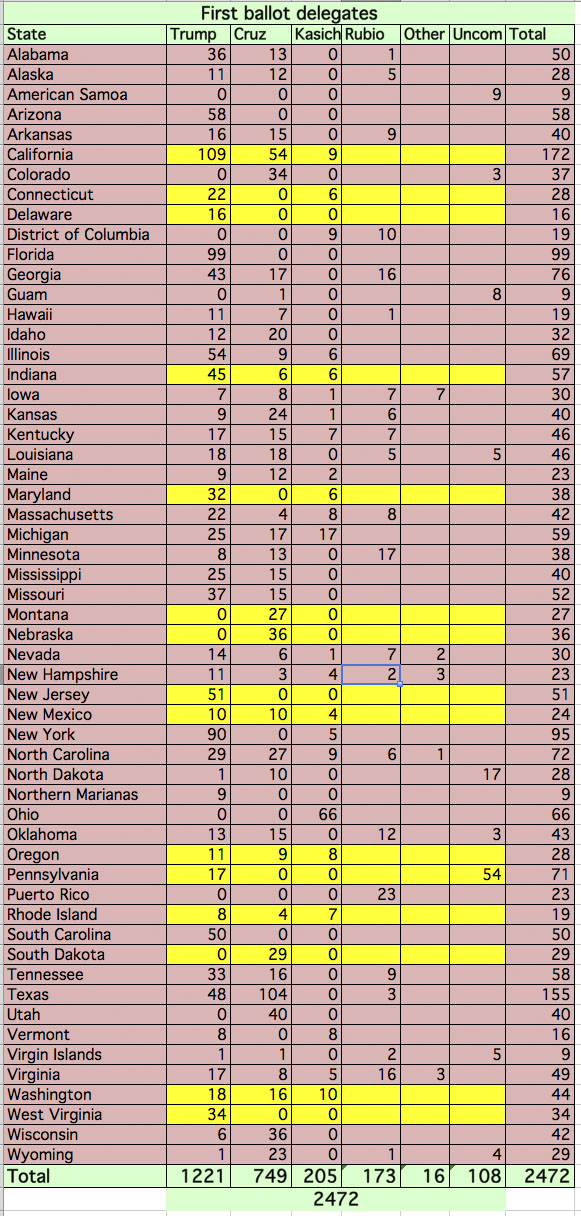
The bottom line for Trump is he is projecting out to 1,221 delegates, 16 shy of the 1,237 needed to win on the first ballot. But there will be over 100 uncommitted first-ballot delegates, of which Trump needs only 16. The pressure on these people is going to be enormous from all sides—Trump, Sen. Ted Cruz (R-TX), and Reince Priebus—all of whom have different agendas. A lot depends on what happens June 7, when California, New Jersey, New Mexico, Montana, and South Dakota vote. If you want to play with the data yourself, the above table is available here in Excel format. (V)
Trump Triumphed Across the Board in New York
Donald Trump's victory was complete (with one footnote, below). He got 60.4% of the vote to Gov. John Kasich's (R-OH) 25.1% and Ted Cruz 's dismal 14.5%. Trump won with just about every demographic group. He won equally with men and women, won in all age groups and educational levels and income groups. He won in New York City, the NYC suburbs, the Hudson Valley, and upstate. He won cities, suburbs, and rural areas. He won conservatives and moderates. OK, you get the picture. Maybe it is easier to list the groups he didn't win. He lost badly among voters who think Kasich would be the strongest candidate against Hillary Clinton. He lost among people who want a candidate that shares their values. Finally, he lost among voters who want the next President to have experience in politics. Other than that, he ran the table.
The one footnote is that the only county in the entire state that Trump lost was New York County (Manhattan)—Trump's home base and the county that is full of buildings that have big signs reading TRUMP on them. Kasich won there. Fortunately, Trump is not easily embarrassed. (V)
Who's Voting For Trump?
Following Donald Trump's across-all-demographics victory in New York, The Economist has taken a closer look at his base of support. And they noticed something interesting: While he certainly draws a lot of support from white, working-class types, he's also doing well with wealthy and educated Republicans.
Working with the states for which there are exit data, the numbers suggest that about 20% of Trump's supporters have a high school education or less, but 43% have a college degree. Meanwhile, 32% of The Donald's base makes less than $50,000 a year, while 34% makes over $100,000 a year. The magazine's conclusion: "The idea that it is mostly poor, less-educated voters who are drawn to Mr Trump is a bit of a myth...It would seem Mr Trump is a broadly appealing fellow after all." It's an interesting and useful corrective to the dominant narrative, though it does not change the fact that winning a bare majority of the minority party's support is not a path to the White House, no matter how you slice it. (Z)
Clinton Beat Sanders in Many Demographic Groups, but Not All
Unlike the Republican race, where Trump won all the marbles, the Democratic race was a mixed bag. Hillary Clinton got 58% of the vote, but her performance was uneven. She won in New York City, Buffalo, Rochester, and Syracuse, as well as in all their suburbs, but Sen. Bernie Sanders (I-VT) carried the day in all the rural parts of the state. Clinton won women by 22%, but lost men by 4%, which may foretell a big gender gap in November. As usual, Sanders trounced Clinton by 44% in the 18-29 year-old group, but once you hit 30, you're for Clinton. Sanders won white voters by 2% but Clinton crushed him by 50% with black voters and by 26% among Latinos. Clinton swept all income levels and all issue-oriented voters except those who think inequality is the top issue. When asked which candidate would do better on gun control, each candidate's supporters were almost unanimous that theirs would be better. They also almost unanimously thought their candidate would make a better commander in chief. Clinton voters think she is honest; Sanders voters don't buy that.
It is quite likely that next week is going to be more of the same, except bigger. New York had 247 delegates up for grabs on Tuesday. Next week, 384 delegates are up in five states, all of which have similar demographics to New York. If Clinton gets 58% of the vote there and 58% of the delegates, it will be a net gain for her of about 50 delegates.
Sanders will have a good May because Indiana, West Virginia, Kentucky, and Oregon vote then, and he might win them all, but together they have only 228 delegates. In June, California and New Jersey weigh in, and Clinton will finish the season with big wins there. (V)
Supreme Court Upholds Arizona Redistricting
In a major redistricting case, Harris v. Arizona Independent Redistricting Commission, late yesterday the Supreme Court unanimously rejected an attempt by Arizona Republicans to undo an electoral map drawn by an independent commission. It is a long story, but this is clearly a major victory for the Democrats and for citizens who are against partisan gerrymandering by both parties.
The Constitution gives the state legislatures the power to run their states' elections, including the power to draw legislative district maps. Whenever one party controls the trifecta in a state (both chambers of the legislature and the governor's mansion), the map wonks in the dominant party go to work to draw the most favorable conceivable map, which often leads to very strange looking districts, but ensures the dominant party has a big advantage in House and state elections. For example, Pennsylvania has 13 Republican representatives and only 4 Democratic ones, even though Pennsylvania is a very blue state in presidential elections. What happened was Democrats didn't bother to vote in 2010, so the Republicans won and drew a map favorable to them. That happened in many states. In some states, the voters got sick enough of this gerrymandering that they passed referendums creating independent commissions to draw nonpartisan maps. Arizona did that in 2000 and last year the Supreme Court, in a 5-4 decision, held that even though the map wasn't literally drawn by the legislature, the fact that the legislature created the referendum process and the map was a consequence of it was good enough.
This time the fight was over the fact that the districts drawn by the independent commission were not exactly equal in population. Making all districts exactly equal is impossible given the constraint that map-makers don't want to split precincts (which would mean some voters in a precinct would be in one congressional district and some in another, an impossible task). Map makers also try to use natural boundaries (e.g., rivers) or political boundaries (e.g., city limits) in drawing logical maps. The new map favors the Democrats but the Court ruled that was not the goal but simply an artifact of the commission trying to avoid splitting minority communities down the middle. By putting the entire minority community (e.g. in a city) in the same district, the map may be somewhat uneven but increases the chance of the minority being able to elect its chosen person in the district at hand. The ruling said that some inequality in population is acceptable if that is a byproduct of trying to protect minority voters.
It is not clear how this decision will play out in the future. One of the commission's arguments was that it was trying to obey the Voting Rights Act, which the Court has since struck down. In future cases, that won't be an issue. (V)
Southern Democrats Feeling Berned by Sanders
Bernie Sanders has been dismissive of Hillary Clinton's success in the South, implying that those states don't really count because they tend to turn red during the general election. The chairs of five Democratic state parties in the region—Allison Tant of Florida, DuBose Porter of Georgia, Karen Carter Peterson of Louisiana, Ricky Cole of Mississippi, and Jaime Harrison of South Carolina—have now heard quite enough, and have sent the Vermont Senator a polite but firm letter telling him to knock it off.
They have three basic complaints. First, the letter observes that by dismissing the South, Sanders is inherently denigrating the black voters that make up the backbone of the Party in the region. Second, they believe that the Democratic Party is on the upswing in the South, and that the region should be viewed as a growth opportunity and not a write-off. Finally, they complain that Southern Republicans are enough of a headache as it is, and they don't need their own party piling on as well.
The letter's authors leave no ambiguity as to where their loyalty lies, since the missive closes with a paragraph praising Clinton. "She has not dismissed the importance of states that you have won," they write, "because she realizes that to be President of the United States you have to be a champion for all of the states." Still, Bernie Sanders is a reasonable man, and the points raised are good ones. Expect to see this particular line of attack disappear from his repertoire. (Z)
Kos Has Had It With Bernie Fans
Markos Moulitsas, the founder and publisher of Daily Kos, which is ground zero for liberal activists, has had it with supporters of Bernie Sanders, who are thick on the ground at Daily Kos. He wrote a piece in which he kind of read Bernie's supporters the riot act. Among other points, he brought up:
- The New York loss was devastating to Sanders because it takes 247 delegates off the table
- The NY polling was excellent and the polling for next week spells more big losses for Sanders
- Stop whining about closed primaries; Democrats should be the ones to pick the Democratic nominee
- Sanders' campaign manager can talk about winning over the supers but it ain't gonna happen
- Momentum means nothing in politics; demographics means everything—and that helps Clinton
- Sanders deserves some credit: He has no chance but the money keeps rolling in
In 1968, when TV anchor Walter Cronkite became critical of the Vietnam War, Lyndon Johnson is reputed to have said: "If I've lost Cronkite, I've lost Middle America." This year, if you've lost Kos, you've lost the battle to get Sanders nominated. Henceforth, the liberal site will focus on helping Clinton defeat the Republican nominee in November. (V)
Kasich Says GOP "Doesn't Like Ideas"
John Kasich sat for a lengthy interview with the Washington Post on Wednesday. The money quote from the conversation was a combined dismissal of Donald Trump/Ted Cruz and a lament about the state of the Republican Party:
If you don't have ideas, you got nothing, and frankly my Republican Party doesn't like ideas. They want to be negative against things. We had Reagan, okay? Saint Ron. We had Kemp, he was an idea guy. I'd say Paul Ryan is driven mostly by ideas. He likes ideas. But you talk about most of 'em, the party is knee-jerk 'against.' Maybe that's how they were created.
This immediately raises two questions. The first is: Did you just realize this, Gov. Kasich? One wonders if he has been watching, say, the last four presidential elections. Perhaps he was riding the turnip truck until late yesterday evening.
The second is: Do you know how the game works, Gov. Kasich? He is, of course, hoping to emerge triumphant at a contested convention, which is why he's conveniently making a point of comparing himself to (a) the most popular Republican of the last 50 years, and (b) the guy who will almost certainly be chairing this year's convention. But if there is one thing we have learned this year, it is that the party pooh-bahs are not calling the shots. And if Kasich thinks that essentially insulting the rank-and-file is a good way to pile up 1,237 delegates, he's got another think coming. (Z)
Trump's Plane Is Not Registered
Donald Trump is not only sloppy about wrangling delegates, he is also sloppy about other things—like making sure it is legal to fly in one of his campaign planes. The plane's registration lapsed on Jan. 31 and has not been renewed. It is illegal to fly an unregistered plane, with a possible fine of $250,000 and three years in prison for offenders. However, this snafu won't ground Trump, as he owns four other aircraft he can use. His big, luxurious Boeing 757 is registered, but it weighs over 100,000 pounds and cannot land at many smaller airports, which is why he often uses the (unregistered) Cessna 750 Citation X. Of course, he can just go out and charter another Cessna until his becomes legal again. (V)
May Hearing Set for Release of Trump University Lawsuit Documents
Donald Trump is having some trouble on the ground as well as in the air. Several students have sued him, claiming he fraudulently deceived them into signing up for Trump University and then failed to deliver the education in real estate he had promised them. Trump denies the charges and a trial is expected in California in the summer.
In another development, the Washington Post has asked the judge to unseal the documents, saying they are relevant to the presidential election and the public should know what is in them. The judge has set a hearing date in May to examine the Post's case. If the Post wins, no doubt lots of dirty laundry will be exposed and will put Trump on the defensive. (V)
Laughing at Ted Cruz
You may have heard that Sen. Al Franken (D-MN) was a comedian in a past life. Last Friday, he got his entertainer's pants out of mothballs for a performance at MinnRoast, an annual variety show hosted by the Minneapolis Post. His set, which might be regarded as something of an audition for the VP slot, was largely composed of bon mots at the expense of Ted Cruz, whom Franken described as "the lovechild of Joe McCarthy and Dracula." The Minnesota Senator also issued forth with this line, which reportedly brought the house down:
Cruz can be really hard to get along with, but I understand that in a couple weeks he's planning to launch a charm offensive. He's having a little trouble with the charm part but he's got the offensive part down cold.
Presumably, the Texas Senator is used to being a target of Democrats (and many Republicans, for that matter), and pays the opinion of one of the Senate's more liberal members no heed. Harder to ignore, however, is a bit of very embarrassing news that turned up in New York once everyone took a closer look at Tuesday's results. In NY-16, Cruz finished in fourth place, behind Donald Trump, John Kasich, and...Ben Carson. It sends an interesting message when Republican voters would prefer someone who is not in the race any more to Cruz. Assuming he doesn't get the nomination this year, Cruz definitely believes he'll be the favorite in 2020. The profound disdain people feel for him across the spectrum suggests that he's fooling himself, Santorum-style. (Z)
Back to the main page