Previous | Next
Sanders Wins Wyoming
Sen. Bernie Sanders (I-VT) extended his winning streak to seven states with a big win in the Wyoming caucuses yesterday, taking 56% of the vote. Sanders has done well in both caucuses and states with an overwhelmingly white population and Wyoming fits the bill on both criteria. That said, Wyoming's small size and its allocation rules meant that the Vermont Senator got the exact same number of delegates as Hillary Clinton did: 7.
And unfortunately for Sanders, the next state up is New York. It does not have a caucus and it is not overwhelmingly white, so that will be a much greater challenge for him. He is already campaigning very hard in the Empire State, but so is Clinton. Brooklyn appears to be the epicenter of both campaigns, with the borough being home to about one-sixth of the state's Democrats. Brooklyn has many young hipsters, who tend to vote for Sanders, but also many ethnic groups, who tend to vote for Clinton. They will continue their hand-to-hand combat in New York until the primary on April 19. (V)
Sanders Trying Hard to Appeal to Black Voters
Bernie Sanders knows that he has a problem with black voters. Consequently, he took a number of steps on Saturday to try and make some inroads with that part of the New York electorate.
To start, Sanders appeared at a rally held at Harlem's famous Apollo Theater, accompanied by filmmaker Spike Lee, singer Harry Belafonte, and Erica Garner (daughter of NYPD chokehold victim Eric Garner). During his remarks, the Vermont Senator drew a connection between his Jewish heritage and the struggles of black Americans. He also criticized the Clintons, denouncing Hillary's use of the term "super predator," decrying Bill's support for the 1994 crime bill, and demanding that the former President apologize for his confrontation with Black Lives Matter protesters earlier this week.
Sanders also released a new ad, produced by Lee, featuring Belafonte and other civil rights activists explaining why the Senator is their candidate. An interesting inclusion is journalist Shaun King, who has been at the center of several controversies over his racial identity and other matters.
Sanders has tried many of these tactics before, up to and including deploying Spike Lee, to no avail. Raising the connection to his Jewish heritage (which he rarely discusses) is new, and of course he could not previously make hay out of Bill Clinton's behavior. So the results might be different this time, though the odds are long. (Z)
Sanders Says Clinton Is Qualified to Be President
Earlier this week Bernie Sanders was saying that Hillary Clinton was unqualified to be President. Now he is taking that back. When asked point blank on the "Today" show if Clinton was qualified to the President, he answered "Of course." He could have continued to insist that she was unqualified, but that option has a strong down side: It offends Democratic women who know very well what her track record is. Also, many independents strongly dislike the fact that candidates are always attacking each other. They would prefer a more civil discourse and by backing away from a personal attack on Clinton, Sanders makes himself appear to be a more civil candidate. (V)
Trump Is Losing Indiana Even Before the Voting Starts
Yesterday, the Indiana Republican Party selected 27 of its delegates to the Republican National Convention, even though the voters won't go to the polls until May 3. It is very unlikely that any of the delegates want to see Donald Trump as the Republican nominee. If Trump wins the primary, the delegates will dutifully vote for him on the first ballot, but will desert him immediately thereafter. They will also vote on rules and credentials without taking his best interests into account. In fact, they will undoubtedly do everything they can to sabotage him on rules and credentials fights. The latter is especially important because Trump's 50-person South Carolina's delegation may be challenged due to his reneging on his promise to support the Republican nominee, as required by the South Carolina Republican Party.
Anti-Trump feeling ran strong at the Indiana convention. Craig Dunn, a candidate for delegate, said: "If Satan had the lead on him and was one delegate away from being nominated as our candidate, and Donald Trump was the alternative, I might vote for Donald Trump." Note the use of "might." Trump has run into this problem in Colorado and other states as well: A substantial number of his delegates will bolt the instant they are allowed to. Normally, when the roll is called, the chairman of each state's delegation makes a little speech like: "Idaho, home of the delicious and nutritious Idaho potato, proudly casts 16 votes for John Q. Candidate." This time we might get things like: "Indiana, home of the largest steel producing region in the United States, grudgingly and against our better judgment hereby reluctantly casts X votes for Donald Trump because Republican Party rules require us to do so." But the more Trump delegates are really Cruz delegates in disguise, the bigger the exodus will be from the Trump column on the second ballot. This almost certainly means that if Trump can't lock it up on the first ballot, there is no tomorrow for him.
Most voters are only peripherally aware that the delegate selection process is completely divorced from the primary and caucus results and having a good ground game is possibly more important than winning primaries and caucuses. As the battle for the actual delegates heats up, a lot of people are going to be surprised by how things work. The system could be fixed very easily, by simply having each candidate submit a slate of delegates, and if the candidate wins x delegate slots in the election, the first x people on the candidate's list would be the actual delegates. But that is not how it works in most states. (V)
Cruz Finishes the Job in Colorado While Trump Fumbles
On Friday, Sen. Ted Cruz (R-TX) laid claim to Colorado's 21 district-level delegates. On Saturday, he took all 13 statewide delegates. With the possible exception of the three RNC delegates who can keep their opinions to themselves (and who could well be Cruz supporters, too), the entire Centennial State delegation is now in the Texas Senator's pocket.
It's an embarrassing setback for Donald Trump, made more so by his staff's Keystone Cop-style blunders. The Cruz campaign printed a list of which thirteen delegates (out of 600 possibilities on the ballot) for whom his supporters should vote. Team Trump tried to duplicate the maneuver, but their original list was rife with errors. Seven of the thirteen names had the wrong candidate number listed, which matters a great deal when the ballot has 600 people on it. Further, the name of Trump supporter Becky Mizel was misspelled as "Mizell." When the mistakes were pointed out, the Trump forces distributed a "corrected" list that still had four numbers and Mizel's name wrong. Trump, to nobody's surprise, has had no comment on the matter. (Z)
Unbound Delegates Could Determine the Republican Nominee
While most delegates to the Republican National Convention are bound to some candidate (including candidates no longer running), nearly 200 delegates from places like West Virginia, Colorado, Pennsylvania, Wyoming, and Guam are not formally pledged to any candidate and are free to vote their conscience on the critical first ballot. They could prove especially important if Donald Trump comes into the convention with a few dozen delegates short of the 1,237 he needs to win. He will know how many pledged delegates he has after June 7, when the last states vote, including New Jersey and California.
If he sees that he is 30 or so delegates shy of the mark, the lobbying of the unbound delegates will commence. He certainly could offer every one a free trip to his Mar-a-Lago club in Florida and offer to pay all convention expenses (delegates pay their own air fare and hotel bills). Could he offer $10,000 or $100,000 for a vote? The law is not clear on that. For delegates who are government officials, probably that would be considered bribery, but for delegates who are simply politically-active private citizens, maybe not. (V)
One-Third of Trump Supporters Won't Vote for Another Republican
A new poll indicates that a third of Donald Trump's supporters won't vote for the Republican candidate in November if it isn't Trump. They will vote for a third party, the Democratic nominee, or stay home. Trump's support is something like 30% of the Republican electorate. If a third of them, which is 10% of all Republicans, really desert the Party, that would spell disaster for the GOP.
However, these PUMA (Party Unity My Ass) voters often calm down by November. We saw frustrated Hillary Clinton supporters in June 2008 swearing that they would never support Barack Obama, but most of them did in the end. So it is likely that many of the Trump supporters will come around by November. Nevertheless, some may not, because Trump is running against the Republican Party and people who support him want to send the Republicans—not the Democrats—a message. Switching to Ted Cruz or Speaker Paul Ryan (R-WI) wouldn't send any message at all. In contrast, in 2008, Hillary Clinton was not running against the Democratic Party and her voters didn't want to send the Party a message. They just wanted her to be the nominee. If even 10% of Trump's supporters sit out the election, that could be enough to swing a close election to the Democrats. (V)
Adelson May Sit This One Out
Republican megadonor Sheldon Adelson is dismayed about the Republican presidential field and may not contribute to any candidate during the primary season. And maybe not afterwards either. He is hosting the Republican Jewish Coalition's Spring meeting at his Venetian Hotel in Las Vegas this weekend. During the meeting, the attendees were asked who would raise money for Donald Trump if he were the nominee. Not one person volunteered. The assembled donors didn't show any interest in Ted Cruz either. Many of the donors are burned out after having supported candidates like Gov. Scott Walker (R-WI) and Jeb Bush earlier this year, only to see them flame out. It is likely that none of the donors will contribute to the Republican presidential race at all this year, saving their pennies (and they have a lot of pennies) for Senate and House races. (V)
Fiorina Desperately Wants to Be Veep
Former presidential candidate, former failed Senate candidate, and former CEO of Hewlett Packard, Carly Fiorina yesterday didn't rule out a vice presidential run. By keeping the door open, she was reminding the Republican candidates that she is still around and is looking for a job. The chance of her being picked is zero. Trump would never run with anyone with a face like that, as he has pointed out earlier. She is not conservative enough for Cruz and too much of a loser for Ryan. Besides, if the Republican nominee wants a woman on the ticket, there are two attractive sitting Republican governors who would be a lot better choices: Gov. Nikki Haley (R-SC) and Gov. Susana Martinez (R-NM). (V)
Boston Globe Running Fake Anti-Trump Front Page Today
Searching for a way to give more oomph to today's vitriolic anti-Trump editorial, the editorial staff of the Boston Globe put together a front page for the newspaper, dated a year from today, that imagines what the headlines under newly-inaugurated President Trump might look like. Among them:
- DEPORTATIONS TO BEGIN: President Trump calls for tripling of ICE force; riots continue
- Markets sink as trade war looms
- US soldiers refuse orders to kill ISIS families
- New libel law targets 'absolute scum' in press
- Bank glitch halts border wall work
Beyond the headlines, the page—which will run at the front of the paper's "Ideas" section—is full of interesting touches, including "Japanese Ambassador Kid Rock," Megyn Kelly being reduced to tweeting while in hiding, and Trump being nominated for the Nobel Peace Prize due to Sunni and Shi'ite Muslims having resolved their differences in order to unite against him. The bottom of the page includes the explainer: "This is Donald Trump's America. What you read on this page is what might happen if the GOP front-runner can put his ideas into practice, his words into action." Here is the fake page.
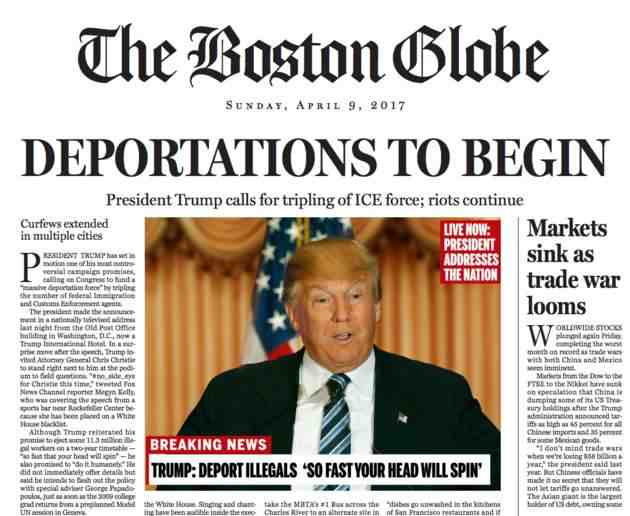
The fake page is actually something of an insider tradition at newspapers, usually created for popular staffers who are retiring or who have achieved some important milestone. Adapting the idea to this purpose is certainly going to get the Globe some attention, though one wonders how much impact it will have on Trump supporters, who tend to rank "the media" right behind "the GOP establishment" on their enemies' list. (Z)
Back to the main page