And the Winners Are...
Voters have gone to the polls and reminded us that nonpresidential-year elections tend to favor the GOP. Republican candidates and socially-conservative causes carried the day across much of America, while progressives suffered a number of embarrassing defeats. An update on the contests we previewed yesterday:
- Kentucky Governor: Polls showed a close
race, and Kentucky tends to be very blue at the state level. Nonetheless, tea partier
Matt Bevin—despite a campaign full of missteps—won an easy victory,
taking 53 percent of the vote to Democrat Jack Conway's 44 percent. He will
become only the second Republican governor of Kentucky since the 1970s. Perhaps
rumors of the tea party's demise were greatly exaggerated.
- Virginia State Senate: The votes will not be
completely counted for a few days, and a few contests were very close, but the
GOP is almost certain to keep control of both houses of the Virginia
legislature. This is a huge blow for Gov. Terry McAuliffe (D-VA), who campaigned
up and down the state in hopes of flipping the upper chamber.
- Pennsylvania Supreme Court: In one of the few bits
of good news for the Democrats on Tuesday, the party won all three open seats on
the court. This gives two of the three branches of the state's
government to the Democrats, strengthening Gov. Tom Wolf's (D-PA) position
relative to the Republican-controlled assembly. As the Pennsylvania Supreme Court
plays a role in the drawing of districts, the Democrats could be set up for the
so-called trifecta-plus (governor, both halves of the legislature, court system)
after the next census.
- Ohio Issue 1: Ohio's plan to combat gerrymandering
easily sailed to victory, with 71 percent of voters giving the thumbs up. Of
course, it won't have any impact until after the next census is complete in 2021
or 2022.
- Ohio Issue 3: To borrow a joke made by roughly
half of all headline writers in the country, Ohio will not become O-high-o, at
least not yet. Anti-drug voters joined with pot advocates who could not abide by
the plan to create a 10-producer marijuana oligarchy to defeat the measure
soundly, 64 percent to 36 percent. Expect another attempt, one without the
state-sanctioned producers, in 2016.
- Maine Question 1: Maine's a big state, and a lot of
conservative-leaning rural votes have not been collected and counted yet, but it
looks like this effort to expose the "hidden money" in elections is going to
pass, with a margin something like 52 to 48.
- Texas Proposition 6: Texans love to hunt, fish, and
harvest wildlife, and 82 percent of them just voted to add their hobbies to the
state constitution. Many other red states are likely to follow suit—such
initiatives, though largely symbolic, are an excellent way to get gun owners to
the polls.
- Houston HERO Referendum: In a shock to pollsters and
pundits, the referendum—which would have banned many forms of
discrimination, most notably against LGBT individuals—was utterly crushed
at the polls, losing by a 2-to-1 margin. Pollsters expected that the initiative
would increase Democratic turnout, and their models were built upon that
assumption. Turnout did double compared to the last mayoral election in the
city, but it appears to have been primarily social conservatives who flocked to
the polls. Such are the perils of polling in the digital age.
- San Francisco Proposition F: Airbnb bought itself a
nice victory for its $8 million, maintaining the privilege to do business in the
city—virtually without restriction—55 percent to 45 percent. The
"rent your residence" service was undoubtedly thinking big-picture; if
anti-Airbnb forces can't secure a victory in the
most liberal city in America,
it's going to give opponents in other cities pause.
Of course, next year is a presidential year and—if form holds—the Democrats should have the down-ballot advantage. It is not a coincidence, for example, that only one pot legalization measure went before voters this year, while a dozen or more may be on the ballot next year. Still, Republicans will go to bed Tuesday night feeling better about their 2016 odds than they did Monday night. (Z)
Another Headache for Pollsters
Speaking of inaccurate polling, another worrisome dynamic (for the pollsters) has already been in evidence this season: Polls conducted by telephone are generating substantially different results than those conducted over the Internet. More specifically, Donald Trump tends to come out ahead in online polls of Republican voters, while Ben Carson tends to come out ahead in polls that use live calls.
This result may seem unsurprising to observers who know that Carson draws his support from evangelicals and older Republicans (less likely to be on the Internet) and Trump draws his support from blue collar workers and younger Republicans (more likely). However, the pollsters know these things, and they adjust their models accordingly. For example, online pollster YouGov knows they will get fewer responses than they should from 85-year-old conservative black lesbian Baptist gun-owning college professors, so they overweight the responses they do get. Even with these corrections, the polls are not aligning.
This news calls to mind the so-called Bradley effect, which got its name after the California gubernatorial election of 1982, when polls incorrectly predicted a comfortable victory for black Los Angeles mayor Tom Bradley. The post-hoc explanation given for the mistake was that white respondents did not want to admit to pollsters that they planned to vote for a white candidate over a black candidate (this is called "social desirability bias"). The problem is that a great many analysts reject this explanation. And even if it is correct, it seems unlikely to be in play here, since it would posit that Ben Carson is a much more "socially acceptable" candidate than Donald Trump. Surely, that is a stretch.
That said, there is no particularly compelling explanation for the phone-Internet discrepancy, and no good indicator as to which results are more correct. It may well be the case that the pollsters will only know for certain once the ballots are counted next year. (Z)
Trump Goes After Rubio
In an ominous sign for the Republican Party, Donald Trump went after Sen. Marco Rubio (R-FL) yesterday. The problem here is that if Rubio ultimately becomes the Republican nominee, the Democrats will run ads featuring Trump dissing Rubio. Assuming Trump still has some supporters, his words could have a negative effect on Rubio's credibility.
Trump said: "He has a very bad record of finances, with his houses, he certainly lives above his means, there is no question about that." Rubio's track record on managing his own money, buying an expensive boat when he was deep in debt, mixing up campaign and personal expenses, selling his house at a loss, and more are going to be major themes during the primaries and, if he makes it that far, in the general election. From Rubio's point of view, having Trump leading off with the attacks means that a response blaming the Democrats won't work. Once the floodgates are open, Jeb Bush, who made tens of millions of dollars as a banker after his two terms as governor of Florida, may decide this is the time to contrast his financial acumen with Rubio's. It could be painful for Rubio if his primary opponents decide that he is now the front runner so it is time to gang up on him.
His opponents aren't the only ones causing trouble for Rubio. The Tampa Bay Times is now on the story and is digging deeper into his finances. New revelations reveal that the Republican Party gave him a credit card while he was speaker of the Florida house. It was intended for paying for party business, such as traveling to party fundraisers. Instead he charged personal expenses to it, from a $10.50 movie ticket to a $10,000 family reunion. He has said that all told he charged $160,000 to the card. Rubio would dearly like the issue to go away, but with his rivals and at least one newspaper on top of it, the issue of his personal finances is not going to vanish any time soon. If he becomes the Republican nominee, The Democrats are going to milk it for all it is worth.
On the plus side for Rubio, who has had very few endorsements, he got his second Senate endorsement yesterday, from Sen. Steve Daines (R-MT). Earlier he had one from Sen. Cory Gardner (R-CO). Jeb Bush is by far the leader in endorsements from leading Republican politicians, so Rubio is playing catch-up. (V)
Sanders Is Losing Ground Among Daily Kos Readers
Sometimes completely unscientific polls have actual information in them. In particular, longitudinal studies of the same group, no matter how biased the group is, can show actual changes. Specifically, Daily Kos runs a poll of its readers about the Democratic primary every 2 weeks. Up until now, Sen. Bernie Sanders (I-VT) has led Hillary Clinton by huge margins, up to +33 at the end of September. This margin says nothing about his chances in the primary because the Daily Kos readership is far left of the center of the Democratic Party. However, the latest iteration of the poll shows Sanders' lead at +12, a drop of 21 points in a month. Here are the numbers.
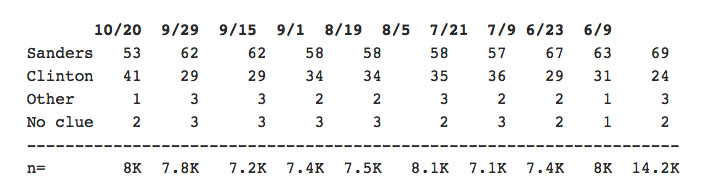
What you can conclude is that Sanders is losing his iron grip on the left wing of the Democratic Party, where all his support was concentrated. This result is comparable to a Republican losing ground in a poll of Fox News viewers. Of course, this poll may be a fluke due to Clinton's good performances in the debate and before the Benghazi committee, so we will have to wait until the next Daily Kos poll to see if the change is permanent.
In another indication that there is movement in the Democratic primary, a new Monmouth University Poll in New Hampshire puts Clinton a hair ahead of Sanders, 48% to 45% (well within the 5% margin of error). Still, earlier polls have put Sanders ahead and being from adjacent Vermont, he has the home field advantage. The director of the poll said that Clinton is improving her standing with women and the elderly. New Hampshire is a must-win state for Sanders because it is followed by Nevada and South Carolina, where Clinton has commanding leads.
Yesterday Clinton campaigned in Iowa where she was greeted by sunshine, 65 degree weather, and a new NBC/WSJ poll giving her a 62% to 31% lead over Sanders in the Hawkeye State. It is starting to appear that all the Democratic voters who were holding out for Vice President Joe Biden have jumped on the Clinton bandwagon. (V)
Will the Candidates' Attempt to Control the Debates Be Counterproductive?
The Republican candidates are trying to change the rules of future debates. As it turns out, the only things they agree on are small-ball items, like having opening statements and keeping the auditorium at 67 degrees. And even with these very minor items in their request, some of the candidates do not agree with the letter and probably won't sign it. The whole exercise makes the party look weak and disorganized.
Chris Weigant pointed out that this whole skirmish may also backfire against the eventual nominee in the general election. Among other things, he notes:
- Whining about minor rules doesn't look presidential or even like the "Daddy party"
- If the candidates can't handle debates, how is one of them going to manage a press conference as President?
- Can a candidate who is afraid of journalists stand up to Vladimir Putin or Xi Jinping?
- If only softball questions are allowed from now on, what kind of preparation is that for debating Hillary Clinton?
The most serious of these points is the last one. Clinton is getting practice debating Bernie Sanders, who is a forceful debater and disagrees with her on many issues. She also sat before the Benghazi committee and answered hostile questions for 11 hours and came out as the winner. If Republicans think the underprepared Becky Quick of CNBC was belligerent, what's going to happen if CNN's very-well-prepared Anderson Cooper or Wolf Blitzer points out their flip-flops in a general election debate? (V)
Bush Apologizes to France
During the last debate, Jeb Bush made a joke about Marco Rubio missing so many votes in the Senate. He said: "I mean, literally, the Senate - what is it, like a French workweek?" Then the fact checkers took a look and lo and behold, the average "lazy" French worker works 39.6 hours/week, compared to 39.2 hours/week for those industrious, hardworking Germans. Yesterday Bush apologized to France. Misstatements and retractions are not a great way to begin Bush's new "Jeb can fix it" and are not likely to reassure nervous donors that Jeb 2.0 is all that much better than Jeb 1.0. (V)
Obamacare Repeal Giving McConnell Headaches
Presidential politics and senatorial politics sometimes intersect but pull in different directions, as Senate Majority Leader Mitch McConnell (R-KY) is learning the hard way. Conservative Senators Ted Cruz (R-TX) and Marco Rubio are leading a small band of rebels who want the Senate to pass a bill to repeal the entire Affordable Care Act, which Republicans call "Obamacare." If McConnell gives in to Cruz and Rubio and tries to shepherd such a bill through the Senate, he will make them happy and enhance their bona fides with conservatives. McConnell would be overjoyed to have one of his senators become President, of course, and it would usher in a period of excellent relations between the White House and the Senate.
This strategy runs into two problems, however. First, to prevent the Democrats from filibustering the bill, McConnell has to use the Senate budget reconciliation process to get to a straight up-or-down vote. However, only budget-related items can use the reconciliation procedure. The arbiter of what is "budget-related" is the Senate parliamentarian, whose full-time job is understanding all of the Senate's many arcane rules in order to advise senators about them. Since 2012, the Senate parliamentarian has been Elizabeth MacDonough, 45, the first woman to hold the job. A single mother who knows everyone associated with the Senate, including all the janitors, she is regarded as being fair and impartial. Her loyalty to the institution of the Senate rather than to the current Majority Leader (her official boss) could be a stumbling block for McConnell as she is likely to rule that parts of the ACA are not budget related and cannot use the reconciliation process. Some examples are the clause stating that young people up to age 26 may remain on their parents' policies and the clause prohibiting insurance companies from rejecting customers based on preexisting conditions. For Cruz and Rubio, a partial repeal is unacceptable.
McConnell's second problem is that about half a dozen Republican senators up for reelection in 2016 come from blue states and if they vote for repeal of the ACA, they are likely to be ex-senators in 2017 and McConnell will become Minority Leader. So McConnell is between a rock and a hard place. Does he do his best for the two senators most likely to become President or does he side with the blue-state senators who desperately want to avoid a vote on a repeal bill? (V)
Back to the main page