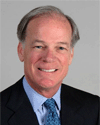
Tom
Foley
(R)
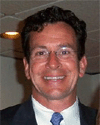
Dan
Malloy
(D)
If you are new to this site, welcome. In addition to the map, which is updated daily with the latest polls, you'll find a wealth of information and downloadable data here by clicking on the map, the links in the panel to the right of the map, and the menu items below it. There is also an RSS feed (via the XML icon), a Twitter feed (@votemaster), and a text-only version of the main page for smart phones (via the PDA icon). The update schedule is one update per day, usually before 7 A.M. Eastern Time. Have fun!
P.S. Donations (via the PayPal icon on the right) are welcome and pay for blog ads to publicize the site. But even better is to tell your friends about it.
Many observers have questioned how reliable Rasmussen polls are. The owner of the company, Scott Rasmussen, is an avowed Republican and works for Fox News. His polls have definitely shown a bias towards the Republicans this cycle. However, this does not necessarily mean he has his thumb on the scale. Rasmussen, like all pollsters, has a demographic model of what he expects the November electorate to look like and normalizes all polls to fit his model. This is perfectly legitimate since it corrects for undersampling or oversampling various demographic groups such as young voters, minorities, or women. The issue is what his model is, for example are 38% of the voters Republicans or are 35%? If in a given sample, say, 34% of the respondents are Republicans, in the former case he will weight each one by 38/34 and in the latter case by 35/34. This affects the results, of course. There is nothing wrong with weighting, the issue is what is the model electorate?
A closely related issue is his likely voter screen. At this point, all pollsters are (or should be) using a screen to separate out voters who are not likely to vote and disregard their answers. All pollsters guard their screens as top secret. It is possible that Rasmussen has an aggressive screen that filters out many young people, minorities, women, and others with flakey voting records. To the extent that he is right, his results may give a better measure of the election results than not screening since it is well established that Democratic-leaning demographic groups are less likely to vote in midterm elections than Republican leaning demographic groups.
To see how big the "Rasmussen effect" is, starting today there will be two main pages produced and two sets of poll state poll graphs (viewed by clicking on a state). The front page includes all polls but there is a link to the right of the map "Without Rasmussen" for the Rasmussen-free data. The latter page is generally more favorable to the Democrats. But it would be a mistake to think the front page is wrong and the other page is right. It is entirely possible that the front page represents people who are going to vote and the Rasmussen-free page represents registered voters, some of whom are unlikely to vote. Perhaps the best way to view the alternative page is what might happen if the Democrats manage to get all their voters to the polls Nov. 2.
A new Siena College poll (see below) has Rep. Scott Murphy (D-NY) leading Christopher Gibson (R) 54% to 37%. Maybe this is a fluke, but maybe it is the canary in the coal mine. The Republican plans to retake the House rest largely on beating new Democrats in marginal districts, of which NY-20 is the poster child. Scott won the special election in April 2009 to fill the seat of appointed senator Kirsten Gillibrand by 339 votes in an R+2 district. It's guys like Murphy who are supposed to go down in November. He's not well known, barely won last time, and has no seniority. Why isn't he way behind? Probably specific characteristics of Murphy and Gibson and the nature of the district matter. In other words, the poll may be expressing the fact that the voters in NY-20 prefer Scott Murphy to Christopher Gibson rather than saying they prefer Nancy Pelosi to John Boehner, neither of whom are running in this district. But this is only one poll so it shouldn't be taken too seriously. If more polls show weak Democrats in marginal districts hanging on, the Republican gains in November (which are virtually certain) may not be enough to take the majority of the House.
Not all the news today is bad for the Republicans. Rob Portman (R), who managed the Budget Office for George W. Bush, is way ahead of Lt. Gov. Lee Fisher (D-OH). Unless something changes radically, it looks like Fisher is toast and the Republicans will hold the seat of the retiring Sen. George Voinovich (R-OH).
Despite polls like NY-20, if the Republicans do manage to capture the House, Rep. John Boehner (R-OH) would become Speaker and would no doubt change many of the ways the House operates. For example, Nancy Pelosi installed energy-efficient lighting, aggressive recyling plans, and banned smoking everywhere. Boehner does not believe in global warming and is a chain smoker, so no doubt he would make many changes, starting with putting food in the House restaurant whose name he can pronounce (a dig at the bok choy and jicama Pelosi contracted for). Politico has an amusing piece on this subject.
Of course, determining what's for lunch isn't the Speaker's only task. In Boehner's case he would have to deal with unruly tea party activists who are more like Democrats than Republicans in a key way--they don't take orders from on high. If the Republicans end up with a very small majority in the House, a handful of tea partiers could hold Boehner at gunpoint constantly much like Ben Nelson and Joe Lieberman always do to Harry Reid in the Senate. For example, what would happen if a dozen or so of them insisted on abolishing the federal income tax, probably a bridge too far for most members. This would put him in a real bind: lose their votes and get nothing done or have the few remaining House moderates balk. Operating with a tiny majority is no fun at all since any group of a half dozen or so members can then hold the entire chamber hostage.
We haven't looked at the governors' races in quite a while, so here is a quick rundown of the most competitive races east of the Mississippi River. Tomorrow the West (but if you are in a hurry, the link "Governors races" below the map contains the scoop on all of them).
| Challenger | Challenger | Notes |
|
Tom Foley (R) |
Dan Malloy (D) |
Open seat (R). With Gov. Jody Rell's (R-CT) announced retirement, this has become a wide open race with the Democrats having a good chance to pick up the governor's mansion. After hotly contested primaries, the Republicans picked former ambassador to Ireland Tom Foley (R) and the Democrats picked former Stanford mayor Dan Malloy (D). Connecticut is a blue state and Malloy has run for and won public office before, so he is the favorite. |
| Challenger | Challenger | Notes |
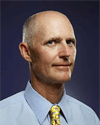
Rick Scott (R) |
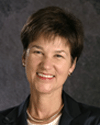
Alex Sink (D) |
Open seat (R). With Gov. Charlie Crist's decision to run for the seat of retired senator Mel Martinez (R), the governor's race was suddenly thrown wide open. Surprisingly, it settled down on both sides very fast, with Attorney General Bill McCollum (R) and Chief Financial Office Alex Sink (D) becoming the overwhelming favorites to get their party's respective nominations. Then a funny thing happened on the way to McCollum's expected easy primary and general election victories. Billionaire Rick Scott, who ran a for-profit hospital company and was fined over $100 million for defrauding Medicare jumped in and bought the nomination. All of a sudden, Sink finds herself the favorite. Scott will no doubt outspend her 10 to 1 but he has a lot of baggage and everyone in Florida knows about it already. |
| Challenger | Challenger | Notes |
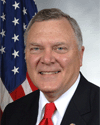
Nathan Deal (R) |
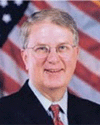
Roy Barnes (D) |
Open seat (R). With Gov. Sonny Perdue (R-GA) term limited, former governor Roy Barnes (D) jumped into the race and won the primary. The Republican primary was indecisive, forcing a runoff between tea partier Karen Handel (R) and former representative Nathan Deal (R). Deal won it by a hair. The general election leans toward Deal in this red state. |
| Incumbent | Challenger | Notes |
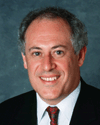
Pat Quinn (D) |
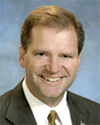
Bill Brady (R) |
Gov. Pat Quinn (D-IL) became governor when his predecessor, Rod Blagojevich (D), was impeached and convicted. So far, Quinn doesn't appear touched by the state's boundless corruption, but when you weren't elected to your current office, you are always vulnerable. The Republicans don't have a stellar candidate here, with Bill Brady (R) eking out the narrowest of victories over his primary challengers. Still, Illinois is a fairly blue state and Quinn is somewhat better known than Brady, so the race leans towards Quinn. However, the Green Party candidate, Rich Whitney, could draw enough votes from from Quinn to have an impact. |
| Challenger | Challenger | Notes |

Libby Mitchell (D) |
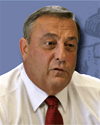
Paul LePage (R) |
Open seat (D). Gov. John Baldacci (D-ME) is term limited, giving the Republicans a shot in this once strongly Republican state. The Democrats nominated state senate president Libby Mitchell (D) in a four-way primary. The Republicans chose the mayor of Waterville, Paul LePage (R). In addition to these two, three independents are also running. Initial polling puts LePage ahead of Mitchell, although the three independent candidates are pulling in about 15-20% of the vote. If any of them drop out later, it could shake things up. |
| Incumbent | Challenger | Notes |
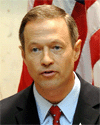
Martin O'Malley (D) |
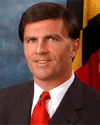
Bob Ehrlich (R) |
Gov. Martin O'Malley (D-MD) will be running for a second term in this very blue state. Early in his term he raised taxes, which lowered his approval ratings somewhat. Former one-term governor Bob Ehrlich (R) wants to get his old job back, so this will be a rematch of the 2006 election. O'Malley beat Ehrlich in 2006, but the wind is blowing a different way now. Likely to be close. |
| Challenger | Challenger | Notes |
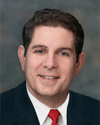
Virg Bernero (D) |
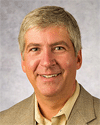
Rick Snyder (R) |
Open seat (D). Term-limited governor Jennifer Granholm (D-MI) is leaving, which is probably a good thing for the Democrats as she was not all that popular. Also, the economy of her state is a complete disaster, although it is not really her fault that General Motors has had little interest over the past 30 years in producing cars that people actually want to buy. Lt. Gov. John Cherry (D-MI) was next in line but decided not to run. The Democratic nominee ended up being Lansing mayor Virg Bernero (D). Rick Snyder (R) won a tough GOP primary. The race probably leans Republican because the voters are so angry about the economy and the Democrats are in charge now. |
| Incumbent | Challenger | Notes |
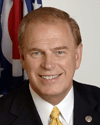
Ted Strickland (D) |
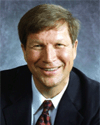
John Kasich (R) |
Gov. Ted Strickland (D-OH) crushed his Republican opponent, Ken Blackwell, in 2006 and has remained relatively popular since then. But with the Ohio economy in the toilet people need to blame someone and the governor is always on everyone's short list. Former representative John Kasich (R) is his opponent and since he is not in office now, he can claim he's not responsible for the economic mess. That might be enough for him to win. |
| Challenger | Challenger | Notes |
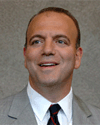
Dan Onorato (D) |
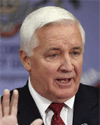
Tom Corbett (R) |
Open seat (D). With two-term governor Ed Rendell (D-PA), retiring in 2010, the governor's mansion in a key swing state will be up for grabs. Rep. Jim Gerlach (R-PA) was running but dropped out leaving the nomination to Pennsylvania Attorney General Tom Corbett (R). The Democrat is Dan Onorato, the County Executive for the county containing Pittsburgh. Neither candidate is an incumbent and Pennsylvania has many more registered Democrats than registered Republicans on account of Hillary Clinton's refusal to drop out of the presidential race in 2008. It is the gift that keeps on giving. Although Pennsylvania is a blue state, Corbett is much better known than Onorato. Pennsylvania has been hit very hard by the tough economy and people then have a natural tendency to blame the folks currently in power, the Democrats, which gives Corbett the edge. |
| Challenger | Challenger | Challenger | Notes |
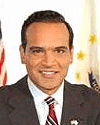
Frank Caprio (D) |
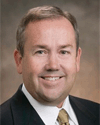
John Robitaille (R) |
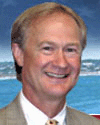
Lincoln Chafee (I) |
Open seat (R). Rhode Island is one of two New England states with a three-way race for governor. The incumbent, Gov. Don Carcieri (R), is term limited. Former senator Lincoln Chafee is trying to make a political comeback as governor. He will face off against the state Treasurer, Frank Caprio (D), and a Republican, John Robitaille, who has no chance. Chafee is still popular in the state and New England has had independent governors before, so he has a fair shot at winning. |
| Challenger | Challenger | Notes |
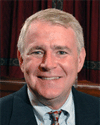
Tom Barrett (D) |
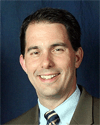
Scott Walker (R) |
Open seat (D). Wisconsin law allows Gov. Jim Doyle (D-WI) to run for a third term but he has decided not to. Milwaukee mayor Tom Barrett (D) is running to succeed him since the lieutenant governor, Barbara Lawton (D-WI) is not interested in the job. The Republicans had a primary in September between Milwaukee County Executive Scott Walker (R) and former congressman Mark Neumann (R) and Walker won. The race leans slightly towards Walker, but should be close. |
| Challenger | Challenger | Notes |
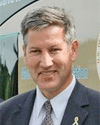
Brian Dubie (R) |

Peter Shumlin (D) |
Open seat (R). Vermont was one of the Republicans' few bright spots in New England. If four-term governor Jim Douglas (R-VT) had run for a fifth two-year term, he'd probably have won, but he is not running, so the Democrats have the edge now. There was a highly competitive four-way primary won by Peter Shumlin, who runs a small family-owned business. Only one Republican filed: Lt.Gov. Brian Dubie(R-VT). It could be close. |
| State | Democrat | D-pct | Republican | R-pct | Ind. | I-pct | Start | End | Pollster |
| Georgia | Mike Thurmond | 33% | Johnny Isakson* | 52% | Sep 13 | Sep 15 | Mason Dixon | ||
| Georgia | Mike Thurmond | 34% | Johnny Isakson* | 52% | Sep 16 | Sep 16 | Insider Advantage | ||
| Maryland | Barbara Mikulski* | 54% | Eric Wargotz | 38% | Sep 15 | Sep 15 | Rasmussen | ||
| New Hampshire | Paul Hodes | 44% | Kelly Ayotte | 51% | Sep 15 | Sep 15 | Rasmussen | ||
| Pennsylvania | Joe Sestak | 39% | Pat Toomey | 49% | Sep 13 | Sep 13 | Rasmussen |
| Cong. Distr. | Democrat | D-pct | Republican | R-pct | I-pct | Start | End | Pollster | |
| DE-AL | John Carney | 48% | Glen Urquhart | 37% | Sep 11 | Sep 12 | PPP | ||
| KS-04 | Raj Goyle | 40% | Mike Pompeo | 50% | Sep 14 | Sep 15 | SurveyUSA | ||
| ME-01 | Chellie Pingree* | 53% | Dean Scontras | 29% | Sep 13 | Sep 13 | Critical Insights | ||
| ME-02 | Mike Michaud* | 48% | Jason Levesque | 28% | Sep 13 | Sep 13 | Critical Insights | ||
| MN-06 | Tarryl Clark | 40% | Michele Bachmann* | 49% | Sep 13 | Sep 15 | SurveyUSA | ||
| NY-20 | Scott Murphy* | 54% | Christopher Gibson | 37% | Sep 12 | Sep 14 | Siena Coll. | ||
| VT-AL | Peter Welch* | 64% | Paul Beaudry | 30% | Sep 13 | Sep 13 | Rasmussen |