Starting today, a graph of the projected number of Democratic and Republican seats over time will be available every day via the "Senate graph" item under the map. Here is what it looks like now.
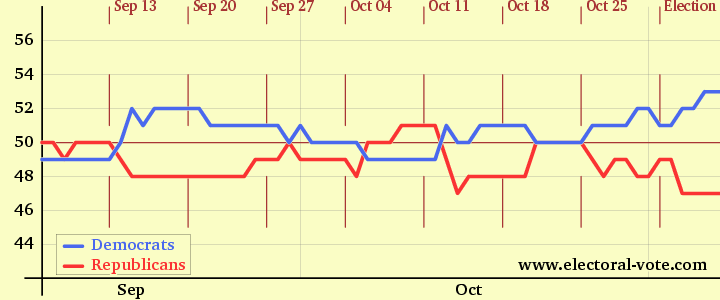
The page will show two versions: counting all the states and counting only the ones in which one candidate is ahead by at least 5% (i.e., is probably really ahead).
Conservative candidate Doug Hoffman, who drove Republican Dede Scozzafava out of the special election for NY-23 last year and then lost to Bill Owens (D), has dropped out of the race for Congress. He ran in the Republican primary and lost to Matt Doheny (R), but was still on the ballot on the Conservative Party line. Now he has abandoned his quest and endorsed Doheny. As a result of his decision, Doheny is now the favorite. Owens was the first Democrat to win this district since the Civil War but now he is in big trouble.
In the past 2 days, polls of likely voters gave generic leads for Republicans of 3% (Rasmussen), 6% (ABC/WaPo), 13% (Gallup model 1) and 18% (Gallup model 2). What's going on here? About 213 million people are eligible to vote and an estimated 68% are in fact registered to vote. However, in 2008, only 62% of the eligible voters in fact cast a ballot. Midterm election turnout rates are much lower. In 2002 and 2006 it was 40%.
Clearly, polling the 60% of the eligible population that doesn't plan to vote is of no use in predicting elections, especially when it is well known that nonvoters skew Democratic. So every pollster has a screen that tries to determine who will vote and who won't. Just asking people if they plan to vote turns out not to be useful. In one study, a week before the 2006 election, 54% of the eligible voters interviewed said they would definitely vote, yet turnout was only 40%. Hence pollsters have to be more devious. Years ago the Gallup organization tackled this problem by developing a series of questions about past voting behavior (e.g., did you vote last time?) and the importance of voting (e.g., do you think your vote matters?) and, depending on the answers, scored the person as being a likely voter or not. Now all pollsters do this. But the screens differ and are tightly guarded as top secret. The different screens are why Rasmussen gives the Republicans a 3% lead and Gallup says it could be an 18% lead. The consequence of all this is that, even a week before the election, some pollsters may be way off. Pollster Mark Blumenthal has written a good article on the subject of finding likely voters.
Washington Post columnist Dana Milbank recently wrote that Sen. Lisa Murkowski (R-AK) was a faithful conservative and got a letter from a reader telling him that someone with her voting record was no conservative and he should check her lifetime rating with the American Conservative Union. He did that and while he was at it, checked the lifetime ratings of Sen. Robert Bennett (R-UT), who was denied renomination this year for being insufficiently conservative and of nearly every other prominent Republican going back several decades. The results were amazing. Many of them are more liberal than Murkowski and nearly all of them are more liberal than Bennett.
Put in other words, the Republican Party has moved so far to the right in the past few years that, under the current standard, nearly all of its past leaders would be considered unacceptable.
The Supreme Court's decision in the Citizens United case to allow corporations, unions, and other organizations to spend unlimited money supporting or attacking specific candidates has unleashed a flood of money, mostly for attack ads against Democrats on television. Much of the money is being funneled through the Chamber of Commerce, which has many foreign offices and actively solicits (paid) memberships from foreign corporations, including corporations controlled by foreign governments. The Chamber is not required to say where its money comes from or who is paying for the thousands of ads it is running. As a result, the small amount of transparency created by McCain-Feingold is now completely swamped now by a torrent of money from undisclosed sources, including foreign ones.
| State | Democrat | D-pct | Republican | R-pct | I | I-pct | Start | End | Pollster |
| California | Barbara Boxer* | 49% | Carly Fiorina | 45% | Oct 02 | Oct 04 | IPSOS | ||
| California | Barbara Boxer* | 49% | Carly Fiorina | 45% | Oct 03 | Oct 03 | Rasmussen | ||
| Colorado | Michael Bennet* | 46% | Ken Buck | 45% | Sep 30 | Oct 02 | PPP | ||
| Connecticut | Richard Blumenthal | 52% | Linda McMahon | 42% | Oct 02 | Oct 02 | Pulse Opinion Research | ||
| Connecticut | Richard Blumenthal | 52% | Linda McMahon | 45% | Oct 03 | Oct 03 | Merriman River Group | ||
| Florida | Kendrick Meek | 18% | Marco Rubio | 39% | Charlie Crist | 33% | Sep 27 | Sep 29 | Zogby |
| Florida | Kendrick Meek | 26% | Marco Rubio | 46% | Charlie Crist | 27% | Sep 23 | Sep 30 | Miami Dade Coll. |
| Illinois | Alexi Giannoulias | 41% | Mark Kirk | 45% | Oct 04 | Oct 04 | Rasmussen | ||
| Indiana | Brad Ellsworth | 33% | Dan Coats | 51% | Sep 29 | Oct 01 | EPIC MRA | ||
| Missouri | Robin Carnahan | 42% | Roy Blunt | 50% | Oct 02 | Oct 02 | Pulse Opinion Research | ||
| Nevada | Harry Reid* | 46% | Sharron Angle | 49% | Oct 02 | Oct 02 | Pulse Opinion Research | ||
| Ohio | Lee Fisher | 37% | Rob Portman | 53% | Oct 02 | Oct 02 | Pulse Opinion Research | ||
| Pennsylvania | Joe Sestak | 38% | Pat Toomey | 45% | Sep 28 | Oct 04 | Muhlenberg Coll. | ||
| West Virginia | Joe Manchin | 43% | John Raese | 48% | Oct 02 | Oct 02 | Pulse Opinion Research |
| Cong. Distr. | Democrat | D-pct | Republican | R-pct | I | I-pct | Start | End | Pollster |
| PA-10 | Chris Carney* | 43% | Thomas Marino | 40% | Sep 26 | Sep 30 | Lycoming Coll. |